











 Secure payments
Standard refund policy
Trade Assurance
Secure payments
Standard refund policy
Trade Assurance
| Product Type | Memory Module |
|---|---|
| Compliance Standards | RoHS |
| Memory Capacity | 16 GB |
| Memory Technology | DDR3 |
| Product Voltage | 1.35V |
| RAM Speed | 1333MHz |
| RAM Standard | DDR3-1333/PC3-10600 |
| Error Identifying | ECC |
| Signal Type | Registered |
| Column Access Strobe (CAS) | CL9 |
| Rank | Dual Rank x4 |
| Quantity of Pins | 240-pin |
| RAM Genre | RDIMM |
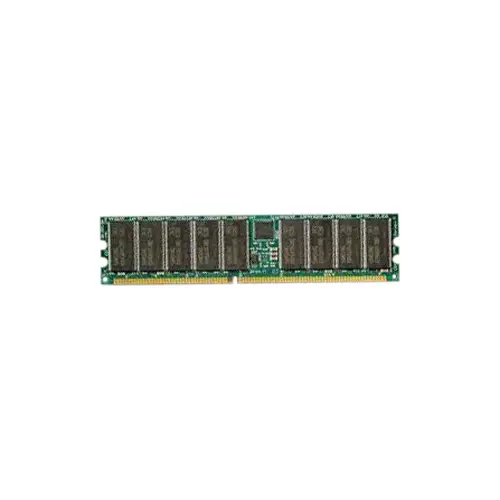
This Registered ECC DDR3 module, operating at an efficient 1.35V with 1333MHz speed, is purpose-built for legacy server platforms requiring high data integrity in virtualized environments or memory-intensive databases. Its dual-rank x4 organization and CL9 latency enhance signal stability and bandwidth in multi-DIMM configurations, making it a reliable choice for sustained enterprise workloads.
1. ECC error correction actively protects against data corruption, preserving the rock-solid data integrity demanded by always-on server environments and financial transactions.
2. Registered DIMM design buffers command and address signals, enabling massive memory scalability without sacrificing signal integrity in multi-socket and high-density server platforms.
3. Generous per-module capacity allows dense memory configurations, directly translating to higher virtual machine consolidation and more efficient data center space utilization.
4. Dual-rank memory organization leverages bank interleaving to saturate memory channels, boosting sustained throughput for memory-hungry virtualization and in-memory database workloads.
5. Proven DDR3 speed grade delivers stable and predictable bandwidth for legacy enterprise applications, balancing reliable performance with low-voltage energy efficiency in cost-optimized server fleets.
When you are running a virtualized cluster hosting dozens of mission-critical VMs, a single undetected memory error can silently corrupt data or bring down an entire host. This is where the ECC on the Micron MT36KSF2G72PZ-1G4E1FG becomes non-negotiable: it detects and corrects single-bit errors, essentially eliminating the risk of bit-flip induced crashes in environments like vSphere or KVM, where memory integrity directly guards your uptime SLA.
Scaling that reliability further, the registered signal buffer on this 240-pin DDR3-1333 RDIMM stabilizes the command and address lines as you populate multiple DIMMs per channel. In dense 2U servers used for in-memory databases such as Redis or SAP HANA, unbuffered modules would suffer signal degradation and limit total capacity. With this dual-rank x4 registered DIMM, you achieve 16GB of rock-solid capacity per slot, allowing you to scale gigabytes of hot data without compromising signal integrity even under heavy memory controller loads.
Meanwhile, the 1.35V low-voltage operation addresses a real pain point in data centers: cumulative power draw and cooling overhead. Dropping from legacy 1.5V to 1.35V per module yields tangible savings in electricity and thermal output across a fleet of hundreds of servers, which compounds year after year. And the dual-rank x4 organization leverages rank interleaving to wring more bandwidth out of that 1333MT/s bus. For database transactions or frequent page swaps in a hypervisor, this translates to measurably lower latency and higher responsive throughput, keeping your workloads swift when all eyes are on the metric dashboards.
General Virtualization
This 16 GB DDR3-1333 RDIMM is a solid building block for moderate-density virtualization hosts. For a dual-socket server, populate at least six identical modules (96 GB total) across memory channels to maintain balanced NUMA access and leave room for growth. A 12-module configuration (192 GB) is recommended for running 30–40 typical virtual machines while avoiding memory ballooning or swapping.
In-Memory Database
In-memory databases thrive on low latency and data integrity, making ECC Registered memory essential. Deploy a minimum of eight modules (128 GB) in a dual-processor server to handle moderate Redis or Memcached datasets entirely in RAM. For larger datasets, scale to 16 modules (256 GB) across all channels, ensuring the dataset fits comfortably with headroom for persistence snapshots and replication overhead.
High-Performance Computing
HPC workloads with dense matrix operations benefit from maximum memory bandwidth. Install these dual-rank RDIMMs in sets of eight or twelve per node, utilizing all available memory channels to saturate the 1333 MHz bus. While capacity per core matters, a 128–256 GB configuration is common for compute nodes running finite element analysis or computational fluid dynamics codes that require large, contiguous memory arrays.
Rigorously tested server memory, compatible with Dell PowerEdge R720, HPE DL380p Gen8, and more.
Q: Can I mix this MT36KSF2G72PZ-1G4E1FG with other memory modules of different brands or speeds?
A: Mixing is not recommended. For server-grade stability, populate all channels with identical Registered ECC modules to avoid timing conflicts and potential system halts.
Q: Is this memory compatible with my Intel or AMD server platform?
A: This 240-pin DDR3-1333 Registered ECC DIMM is designed for dual-processor servers using Intel Xeon E5-2400/E5-2600 v1/v2 or AMD Opteron 4300/6300 series with C600/C602 chipsets.
Q: What is the recommended DIMM population order for optimal performance?
A: Install identical DIMMs in matched white/black slot sets per channel, starting with slot 1 (farthest from the CPU). Always balance memory across memory channels for maximum throughput.
Q: Does this module support overclocking or XMP profiles?
A: No. This is a JEDEC-compliant server RDIMM. It prioritizes data integrity and 24/7 stability—overclocking or XMP is not supported and would violate registered memory specifications.
Q: What warranty and typical failure rate can I expect?
A: It includes a 1-year limited warranty. Enterprise-grade Registered ECC modules exhibit a very low annualized failure rate (typically <0.5%) under proper cooling and load.