











 Secure payments
Standard refund policy
Trade Assurance
Secure payments
Standard refund policy
Trade Assurance
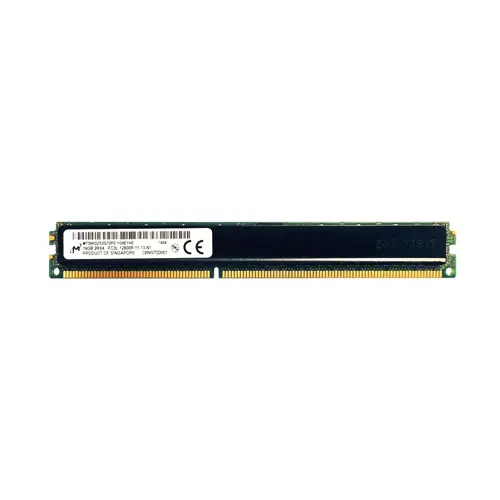
| Model | MT36KDZS2G72PZ-1G6E1HE |
|---|---|
| Product Type | Memory Module |
| Compliance Standards | RoHS |
| Memory Capacity | 16 GB |
| Memory Technology | DDR3 |
| Product Voltage | 1.35V |
| RAM Speed | 1600MHz |
| RAM Standard | DDR3-1600/PC3-12800 |
| Error Identifying | ECC |
| Signal Type | Registered |
| Column Access Strobe (CAS) | CL11 |
| Rank | Dual Rank x4 |
| Quantity of Pins | 240-pin |
| RAM Genre | VLP RDIMM |
Designed as a Very Low Profile (VLP) Registered DDR3L ECC module, this 16GB DIMM is purpose-built for dense server deployments such as 1U rack and blade systems where vertical clearance is minimal. Its dual-rank x4 organization and registered signal architecture deliver robust data integrity and stable performance under heavy memory loads, making it an optimal choice for virtualization clusters or in-memory database applications that demand both reliability and energy efficiency from 1.35V operation.
1. ECC protection actively corrects single-bit errors in real time, preserving data integrity across long-running enterprise workloads and preventing silent corruption that could compromise transactional databases.
2. Registered signal buffering stabilizes high-density memory configurations, ensuring clean command and address signals even when all server DIMM slots are fully populated.
3. Dual Rank x4 organization enables interleaved memory accesses across ranks, sustaining peak channel utilization essential for consistent virtual machine responsiveness under heavy consolidation.
4. The 1.35V operating voltage significantly lowers power draw and waste heat per module, shrinking the overall cooling burden inside energy-conscious multi-node data centers.
5. Very Low Profile RDIMM design maximizes clearance for unblocked front-to-rear airflow in compact 1U servers, preserving thermal headroom for densely packed memory banks.
When you are deploying dense virtualization clusters or running in-memory databases like SAP HANA or Redis, memory errors are not an inconvenience—they are a risk to business integrity. The Micron MT36KDZS2G72PZ-1G6E1HE, a 16 GB DDR3L-1600 VLP RDIMM, directly addresses that reality through four critical engineering choices. Its ECC capability continuously detects and corrects single-bit errors, preventing silent data corruption that could otherwise ripple through financial transactions or customer records without a trace. The registered signal buffering decouples the electrical load from the memory bus, enabling you to populate all 24 DIMM slots on a dual-socket server without compromising command signal integrity, which is essential when consolidating dozens of virtual machines onto a single host. The dual-rank x4 organization interleaves internal banks to deliver higher sustained bandwidth under concurrent access patterns—exactly what hypervisors and multi-threaded analytical engines need to avoid micro-stutters under peak loads. Finally, the combination of extreme low-profile form factor and 1.35V operation tackles two infrastructure pains simultaneously: it fits into 1U rack servers where vertical clearance is measured in millimeters, and it cuts memory power consumption by roughly 20 percent compared to standard 1.5V DDR3, directly reducing cooling overhead in data centers running hundreds of nodes.
General Virtualization
For dense virtualization, install this 16 GB VLP RDIMM in multiples of three or six per populated memory channel to balance capacity and memory bandwidth. A typical dual-socket server with 12 DIMM slots can be populated with 12 modules (192 GB) to host 30–40 moderate VMs, while keeping a handful of slots free for future expansion.
In-Memory Database
In-memory databases require large, contiguous capacity and fault tolerance. Deploy at least eight modules (128 GB) per NUMA node in a symmetric 2-DIMM-per-channel configuration, enabling rank interleaving and ECC protection. For mission-critical Redis or SAP HANA instances, scale to 16 identical modules (256 GB) per host to keep entire datasets resident and avoid NUMA imbalance.
High-Performance Computing
HPC clusters benefit from this RAM’s low voltage and registered signaling, which improve thermal stability in dense nodes. Populate one DIMM per channel (e.g., six modules for 96 GB per server) to achieve maximum clock speed and lowest latency, critical for tightly coupled MPI workloads. If capacity is the priority, move to two DIMMs per channel (192 GB) but expect a slight drop to 1333 MHz due to dual-rank loading.
Rigorously tested to ensure compatibility with servers like Dell PowerEdge R720, HP DL380p Gen8, IBM x3650 M4.
Q: Can I mix this MT36KDZS2G72PZ-1G6E1HE with other memory modules of different brands or speeds?
A: Mixing this registered ECC RDIMM with modules of different brands, speeds, or ranks is not recommended. Even if the system posts, subtle timing mismatches can cause silent data corruption and compromise mission-critical server stability.
Q: Is this memory compatible with my server? Which Intel or AMD platforms support it?
A: This DDR3-1600 VLP RDIMM is designed for Intel Xeon E5-2400/2600 series and AMD Opteron 6300/4300 platforms. Verify your motherboard supports low-voltage 1.35V, 240-pin registered ECC memory and 16GB dual-rank x4 modules.
Q: What is the recommended DIMM population order for optimal performance with this module?
A: Populate identical modules per channel, starting with the farthest slot from the CPU. For a dual-socket server, balance across all memory channels and avoid mixing ranks in the same channel to sustain peak 1600 MT/s throughput.
Q: Does this module support overclocking or XMP profiles?
A: No. This is an enterprise server RDIMM that strictly adheres to JEDEC DDR3-1600 (PC3-12800) standards at CL11. It does not support XMP or any overclocking profiles, as data integrity and uptime are the priorities.
Q: What warranty and typical failure rate can I expect for this memory module?
A: This module includes a one-year warranty. As a Micron enterprise-grade RDIMM built with qualified components, it delivers the very low annualized failure rate characteristic of server memory, ensuring long-term data center reliability.