











 Secure payments
Standard refund policy
Trade Assurance
Secure payments
Standard refund policy
Trade Assurance
| Product Type | Memory Module |
|---|---|
| Memory Capacity | 16 GB |
| Memory Technology | DDR3 |
| Product Voltage | 1.35V |
| RAM Speed | 1600MHz |
| RAM Standard | DDR3-1600/PC3-12800 |
| Error Identifying | ECC |
| Signal Type | Registered |
| Column Access Strobe (CAS) | CL11 |
| Rank | Dual Rank x4 |
| Quantity of Pins | 240-pin |
| RAM Genre | RDIMM |
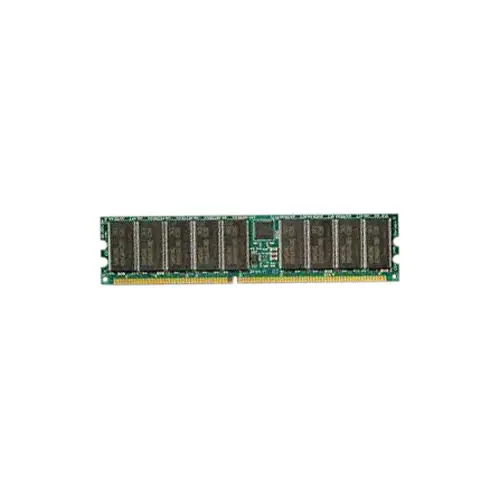
This 16 GB DDR3-1600 RDIMM with ECC and dual-rank x4 organization is engineered for server platforms demanding data integrity and high memory density, making it ideal for virtualization and in-memory database workloads. Its registered signal type and dual-rank configuration provide superior electrical stability and interleaving efficiency, ensuring reliable operation under sustained heavy loads.
1. ECC protection silently corrects single-bit memory errors, safeguarding transactional integrity and preventing costly downtime in virtualized database environments.
2. Registered signal buffering stabilizes command and address signals across fully populated channels, enabling dense memory configurations without sacrificing signal integrity.
3. A high per-module capacity expands the memory footprint within limited DIMM slots, maximizing virtual machine density and in-memory dataset sizes on a single server.
4. Low-voltage operation curtails power consumption and waste heat in dense rack deployments, directly reducing energy bills and improving thermal headroom for sustained workloads.
5. Dual-rank organization enables rank interleaving to keep memory pipelines saturated, delivering higher effective throughput for heavy virtualization and large-scale data processing.
The MT36KSF2G72PZ-1G6N1LF is a 16GB DDR3-1600 RDIMM purpose-built for enterprise servers. Its four defining characteristics—ECC, registered buffering, 1.35V low voltage, and dual-rank x4 organization—directly address the pain points of modern data centers. In a virtualized cluster, ECC is non-negotiable: it detects and corrects single-bit errors caused by background radiation, preventing silent data corruption that could crash VMs or poison database transactions. The registered architecture buffers control signals to maintain signal integrity across fully populated memory channels, enabling stable configurations of 384GB and beyond—vital for memory-hungry hypervisors and in-memory databases like Redis. The 1.35V supply reduces power draw and heat, which compounds across dozens of modules to cut cooling OPEX. Additionally, the dual-rank design interleaves memory banks, boosting throughput for simultaneous VM workloads and real-time analytics. This memory translates into hardened stability, higher consolidation ratios, and measurable savings in your server farm.
General Virtualization
For general virtualization hosts, balance density and cost by populating all memory channels with these 16 GB RDIMMs. A dual‑socket platform equipped with six modules per CPU delivers 192 GB total, comfortably supporting 30–40 moderate VMs. The 1.35 V low‑voltage operation reduces power draw across always‑on servers, improving TCO without sacrificing registered ECC reliability.
In‑Memory Database
In‑memory databases demand the largest possible capacity at low latency. Deploy the maximum supported DIMMs per channel—typically three dual‑rank modules at 1600 MT/s—to reach 384 GB or more per host. Dual‑rank x4 construction and CL11 timing sustain high throughput, while ECC protects critical data structures from bit errors during non‑stop transactional workloads.
High‑Performance Computing
HPC clusters benefit from the bandwidth of fully populated memory channels. Install an identical RDIMM in every channel to enable symmetric interleaving; a common configuration is 4 or 8 modules per node, yielding 64 GB or 128 GB. Registered buffering stabilizes signals across numerous ranks, letting tight‑coupling MPI jobs scale without memory‑induced node failures.
Rigorously tested server memory, compatible with Dell PowerEdge R720, HP DL380p Gen8, and Lenovo x3650 M4.
Q: Can I mix this MT36KSF2G72PZ-1G6N1LF with other memory modules of different brands or speeds?
A: Mixing this registered ECC RDIMM with different brands or speeds is not recommended. It risks system instability, POST failures, or unbuffered ECC conflicts. Always use identical modules for reliable server operation.
Q: Is this memory compatible with my server? Which Intel or AMD platforms are supported?
A: This DDR3-1600 registered ECC module is designed for servers based on Intel Xeon E5-2600 v1/v2 or AMD Opteron 6300 series. Confirm compatibility via your motherboard's qualified vendor list and chipset support.
Q: What is the recommended DIMM population order for optimal performance?
A: Populate identical DIMMs per channel, starting with slot A1/B1 for each CPU in dual-processor servers. Follow your platform's population guide to enable memory interleaving and maximize bandwidth.
Q: Does this module support overclocking or XMP profiles?
A: No. As a registered ECC server module, it runs strictly at JEDEC standard DDR3-1600 with CL11 timings. Overclocking and XMP are not supported to preserve data integrity and 24/7 stability.
Q: What warranty and typical failure rate can I expect?
A: This module is backed by a 1-year warranty. Enterprise-grade RDIMMs like this typically exhibit an annualized failure rate (AFR) below 0.5% under normal operating conditions.