











 Secure payments
Standard refund policy
Trade Assurance
Secure payments
Standard refund policy
Trade Assurance
| Product Type | Memory Module |
|---|---|
| Compliance Standards | RoHS |
| Memory Capacity | 16 GB |
| Memory Technology | DDR3 |
| Product Voltage | 1.35V |
| RAM Speed | 1600MHz |
| RAM Standard | DDR3-1600/PC3-12800 |
| Error Identifying | ECC |
| Signal Type | Registered |
| Column Access Strobe (CAS) | CL11 |
| Rank | Dual Rank x4 |
| Quantity of Pins | 240-pin |
| RAM Genre | RDIMM |
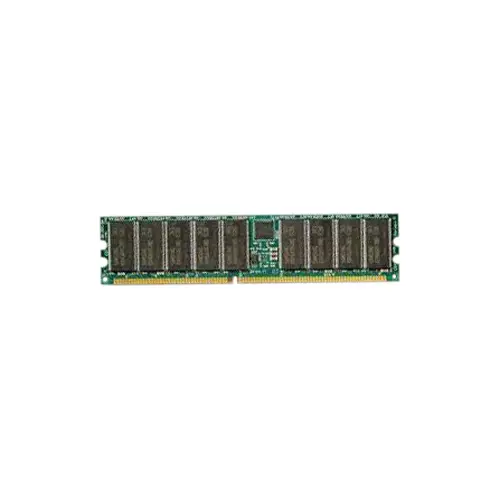
This 16GB DDR3-1600 Registered ECC RDIMM, with a low operating voltage of 1.35V and dual-rank x4 organization, is engineered for legacy server platforms where data integrity and stability under heavy load are critical. It excels in virtualized environments and memory-intensive workloads such as in-memory databases, delivering reliable 72-bit ECC error correction alongside registered signal buffering to maintain signal integrity across fully populated channels.
1. ECC protection proactively detects and corrects single-bit memory errors, safeguarding transactional integrity in databases and financial workloads where data corruption is unacceptable.
2. Registered signal type buffers the command and address lines, enabling large memory populations per server node to maximize virtual machine density without compromising signal stability.
3. Dual Rank x4 architecture interleaves data across two internal rank groups per DIMM, sustaining high bandwidth utilization for latency-sensitive enterprise applications under simultaneous access.
4. 16 GB capacity per module allows dense memory configurations in a limited socket count, providing the headroom needed for memory-hungry virtualization hosts and in-memory analytics.
5. 1.35V low-voltage operation reduces overall power draw in fully populated racks, cutting cooling overhead and energy costs while maintaining reliable data center performance.
Identify the type: This is a server memory module, evidenced by RDIMM, ECC, Registered, and 240-pin configuration. Here is the explanation:
In dense server environments, the MT36KSF2G72PZ-1G6E1KF module is engineered to eliminate the silent threats that cripple data integrity and uptime. Its ECC technology continuously detects and corrects single-bit memory errors caused by cosmic radiation or electrical noise—without halting operations—so a financial transaction database or a clinical records system never writes corrupted values to permanent storage. The registered signal buffer re-drives command and address lines, allowing you to populate all 24 DIMM slots in a virtualization host without degrading signal quality; this directly translates to packing more virtual machines per physical node and avoiding memory-related hypervisor crashes under heavy consolidation. Operating at 1.35V instead of the standard 1.5V lowers each DIMM’s thermal footprint, which compounds into significant cooling savings across a rack full of nodes and reduces the risk of thermal throttling during sustained in-memory analytics. Finally, the dual-rank x4 organization interleaves requests across two internal sets of DRAM pages, delivering higher sustained bandwidth for latency-sensitive workloads like Redis or SAP HANA—because when milliseconds matter, parallel page access ensures your key-value lookups never stall behind a single bank refresh. Together, these design choices turn a 16 GB stick into a building block for resilient, scalable infrastructure where data fidelity and predictable low latency are non-negotiable.
Capacity Planning Guidance for DDR3-1600 ECC Registered Server Memory (16GB RDIMM)
The specified module is a 16GB DDR3-1600 ECC Registered RDIMM operating at 1.35V—a server‑class memory ideal for platforms requiring data integrity and sustained throughput. Below are configuration recommendations for typical data‑centre workloads.
General Virtualization
For hypervisor hosts running multiple moderate virtual machines, populate at least four identical modules (64GB total) across memory channels to balance capacity and bandwidth. Leverage the ECC and registered features to maintain stability under mixed workloads. Scale to six or eight modules (96–128GB) if VM density increases, ensuring each populated channel uses matched dual‑rank x4 DIMMs for optimal interleaving.
In‑Memory Database
In‑memory databases (e.g., Redis, SAP HANA) demand low latency and large, contiguous memory pools. Install six or eight modules (96–128GB) distributed evenly across all memory channels to maximize bandwidth and support rank interleaving. The 1.35V operation reduces thermal stress during constant access, while the dual‑rank x4 organization helps lower effective latency under heavy transactional loads.
High‑Performance Computing (HPC)
HPC clusters benefit from both capacity and parallel memory access. Equip each node with a full complement of eight 16GB RDIMMs (128GB total) to fully populate dual‑socket systems with four channels per CPU. This configuration saturates memory bandwidth, accelerates large‑scale simulations, and the registered nature maintains signal integrity at scale. For dense compute nodes, this balance of capacity and speed is essential.
Rigorously tested server DDR3 RDIMM, compatible with Dell PowerEdge R720, HP ProLiant DL380p Gen8, Lenovo System x3650 M4.
Q: Can I mix this MT36KSF2G72PZ-1G6E1KF with other memory modules of different brands or speeds?
A: Mixing is not advised in server environments. For guaranteed stability, use identical ECC Registered DIMMs with matching speed, rank, and CAS latency. Mismatched modules may cause POST failures or data corruption.
Q: Is this memory compatible with my system?
A: This 16GB DDR3-1600 ECC RDIMM is designed for servers supporting 1.35V registered DDR3 memory, such as Intel Xeon E5/E5 v2 or AMD Opteron 6300 platforms. Please consult your motherboard's qualified vendor list for precise compatibility.
Q: What is the recommended DIMM population order for optimal performance?
A: Follow your server board manual closely. Typically, populate identical DIMMs starting from the farthest slot in each channel. For dual-rank x4 modules, balance population evenly across all memory channels to maximize throughput and interleaving.
Q: Does this module support overclocking or XMP profiles?
A: No. This server-grade RDIMM operates strictly at JEDEC standard DDR3-1600 CL11. It does not support overclocking, undervolting, or XMP profiles, as data integrity and error correction take precedence over speed tuning.
Q: What warranty and typical failure rate can I expect?
A: You receive a 1-year warranty. Enterprise ECC memory boasts a very low annualized failure rate, typically below 0.2%. Each module is RoHS compliant and undergoes rigorous testing to ensure reliable, long-term operation.