











 Secure payments
Standard refund policy
Trade Assurance
Secure payments
Standard refund policy
Trade Assurance
| Product Type | Memory Module |
|---|---|
| Compliance Standards | RoHS |
| Memory Capacity | 16 GB |
| Memory Technology | DDR3 |
| Product Voltage | 1.5V |
| RAM Speed | 1600MHz |
| RAM Standard | DDR3-1600/PC3-12800 |
| Error Identifying | ECC |
| Signal Type | Registered |
| Column Access Strobe (CAS) | CL11 |
| Rank | Dual Rank x4 |
| Quantity of Pins | 240-pin |
| RAM Genre | VLP RDIMM |
Designed for server platforms, this 16GB VLP RDIMM with ECC and registered signal buffering ensures critical data integrity in virtualized environments and memory-intensive database workloads. Its dual-rank x4 organization and compact very low-profile form factor improve memory bandwidth utilization while enabling high-density deployments in space-constrained 1U and blade servers.
1. ECC memory actively corrects single-bit errors in real time, preserving data integrity for mission-critical server applications like financial databases and virtualization hosts where even a silent bit flip can cascade into system failure.
2. Registered signal buffering isolates the memory controller from excessive electrical load, enabling fully populated multi-rank configurations across all channels without compromising signal stability in dense multi-socket server platforms.
3. A 16 GB module capacity strikes the sweet spot for memory-hungry hypervisors, allowing more virtual machines per node while maintaining balanced NUMA access and leaving room for future scaling.
4. Dual Rank x4 organization uses internal rank interleaving to keep the data bus continuously utilized, reducing read/write latency under heavy concurrent access patterns typical of enterprise database engines.
5. The VLP RDIMM form factor minimizes vertical clearance inside 1U rack servers and blade chassis, improving front-to-back airflow and enabling higher-density deployments without thermal bottlenecks.
When designing your server infrastructure, every component must deliver unwavering reliability and performance. The Micron MT36JDZS2G72PZ-1G6E1, a 16GB DDR3-1600 VLP RDIMM, embodies this principle, making it essential for mission-critical environments. Its integrated Error Correcting Code (ECC) memory technology proactively detects and corrects single-bit data corruption caused by cosmic radiation or electrical noise, directly protecting the integrity of financial transactions in an in-memory database or the state of active virtual machines across your cluster. Coupled with a registered signal buffer, the module ensures clean, synchronized communication to the memory controller even when all 24 DIMM slots in a dual-processor server are fully populated, eliminating the crashes and unpredictable slowdowns that plague uncorrected setups during heavy consolidation. The Very Low Profile (VLP) heat-spreader design is engineered for dense 1U rack servers and blade systems, where every millimeter of clearance improves airflow and thermal management, directly preventing thermal throttling during sustained analytical workloads. Finally, the dual-rank x4 organization leverages internal bank interleaving to significantly increase sustained throughput, dramatically accelerating hypervisor memory overcommit operations and large Redis dictionary lookups where microsecond latency matters. This memory module does not just fill a slot; it transforms how reliably your virtualized services and latency-sensitive databases perform under constant load.
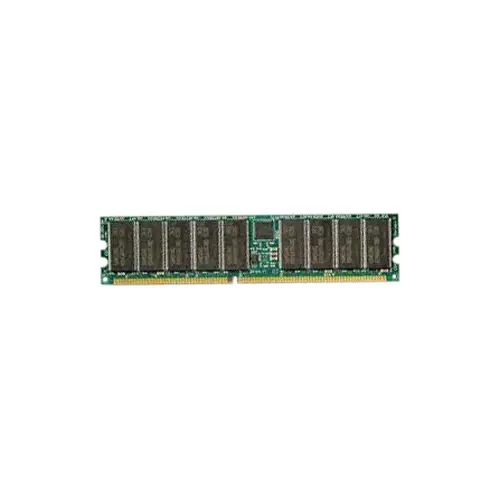
The ECC, Registered signal, 240-pin layout, and VLP form factor clearly identify this as a server memory module. Below is capacity planning guidance for typical server workloads.
General Virtualization
For general virtualization hosts, balance capacity and cost by populating all memory channels. In a dual-socket server with four channels per CPU, install two of these 16 GB dual‑rank RDIMMs per channel (8 DIMMs per CPU) to achieve 128 GB per socket while maintaining 1600 MHz speed. This yields a robust 256 GB total for hosting numerous VMs with ECC protection.
In‑Memory Database
In‑memory databases demand maximum capacity. Fully populate every available DIMM slot on a multi‑socket platform; for a dual‑socket server supporting 24 DIMMs, use 24 of these 16 GB modules to reach 384 GB. Although the speed may drop to 1333 MHz at three DIMMs per channel, the capacity gain is critical for caching large datasets entirely in DRAM.
High‑Performance Computing
HPC workloads prioritize memory bandwidth and reliability. Install one 16 GB DIMM per channel to leverage the full 1600 MHz frequency without clock penalties. In a dual‑socket configuration with four channels each, this results in 128 GB total (8 DIMMs), delivering maximum throughput for simulation and modeling codes while ECC guards against silent data corruption.
Rigorously tested server memory compatible with Dell PowerEdge R720, HP DL380p Gen8, Lenovo RD530, and more.
Q: Can I mix this MT36JDZS2G72PZ-1G6E1 with other memory modules of different brands or speeds?
A: Mixing this registered ECC module with different brands or speeds is not recommended. Mismatched DIMMs may cause system instability or boot failures. For guaranteed reliability, use identical modules with matching part numbers per channel.
Q: Is this memory compatible with my system?
A: This DDR3-1600 registered ECC VLP RDIMM is designed for servers supporting 240-pin, 1.5V slots. Compatible with Intel Xeon E5-2600 v1/v2 and AMD Opteron 6300 platforms. Verify your motherboard's QVL list for specific validation.
Q: What is the recommended DIMM population order for optimal performance?
A: For optimal performance, populate identical DIMMs per channel, starting from the slots farthest from the CPU. Follow your server vendor's memory population guide to balance channels and maximize memory bandwidth correctly.
Q: Does this module support overclocking or XMP profiles?
A: No. This is a JEDEC-compliant registered ECC module built for data integrity and stability. It does not support overclocking or XMP profiles; enterprise servers prioritize reliability over speed adjustments.
Q: What warranty and typical failure rate can I expect?
A: This module includes a 1-year warranty. Enterprise registered ECC memory typically has an annualized failure rate (AFR) below 0.5% under proper cooling and standard operating conditions, ensuring high long-term reliability.