











 Secure payments
Standard refund policy
Trade Assurance
Secure payments
Standard refund policy
Trade Assurance
| Product Type | Memory Module |
|---|---|
| Compliance Standards | RoHS |
| Memory Capacity | 16 GB |
| Memory Technology | DDR3 |
| Product Voltage | 1.5V |
| RAM Speed | 1600MHz |
| RAM Standard | DDR3-1600/PC3-12800 |
| Error Identifying | ECC |
| Signal Type | Registered |
| Column Access Strobe (CAS) | CL11 |
| Rank | Dual Rank x4 |
| Quantity of Pins | 240-pin |
| RAM Genre | RDIMM |
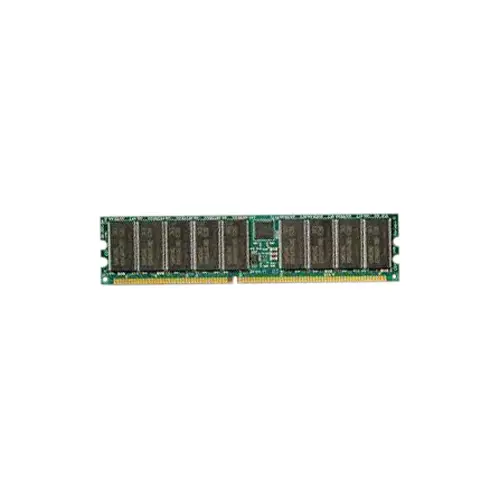
This 16GB DDR3-1600 Registered ECC module, built with a dual-rank x4 organization and CL11 latency, is engineered for server platforms where data integrity and memory stability are paramount. It excels in virtualized environments and in-memory database workloads, leveraging its registered signal architecture and ECC to ensure consistent performance and error correction under sustained heavy loads.
1. Registered signal buffering preserves command and address integrity across fully populated server memory channels, eliminating electrical loading issues that could cause silent system instability in multi-slot configurations.
2. ECC protection transparently detects and corrects single-bit memory errors in real time, safeguarding transactional data integrity for mission-critical enterprise applications and financial databases.
3. Dual Rank x4 organization interleaves accesses across internal banks, keeping memory throughput high enough to sustain multiple virtual machines during peak consolidation without latency spikes.
4. Sixteen-gigabyte module density allows builders to achieve generous total memory footprints, reflecting in more simultaneous containers or VDI instances per physical host without pushing into exotic, high-cost DIMMs.
5. 1600 MT/s effective frequency supplies the steady bandwidth essential for in-memory caches and heavy database joins, ensuring consistent response times under multi-tenant workloads.
The MT36JSF2G72PZ-1G6P1 is a 16GB DDR3-1600 Registered DIMM engineered for server environments, and its four defining characteristics directly address the real-world demands of data centers and enterprise computing. ECC memory continuously detects and corrects single-bit errors, which is critical when running an in-memory database like SAP HANA or Redis where even a silent bit flip can corrupt financial transactions or cached user sessions, turning a minor hardware fault into a major business integrity issue. The Registered architecture buffers command and address signals, stabilizing the memory bus when populating all 24 DIMM slots in a virtualization cluster; without this, signals degrade across dozens of modules, causing intermittent crashes during live migration of virtual machines. The dual-rank x4 organization interleaves memory accesses across two internal ranks, boosting bandwidth for hypervisors juggling multiple VMs simultaneously, reducing latency spikes when a VMware ESXi host services storage I/O and compute workloads side by side. Finally, the 16GB capacity on a single module maximizes density in 2U rack servers with limited slots, allowing you to allocate generous RAM to containerized microservices or large-scale VDI deployments without sacrificing performance headroom. Every one of these features translates from a specification on paper into tangible resilience, density, and speed for mission-critical operations.
Server Memory Capacity Planning
This module is a 16GB DDR3-1600 Registered ECC RDIMM (1.5V, dual-rank x4), designed exclusively for servers and workstations. Its ECC and registered signaling ensure data integrity and signal stability in multi-DIMM configurations. Below are capacity planning recommendations for three typical enterprise workloads.
General Virtualization
For a mid-density virtualization host running 20–30 light to medium VMs, populate six of these 16GB modules across three channels (one DIMM per channel, 2DPC if supported) for 96GB total. This balances memory bandwidth and capacity while leaving room for future expansion. Avoid mixing ranks within the same channel to maintain optimal performance.
In-Memory Database
Applications like Redis or SAP HANA demand large, reliable memory pools. Configure a four-socket server with 24 modules (six per CPU) to achieve 384GB. Use identical dual-rank x4 DIMMs to maximize rank interleaving and reduce latency. Always enable ECC scrubbing to guard against bit errors in long-running data sets.
High Performance Computing
HPC clusters benefit from bandwidth over raw capacity per node. Install four modules per CPU (one per channel, 4×16GB=64GB) to populate all memory channels without exceeding electrical limits. This configuration sustains high stream throughput for MPI workloads. If more capacity is needed, step to 2DPC with matching RDIMMs, but expect slightly reduced clock speeds due to loading.
Validated for servers: compatible with Dell PowerEdge R720, HP ProLiant DL380p Gen8, Lenovo System x3650 M4 and more.
Q: Can I mix this MT36JSF2G72PZ-1G6P1 with other memory modules of different brands or speeds?
A: Mixing RDIMMs of different brands or speeds is not recommended. It can cause signal integrity issues or degraded performance. For optimal reliability, populate all channels with identical modules from the same validated kit.
Q: Is this memory compatible with my Intel or AMD server platform?
A: It is compatible with server boards supporting DDR3-1600 Registered ECC DIMMs. Verify that your CPU and chipset, such as Intel Xeon E5-2600 v1/v2 or AMD Opteron 6300 series, accept 1.5V, 240-pin RDIMMs.
Q: What is the recommended DIMM population order for optimal performance?
A: Follow your server motherboard’s population guide. Typically, install identical DIMMs into corresponding blue or white slots first to enable balanced memory channels and maintain ECC functionality across multiple processors.
Q: Does this module support overclocking or XMP profiles?
A: No. This is a JEDEC-compliant server RDIMM running at fixed 1600MHz, CL11. It does not support XMP or any overclocking, as enterprise platforms prioritize stability and error correction over frequency tuning.
Q: What warranty and typical failure rate can I expect?
A: This module includes a 1-year warranty. It meets rigorous enterprise testing standards, delivering an annualized failure rate (AFR) well below 0.5% under normal operating conditions when properly cooled and configured.