











 Secure payments
Standard refund policy
Trade Assurance
Secure payments
Standard refund policy
Trade Assurance
| Product Type | Memory Module |
|---|---|
| Compliance Standards | RoHS |
| Memory Capacity | 16 GB |
| Memory Technology | DDR3 |
| Product Voltage | 1.35V |
| RAM Speed | 1600MHz |
| RAM Standard | DDR3-1600/PC3-12800 |
| Error Identifying | ECC |
| Signal Type | Registered |
| Column Access Strobe (CAS) | CL11 |
| Rank | Dual Rank x4 |
| Quantity of Pins | 240-pin |
| RAM Genre | VLP RDIMM |
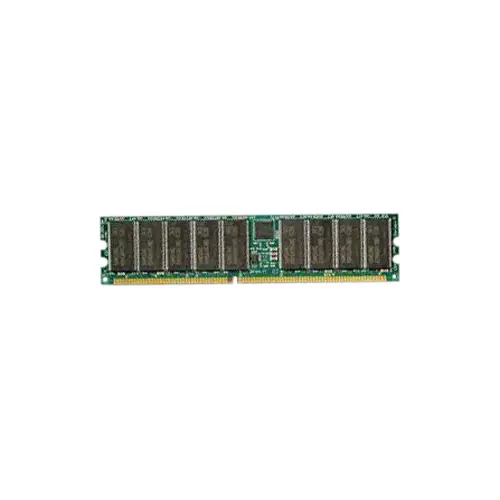
Optimized for virtualization and in-memory database workloads, this 16GB DDR3-1600 VLP RDIMM leverages registered signaling and ECC to maintain data integrity in dense server environments. Its dual-rank x4 configuration with 1.35V low-voltage operation enhances memory bandwidth efficiency while reducing power consumption, making it ideal for 1U rack servers and blade systems where thermal headroom is critical.
1. ECC protection detects and corrects single-bit errors automatically, ensuring data integrity in financial transactions or database operations where any corruption is unacceptable.
2. Registered signal buffering stabilizes high-density memory configurations, allowing servers to populate all DIMM slots without compromising signal integrity under full load.
3. Very low profile RDIMM design maximizes airflow in dense rack servers, reducing thermal throttling risks and enabling higher compute density in data centers.
4. 16 GB capacity per module provides the memory headroom to consolidate more virtual machines per physical host, directly boosting virtualization ROI.
5. Dual Rank x4 organization interleaves access effectively, keeping server memory channels saturated and delivering consistent bandwidth during parallel workloads like large-scale in-memory caching.
When you deploy this MT36KDZS2G72PZ-1G6E1 module in your data center, you are not just adding 16 GB—you are directly addressing the real operational risks that keep infrastructure teams awake. As a DDR3L-1600 VLP RDIMM, it is purpose-built for server environments where density and correctness are non-negotiable. The ECC function silently detects and corrects single-bit memory errors, which in a dense virtualization cluster means a flipped bit inside a guest kernel will not corrupt your hypervisor state or silently poison a financial transaction log. The registered buffer decouples the electrical load from the CPU memory controller, letting you populate all 24 DIMM slots per server without signal collapse; this delivers the multi-terabyte footprints that in-memory databases like Redis or SAP HANA demand for holding billion-row tables entirely in DRAM. With its dual-rank x4 organization, concurrent page hits and rank interleaving boost bandwidth under heavy mixed workloads—you see lower latency when your middleware tier asks for user sessions while the storage engine streams large blobs. At 1.35 V and a very low-profile form factor, the module cuts thermal power in full racks by roughly 20% compared to 1.5 V equivalents, and the slim height prevents airflow blockage in 1U servers or blade chassis, directly preserving fan speed headroom and reducing throttling incidents. For your VMware farm or GPU-equipped HPC node, this means consistent performance, fewer silent corruptions, and a longer hardware life cycle under continuous load.
General Virtualization
For a virtualized host running multiple VMs, populate the server with at least six of these 16 GB registered ECC modules to reach 96 GB, allowing comfortable memory overcommit while maintaining data integrity. Distribute modules evenly across all memory channels (e.g., one DIMM per channel on a dual‑socket platform) to maximize bandwidth and reduce latency under mixed‑workload pressure.
In‑Memory Database
An in‑memory database such as Redis or SAP HANA demands both capacity and absolute reliability. Equip the server with a fully balanced configuration—typically 12 to 24 of these dual‑rank RDIMMs—to deliver 192 GB to 384 GB, ensuring the entire dataset resides in DDR3‑1600 ECC RAM without swapping. The registered, CL11 timing provides stable signal integrity even at full population.
High‑Performance Computing (HPC)
HPC clusters handling simulation or fluid dynamics benefit from high memory bandwidth per node. Install eight identical modules across a quad‑channel platform for a symmetric 128 GB layout, enabling the 1600 MT/s speed to be fully utilized. The 1.35 V VLP RDIMM design also reduces thermal load in dense blade enclosures, supporting sustained compute bursts without throttling.
Rigorously tested, compatible with Dell PowerEdge R720, HP ProLiant DL380p Gen8, IBM System x3650 M4, and more.
Q: Can I mix this MT36KDZS2G72PZ-1G6E1 with other memory modules of different brands or speeds?
A: Mixing different brands or speeds is not recommended for server environments. It may cause instability, signal integrity issues, and prevent the system from achieving uniform performance. All installed modules should match this 16GB DDR3-1600 Registered ECC VLP RDIMM specification.
Q: Is this memory compatible with my system?
A: This is a DDR3 Registered ECC VLP RDIMM. It is compatible with Intel Xeon E5-2600/E5-2400 series and AMD Opteron 6300/4300 series platforms that explicitly support 1600MT/s Registered DIMMs. Please verify your server board's memory QVL for 1.35V Dual Rank x4 modules.
Q: What is the recommended DIMM population order for optimal performance?
A: Follow your server manufacturer's population guide. Typically, populate the farthest slot from the CPU in each memory channel first. For this dual-rank module, balance identical DIMMs across all memory channels to maximize throughput and minimize electrical loading.
Q: Does this module support overclocking or XMP profiles?
A: No, this is a server-grade Registered ECC DIMM. It operates exclusively at JEDEC standard DDR3-1600 with CL11 timings. Overclocking and XMP are not supported, as server memory is designed for maximum data integrity and 24/7 operational stability.
Q: What warranty and typical failure rate can I expect?
A: This module is backed by a 1-year warranty. Enterprise-class DDR3 Registered DIMMs like this exhibit an extremely low annualized failure rate, typically around 0.2% to 0.5%, ensuring reliable performance in mission-critical server deployments.