











 Secure payments
Standard refund policy
Trade Assurance
Secure payments
Standard refund policy
Trade Assurance
| Product Type | Memory Module |
|---|---|
| Memory Capacity | 16 GB |
| Memory Technology | DDR3 |
| Product Voltage | 1.35V |
| RAM Speed | 1600MHz |
| RAM Standard | DDR3-1600/PC3-12800 |
| Error Identifying | ECC |
| Signal Type | Unbuffered |
| Column Access Strobe (CAS) | CL11 |
| Rank | Dual Rank x8 |
| Quantity of Pins | 240-pin |
| RAM Genre | UDIMM |
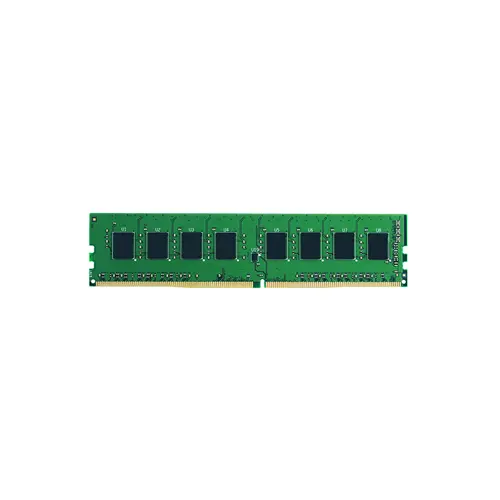
This 16GB DDR3-1600 UDIMM with ECC is purpose-built for entry-level servers, small business NAS, and workstation platforms that require uncompromised data integrity, leveraging unbuffered signal stability and dual-rank x8 organization to enhance memory interleaving efficiency under continuous operation. Its 1.35V low-voltage design reduces power draw and thermal stress, while the CL11 latency delivers predictable, reliable performance for virtualization and memory-intensive critical workloads.
1. Error-correcting code memory detects and corrects single-bit data corruption, preserving transaction integrity for mission-critical database workloads.
2. Unbuffered module architecture trims latency by eliminating register delays, speeding up small-block access in lightweight virtualized environments.
3. Dual rank interleaving increases per-channel throughput, sustaining steady performance when multiple guest machines contend for memory resources.
4. Low-voltage operation cuts power consumption and waste heat, improving energy efficiency across dense, always-on microserver deployments.
5. Generous module density empowers higher memory capacity within compact server nodes, enabling more containers and virtual machines to run concurrently without swapping.
Server environments demand unwavering stability, where a single undetected bit-flip can corrupt financial records or crash a virtualized workload. This Micron 16GB DDR3 UDIMM with ECC neutralizes that risk head-on by detecting and correcting single-bit errors in real time, making it indispensable for memory-resident databases like Redis or SAP HANA that cannot tolerate silent data corruption. Its low 1.35V operating voltage directly translates to lower energy bills and reduced thermal stress across dense virtualization clusters running dozens of VMs per host—every watt saved compounds at scale. The dual-rank x8 construction and 1600MHz speed deliver the interleaved bank access necessary to sustain high bandwidth under concurrent transaction loads, preventing the memory bottleneck that often throttles hypervisor performance during peak query storms. For IT managers upgrading aging servers, this unbuffered ECC module slots into cost-effective single-socket workstations and entry-level servers, extending platform life while fortifying data integrity exactly where it matters most: at the point where business logic hits live data.
General Virtualization
Populate memory channels evenly to maximize shared bandwidth. A dual-channel configuration with two 16GB UDIMMs delivers 32GB, comfortably supporting a mix of light to moderate VMs. For higher consolidation ratios, fill all four DIMM slots to reach 64GB; dual-rank x8 organization enhances interleaving. ECC protection safeguards guest data integrity in multi-tenant environments.
In-Memory Database
Achieve maximum capacity by installing identical 16GB ECC UDIMMs in every slot—64GB in a typical four-slot server or 128GB with eight slots. These dual-rank, 1.35V modules ensure stable operation and lower thermal stress for 24/7 databases. ECC is mandatory to preserve transactional consistency and prevent silent data corruption.
High-Performance Computing (HPC)
Balance bandwidth and capacity: a pair of modules in dual-channel mode yields the lowest effective latency. Scale to four modules (two per channel) when larger working sets are needed; dual-rank interleaving also boosts throughput. The 1.35V UDIMMs reduce power draw, a key advantage in dense cluster nodes running sustained calculations.
Rigorously tested, compatible with Dell PowerEdge R220, T20, HPE MicroServer Gen8, and Lenovo TS140 servers.
Q: Can I mix this MT18KDF2G72AZ-1G6A1ZE with other memory modules of different brands or speeds?
A: Mixing ECC UDIMMs from different brands or speeds is not recommended. It can cause signal integrity issues, forcing the memory controller to downgrade to the lowest common speed or leading to system instability in server environments.
Q: Is this memory compatible with my system?
A: This 240-pin DDR3 ECC UDIMM requires a server or workstation board with an Intel Xeon E3/E5 or AMD Opteron platform that specifically supports unbuffered ECC memory. Check your motherboard’s qualified vendor list to confirm 16GB Dual Rank x8 compatibility.
Q: What is the recommended DIMM population order for optimal performance?
A: Populate identical modules per memory channel to maximize bandwidth. For dual-processor servers, balance DIMMs across both CPU sockets. Always install the first module in the farthest slot from the CPU per channel as specified in your server manual.
Q: Does this module support overclocking or XMP profiles?
A: No. As an enterprise-class ECC UDIMM, this module strictly adheres to JEDEC DDR3-1600 (PC3-12800) standards for maximum data integrity. It does not support XMP profiles or overclocking, prioritizing error-free operation over performance tuning.
Q: What warranty and typical failure rate can I expect?
A: This Micron module includes a 1-year warranty. Enterprise memory typically exhibits an Annualized Failure Rate (AFR) well below 1%, supported by rigorous factory testing and integrated ECC to mitigate soft errors during operation.