











 Secure payments
Standard refund policy
Trade Assurance
Secure payments
Standard refund policy
Trade Assurance
| Product Type | Memory Module |
|---|---|
| Memory Capacity | 16 GB |
| Memory Technology | DDR3 |
| Product Voltage | 1.35V |
| RAM Speed | 1600MHz |
| RAM Standard | DDR3-1600/PC3-12800 |
| Error Identifying | ECC |
| Signal Type | Unbuffered |
| Column Access Strobe (CAS) | CL11 |
| Rank | Dual Rank x8 |
| Quantity of Pins | 240-pin |
| RAM Genre | UDIMM |
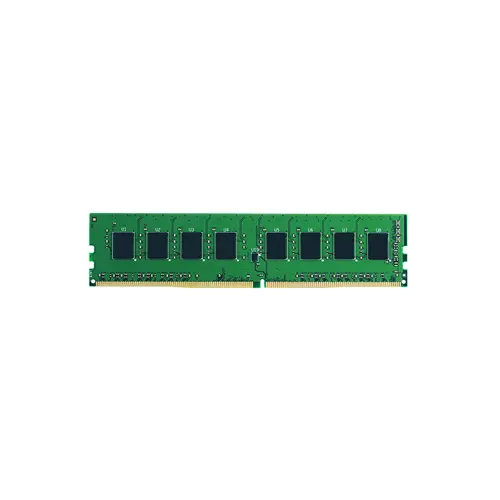
This unbuffered ECC UDIMM is engineered for entry-level servers and workstations, where its dual-rank x8 organization boosts memory bandwidth and the 1.35V low-voltage operation improves energy efficiency without sacrificing 1600MHz stability. It excels in virtualized environments and memory-intensive database applications, delivering strong data integrity through hardware error correction while maintaining the low latency advantages of an unbuffered signal path.
1. ECC protection actively corrects single-bit errors and detects multi-bit faults, safeguarding financial transactions and database integrity in always-on enterprise servers.
2. A 16GB capacity per module increases virtual machine density, allowing more isolated workloads to coexist on a single host without immediate slot exhaustion.
3. Dual Rank x8 organization enables rank interleaving, keeping the memory pipeline saturated and reducing latency spikes during heavy concurrent processing like virtualization or large-scale analytics.
4. The 1600MHz clock speed provides sufficient throughput for legacy server platforms, ensuring stable performance in ERP, mail, or file-serving roles under steady user loads.
5. 1.35V low-voltage operation trims datacenter power draw and lowers DIMM temperatures, which extends hardware lifespan and supports greener, higher-density rack deployments.
In workstation and entry‑server environments where every calculation matters, the MT18KDF2G72AZ-1G6 16 GB DDR3 UDIMM directly addresses the most painful realities of running mission‑critical workloads. Its ECC technology is what keeps a virtualization cluster alive at 3 AM; when a stray cosmic ray flips a memory bit, this module silently corrects the error before it corrupts a guest operating system or crashes a live database transaction. For an in‑memory database such as Redis or a heavily paged VMware host, that single‑bit correction is the difference between uninterrupted uptime and a costly, mysterious outage.
The module’s dual‑rank x8 organization and 1600 MHz speed then ensure that sustained throughput does not collapse under concurrency. When multiple virtual machines compete for memory bandwidth, the dual‑rank layout allows the memory controller to interleave accesses and reduce idle cycles, keeping query latency flat during spikes. Combined with a low 1.35 V operating voltage, this UDIMM reduces thermal load inside compact 1U servers or small‑form‑factor NAS boxes, so passive cooling remains effective and power bills stay predictable even when storage pools grow. While unbuffered by design—suitable for lighter server loads—the module’s CL11 latency and genuine 16 GB capacity transform a modest tower server into a responsive local compute node that can simultaneously host a file server, a lightweight hypervisor, and a transactional application without trading reliability for performance.
General Virtualization
Begin with two 16 GB DDR3L ECC UDIMMs (32 GB) for small virtualization hosts running a handful of light VMs. Scale to four modules (64 GB) on common dual-channel Xeon E3 platforms to comfortably consolidate moderate workloads while preserving full dual-channel bandwidth. The 1.35 V low-voltage design helps reduce total power draw in always-on server environments.
In-Memory Database
For in-memory databases such as Redis, populate every DIMM slot to maximize capacity—typically four 16 GB modules for 64 GB on a single-socket board. This keeps the entire dataset resident under ECC protection, with the dual-rank construction offering a favorable balance between density and latency. Confirm that the platform supports full population without an undesirable memory speed reduction.
High-Performance Computing
HPC nodes demand peak memory bandwidth. On dual-channel platforms, install one 16 GB module per channel (32 GB total) to achieve the highest symmetric throughput. If larger per-node capacity is required, equip all four slots but benchmark carefully, as fully populating channels may force a slight frequency drop that can impact bandwidth-sensitive applications.
Rigorously tested server-grade DDR3 ECC UDIMM for Dell PowerEdge R320, HPE ProLiant DL320e Gen8, Lenovo TS140, Fujitsu TX1310 M1.
Q: Can I mix this MT18KDF2G72AZ-1G6 with other memory modules of different brands or speeds?
A: Mixing is discouraged. This ECC UDIMM will downclock to the slowest module, potentially causing stability issues. For server environments, matching identical part numbers ensures validated RAS and compatibility.
Q: Is this memory compatible with my server platform?
A: It is designed for single-socket Intel Xeon E3-1200 v2/v3 series with C200/C220 chipsets, or AMD AM3+ platforms supporting unbuffered ECC DDR3. Verify your motherboard supports 1.35V, 1600MT/s ECC UDIMMs.
Q: What is the recommended DIMM population order for optimal performance?
A: Populate identical dual-rank DIMMs per channel, starting with the furthest slot from the CPU. Typically, fill blue slots first. Consult your server board manual for balanced memory configurations and maximum bandwidth.
Q: Does this module support overclocking or XMP profiles?
A: No. This is a JEDEC-compliant ECC UDIMM running at standard DDR3-1600 CL11. Server-class memory prioritizes data integrity and stability, so it does not support overclocking or XMP profiles.
Q: What warranty and typical failure rate can I expect?
A: It includes a one-year warranty covering manufacturing defects. Enterprise UDIMMs exhibit very low annualized failure rates under 0.5% when operated within specified temperature and voltage ranges.