











 Secure payments
Standard refund policy
Trade Assurance
Secure payments
Standard refund policy
Trade Assurance
| Product Type | Memory Module |
|---|---|
| Compliance Standards | RoHS |
| Memory Capacity | 16 GB |
| Memory Technology | DDR3 |
| RAM Speed | 1600 |
| RAM Standard | DDR3-1600/PC3-12800 |
| Signal Type | Unbuffered |
| Column Access Strobe (CAS) | CL11 |
| Rank | Dual Rank x8 |
| Quantity of Pins | 204-pin |
| RAM Genre | SoDIMM |
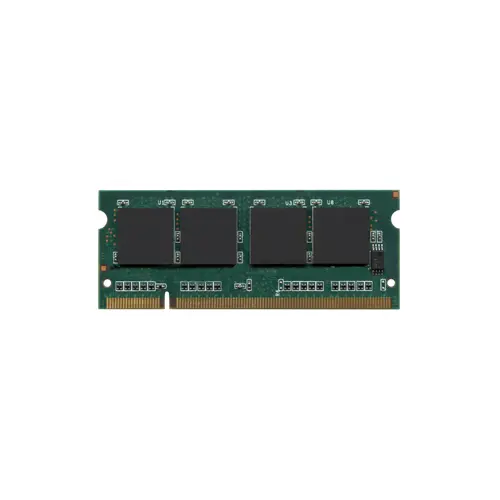
This 16GB DDR3-1600 SoDIMM provides an ideal plug-and-play upgrade for laptops and mobile workstations, delivering reliable unbuffered signal integrity and low-latency operation. Its dual-rank x8 configuration boosts memory interleaving for improved multitasking performance, perfectly matching the thermal and power efficiency demands of legacy notebook platforms.
1. Unbuffered signal type eliminates the register chip, reducing power draw and latency to extend battery runtime in thin-and-light notebooks.
2. 16 GB capacity comfortably accommodates heavy browsing, office suites, and multiple virtual meeting apps simultaneously without resorting to sluggish storage swapping.
3. DDR3 technology ensures a cost-effective, drop-in upgrade for aging laptop platforms, extending usable life without requiring a full system replacement.
4. 1600 MT/s transfer rate accelerates data movement between the memory and processor, cutting application load times during everyday mobile productivity.
5. CL11 latency strikes a practical balance between responsiveness and power consumption, helping the module operate coolly inside thermally constrained laptop chassis.
The Micron MT18KSF2G72HZ-1G6A1 is a DDR3-1600 SODIMM designed for notebooks and small-form-factor systems, and its four defining characteristics directly address the real-world frustrations of mobile users. The 204-pin SODIMM form factor guarantees a straightforward, tool-free upgrade for ultrabooks and mobile workstations, snapping securely into space-constrained slots where compatibility issues often derail component swaps. Its 16 GB capacity transforms a struggling laptop into a capable multitasking platform: a field engineer can run a local virtual machine for testing while maintaining a demanding CAD assembly and a dozen browser tabs, all without the system stalling as it avoids paging to slow mechanical storage. The dual-rank x8 organization allows the memory controller to interleave commands efficiently, delivering smoother 3D model rotation in SolidWorks or responsive layer manipulation in Photoshop even when the system lacks the latest chipset. Operating at 1600 MT/s with CL11 latency, this module supplies the consistent bandwidth needed for smooth video conferencing while a large dataset streams from a cloud drive. And with RoHS compliance, IT managers can deploy these modules across a fleet of corporate notebooks knowing they meet strict environmental standards without sacrificing the longevity that DDR3 still offers for cost-effective fleet refreshes—every watt not wasted contributes to extended battery runtime during back-to-back meetings.
Laptop Upgrade
For older notebooks limited to two SO-DIMM slots, a single 16GB DDR3-1600 module is a cost-effective way to double capacity from 8GB. If the system supports dual-channel, install a matched pair of these dual-rank x8 modules for 32GB total; this improves integrated graphics performance and multitasking responsiveness without changing the entire platform.
Mobile Workstation
Professional workloads like CAD, large spreadsheets, or virtual machines demand maximum capacity. Populate both slots with these 16GB Unbuffered SO-DIMMs to reach 32GB—the practical ceiling for most dual-core/quad-core DDR3 mobile workstations. The dual-rank construction helps sustain bandwidth under sustained memory pressure, although check the chipset’s per-slot limit before deployment.
Ultrabook Power Saving
This standard-voltage (1.5V) DDR3 module delivers higher capacity but draws more power than low-voltage DDR3L. In an Ultrabook, use a single 16GB stick to minimize power compared to two modules, but verify BIOS support for 16GB density. For extended battery runtime, prefer the DDR3L-1600 (PC3L-12800) variant if the processor requires 1.35V; otherwise, the dual-rank design adds a marginal power penalty over single-rank alternatives.
Rigorously tested, compatible with mobile workstations like Lenovo ThinkPad W540, Dell Precision M4800, and HP ZBook 15 G2.
Q: Can I mix this MT18KSF2G72HZ-1G6A1 with other memory modules of different brands or speeds?
A: Mixing is not recommended. Timings and voltage differences can cause instability. For optimal reliability, use identical modules or a matched kit specifically validated for your laptop.
Q: Is this memory compatible with my system?
A: It fits notebooks with 204-pin DDR3 SoDIMM slots, typically supporting 3rd/4th Gen Intel Core platforms. Always verify your laptop model’s QVL or use a configurator to confirm compatibility.
Q: What is the recommended DIMM population order for optimal performance?
A: Install identical modules as a pair in both slots for dual-channel operation. If your laptop has only one slot, a single module works; ensure it is fully seated and the system recognizes 16 GB.
Q: Does this module support overclocking or XMP profiles?
A: No, this is a standard JEDEC-compliant DDR3-1600 SoDIMM running at 1600 MHz with CL11. It does not support XMP or manual overclocking and operates only at its rated specification.
Q: What warranty and typical failure rate can I expect?
A: This module carries a 1-year warranty. The Annualized Failure Rate (AFR) is typically below 0.5% under normal operating conditions, consistent with industry-standard enterprise-quality DRAM reliability.