











 Secure payments
Standard refund policy
Trade Assurance
Secure payments
Standard refund policy
Trade Assurance
| Product Type | Memory Module |
|---|---|
| Compliance Standards | RoHS |
| Memory Capacity | 16 GB |
| Memory Technology | DDR3 |
| Product Voltage | 1.5V |
| RAM Speed | 1600MHz |
| RAM Standard | DDR3-1600/PC3-12800 |
| Error Identifying | ECC |
| Signal Type | Registered |
| Column Access Strobe (CAS) | CL11 |
| Rank | Dual Rank x4 |
| Quantity of Pins | 240-pin |
| RAM Genre | RDIMM |
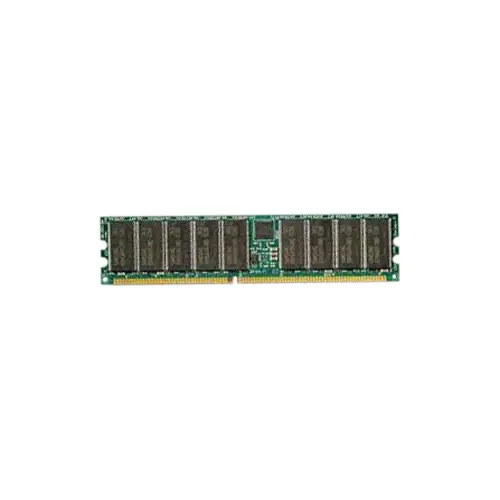
This DDR3-1600 Registered ECC RDIMM is a server-class memory module purpose-built for virtualization clusters and in-memory databases where data integrity and uptime are paramount. Its registered signal buffering and dual-rank x4 organization provide the electrical stability needed for high-density memory populations, while ECC error correction reliably detects and corrects single-bit data errors in real time.
1. Registered signal buffering stabilizes high-capacity memory arrays, enabling reliable operation across multiple DIMMs in dense server virtualization platforms.
2. ECC protection automatically corrects single-bit errors, safeguarding transactional databases and financial workloads from silent data corruption.
3. Dual Rank x4 organization interleaves memory accesses to maximize sustained bandwidth, preserving application responsiveness under heavy concurrent user loads.
4. Sixteen-gigabyte capacity per module maximizes total system memory footprint, allowing IT to consolidate more virtual machines without sacrificing guest performance.
5. DDR3-1600 speed delivers the throughput necessary for real-time analytics and in-memory caching, reducing latency spikes during peak processing windows.
When deploying the Micron MT36JSF2G72PZ-1G6E1FG—a 16GB DDR3-1600 registered ECC RDIMM—in a server environment, data integrity and sustained performance are non-negotiable. In a dense virtualization cluster running dozens of VMs, a single undetected bit flip caused by background radiation or signal noise can corrupt hypervisor memory, silently crashing multiple virtual machines. The ECC on this module hunts down and corrects single-bit errors inline, keeping your entire virtual infrastructure trustworthy, while the registered buffering decouples the electrical load from the memory controller, allowing you to populate all 24 DIMM slots without timing failures as your VM density scales.
For an in-memory database like Redis or a transactional MySQL cluster, the dual-rank x4 organization directly translates into faster data throughput. Memory controllers can interleave accesses across the two ranks on the same stick, effectively hiding precharge delays and delivering lower average latency under the continuous, randomized small-block reads these applications hammer. That means more queries served per second and snappier cache responses for your users. Coupled with a tested CAS latency of 11 at 1600MHz, this registered DIMM balances responsive clock cycles with rock-solid stability, preventing the data corruption that would force a database rebuild. It is not just memory—it is the layer of certainty that safeguards business continuity when every transaction counts.
General Virtualization
For a typical hypervisor hosting multiple VMs, 16 GB RDIMMs are the sweet spot for density and cost. Deploying six to eight modules per dual-socket server (96–128 GB total) provides ample headroom for moderate consolidation, and adding identical kits allows seamless scaling as VM counts grow.
In-Memory Database
In-memory databases like Redis or SAP HANA demand low latency and absolute data integrity, making ECC Registered memory non-negotiable. Populate all available memory channels with these 16 GB modules—aiming for 256 GB or more—to keep entire datasets in RAM, and strictly match DIMM ranks across channels to maintain peak throughput.
High-Performance Computing (HPC)
HPC workloads scale with memory bandwidth, so a balanced configuration is critical. Install one DIMM per channel (typically 8 modules for 128 GB) to maximize speed in dual-socket nodes running CFD or genomic analysis. Monitor memory utilization closely; if jobs spill into swap, double capacity with a second matching set while preserving the one-DIMM-per-channel ratio.
Proven compatible with Dell PowerEdge R720/R620, HP ProLiant DL380p Gen8, and similar servers.
Q: Can I mix this MT36JSF2G72PZ-1G6E1FG with other memory modules of different brands or speeds?
A: Mixing DIMMs is not recommended for servers. All modules should match in type, speed, rank, and capacity. Mismatched Registered ECC memory can cause POST failures, instability, or silent data corruption.
Q: Is this memory compatible with my system?
A: This DDR3-1600 Registered ECC module is designed for server platforms. Verify your Intel Xeon E5/E7 or AMD Opteron server board explicitly supports 1.5V RDIMMs and check the qualified vendor list.
Q: What is the recommended DIMM population order for optimal performance?
A: Follow your server motherboard’s population guidelines precisely. Typically, populate identical DIMMs per channel starting with the slot farthest from the CPU, balancing across channels to maximize interleaving and bandwidth.
Q: Does this module support overclocking or XMP profiles?
A: No. This is a JEDEC-compliant server RDIMM. It operates strictly at DDR3-1600 with standard timings. Overclocking and XMP are not supported, as stability and data integrity are paramount in server environments.
Q: What warranty and typical failure rate can I expect?
A: This module includes a 1-year warranty. As an enterprise-grade product, it exhibits a very low Annualized Failure Rate (AFR) under specified conditions, ensuring long-term reliability for mission-critical deployments.