











 Secure payments
Standard refund policy
Trade Assurance
Secure payments
Standard refund policy
Trade Assurance
| Product Type | Memory Module |
|---|---|
| Compliance Standards | RoHS |
| Memory Capacity | 16 GB |
| Memory Technology | DDR3 |
| Product Voltage | 1.5V |
| RAM Speed | 1866MHz |
| RAM Standard | DDR3-1866/PC3-14900 |
| Error Identifying | ECC |
| Signal Type | Registered |
| Column Access Strobe (CAS) | CL13 |
| Rank | Dual Rank x4 |
| Quantity of Pins | 240-pin |
| RAM Genre | RDIMM |
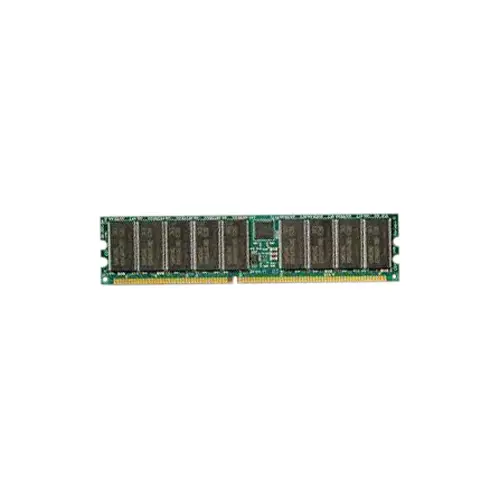
This 16GB DDR3-1866 Registered ECC RDIMM, featuring a dual-rank x4 organization and CL13 latency, ensures robust data integrity and signal stability for demanding server platforms running virtualization, in-memory databases, and other mission-critical workloads. Its registered architecture combined with ECC minimizes electrical loading on the memory bus, enabling reliable, error-corrected performance in dense multi-DIMM configurations essential for 24/7 enterprise operations.
1. A 16 GB module density lets each server node host significantly more virtual machines, reducing hardware footprint and licensing costs in dense data centers.
2. The 1866 megatransfers per second data rate supplies the memory throughput essential for real-time analytics and large in-memory database operations without stalls.
3. ECC protection eliminates single-bit errors on the fly, preventing silent data corruption that could compromise financial transactions or long-running scientific computations.
4. Registered clock driver buffering stabilizes signal integrity across fully populated memory channels, making large-scale, always-on deployments dependable under sustained load.
5. Dual Rank x4 organization interleaves memory accesses efficiently, keeping the channel pipeline saturated for uniform low-latency response even as virtualization consolidation peaks.
The Micron MT36JSF2G72PZ-1G9E1HE is an RDIMM engineered for server-class reliability, where every bit of data integrity and uptime matters. In a virtualized cluster running a dozen guest machines on a single hypervisor, a single undetected memory error can cascade into corrupted customer databases or hours of forensic downtime. The module’s ECC technology constantly scans and corrects single-bit errors—essentially silent cosmic-ray-induced bit flips—before they manifest as application crashes. Meanwhile, registered signal buffering decouples the memory bus from the CPU’s electrical load, letting you populate all DIMM slots with confidence that the memory controller won’t buckle under high density. This becomes critical when deploying in-memory databases like Redis or SAP HANA: the dual-rank x4 organization doubles the number of parallel banks, sustaining robust command bus efficiency and bandwidth under intensive read-modify-write workloads. At 1866 MHz and a CAS latency of 13, the DIMM delivers the low-latency throughput that real-time analytics engines demand, slashing query response times while the 1.5V standard keeps thermal load manageable inside dense rack servers. It transforms raw specs into a single assurance—your services stay consistent and available even as workloads surge.
Server Memory Identification
This 16GB DDR3-1866 ECC Registered RDIMM is purpose-built for server platforms. Its error correction and registered signaling ensure stability under sustained, mission-critical workloads.
General Virtualization
Populate at least six to eight modules per host to provide 96–128 GB of total capacity, comfortably hosting 20–30 typical virtual machines. Distribute modules evenly across all memory channels to maximize bandwidth, and rely on ECC to prevent in-memory data corruption in multi-tenant environments.
In-Memory Database
Maximize capacity by filling all available DIMM slots—many dual-socket servers can accept 24 of these 16 GB modules for 384 GB of RAM. Such large footprints let entire datasets reside in memory, eliminating disk I/O bottlenecks. When populating three DIMMs per channel, be aware of slight speed reductions and plan for adequate cooling.
High-Performance Computing (HPC)
For bandwidth-sensitive parallel workloads, install one DIMM per channel (eight modules for 128 GB) to sustain the full 1866 MT/s with CL13 latency. This configuration avoids rank contention while delivering the throughput needed for tightly coupled simulations. Scale horizontally across nodes and use identical modules to guarantee predictable performance.
Tested server-grade DDR3 RDIMM; compatible with Dell PowerEdge R720/R620, HPE ProLiant DL380p Gen8.
Q: Can I mix this MT36JSF2G72PZ-1G9E1HE with other memory modules of different brands or speeds?
A: Mixing with different brands or speeds is not recommended. The system will downclock to the slowest module and mixing ECC Registered DIMMs may cause instability. Use identical modules for validated reliability.
Q: Is this memory compatible with my server platform?
A: It is compatible with servers using DDR3 ECC Registered DIMM slots. Supports Intel Xeon E5-2600 v2/v1 and AMD Opteron 6300 series platforms. Verify your board supports 1866MHz RDIMMs before purchase.
Q: What is the recommended DIMM population order for optimal performance?
A: Follow your server manual for balanced memory configurations. Generally, populate identical DIMMs per channel starting with the farthest slot from the CPU. Always install in matched sets for dual-rank x4 performance.
Q: Does this module support overclocking or XMP profiles?
A: No. As an enterprise ECC Registered DIMM, it operates strictly at JEDEC standard DDR3-1866. Overclocking and XMP are not supported to maintain signal integrity and data reliability.
Q: What warranty and typical failure rate can I expect?
A: This Micron module includes a 1-year warranty. Enterprise RDIMMs exhibit very low failure rates with an annualized AFR typically below 0.5% under specified operating conditions.