











 Secure payments
Standard refund policy
Trade Assurance
Secure payments
Standard refund policy
Trade Assurance
| Product Type | Memory Module |
|---|---|
| Compliance Standards | RoHS |
| Memory Capacity | 16 GB |
| Memory Technology | DDR3 |
| Product Voltage | 1.5V |
| RAM Speed | 1866MHz |
| RAM Standard | DDR3-1866/PC3-14900 |
| Error Identifying | ECC |
| Signal Type | Registered |
| Column Access Strobe (CAS) | CL13 |
| Rank | Dual Rank x4 |
| Quantity of Pins | 240-pin |
| RAM Genre | RDIMM |
This DDR3-1866 RDIMM with ECC and registered signaling is engineered for legacy server platforms requiring high data integrity, making it ideal for memory-intensive workloads like virtualization and in-memory databases. Its dual-rank x4 configuration and CL13 latency optimize bank-level parallelism to sustain throughput under heavy load, while error correction safeguards against single-bit data corruption.
1. The 16 GB capacity per module allows for dense memory configurations in a 2U server, substantially increasing the number of virtual machines that can run concurrently without resorting to slower swap storage.
2. Error Correcting Code (ECC) technology silently detects and corrects single-bit memory errors, an absolute necessity in financial transaction servers where data corruption could lead to catastrophic reconciliation failures.
3. Registered signal buffering stabilizes the electrical load on the memory bus, enabling large 24-DIMM server deployments to operate flawlessly around the clock without signal integrity degradation.
4. Dual Rank x4 organization maximizes interleaving across memory banks, sustaining higher bandwidth utilization for in-memory databases that demand consistent low-latency access to massive datasets.
5. The 1866 MHz clock speed within the DDR3 ecosystem delivers a balanced throughput sweet spot, efficiently feeding multi-core server processors during peak virtualization workloads without incurring costly thermal overhead.
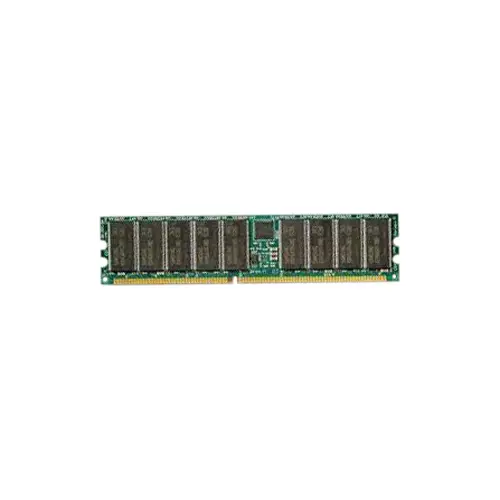
The Micron MT36JSF2G72PZ-1G9E3 is a 16GB DDR3-1866 registered DIMM purpose-built for servers where data integrity and scalability are non-negotiable. Its four defining characteristics directly solve the acute pain points of modern data centers. ECC silently corrects single-bit errors that cosmic radiation or electrical noise can trigger; in a dense virtualization cluster, this prevents an uncorrected bit flip from crashing a critical VM kernel and triggering a costly chain of failovers. The registered buffer multiplexes command and address signals, letting you populate all memory channels with multiple DIMMs without signal degradation—essential when you need hundreds of gigabytes to host memory-hungry in-memory databases like SAP HANA or a farm of Redis nodes. The dual-rank x4 organization interleaves memory accesses and supports chipkill-level resilience, boosting effective bandwidth so your hypervisor juggles dozens of VMs without latency spikes. Finally, the 1866MHz clock speed at CL13 delivers 14.9 GB/s throughput, cutting query response times for real-time analytics platforms. In a financial trading engine, that means fast, accurate decisions instead of silent data corruption that erodes trust. This module translates raw specs into business continuity, making it the cornerstone of a reliable, high-density server deployment.
General Virtualization
For moderate-density VM hosts, deploy six to eight of these 16 GB RDIMMs (96–128 GB total) in a dual-socket server to comfortably support 20–30 light-to-medium VMs. Distribute modules evenly across memory channels—one DIMM per channel—to sustain 1866 MT/s speed and maximize throughput for hypervisor overhead and guest workloads.
In-Memory Database
Populate all available channels with one 16 GB DIMM per channel initially, yielding 128–256 GB depending on the platform, which suits datasets up to roughly 200 GB in RAM. To avoid NUMA-induced latency spikes, balance memory identically across both sockets and ensure the working set fits in DRAM so ECC-registered integrity safeguards in-memory structures without sacrificing access speed.
High-Performance Computing
Configure the server with the maximum number of channels populated (typically 8 DIMMs per node for dual-socket, one per channel) to provide 128 GB of high-bandwidth memory, ideal for memory-bandwidth-bound HPC codes. Dual-rank x4 RDIMMs at 1866 MHz deliver the peak transfer rate the architecture supports; keep an identical spare module on hand to replace any ECC-correctable-error-prone DIMM immediately and preserve node uptime in large clusters.
Rigorously tested, compatible with Dell PowerEdge R720, HP DL380p Gen8, IBM x3650 M4, etc.
Q: Can I mix this MT36JSF2G72PZ-1G9E3 with other memory modules of different brands or speeds?
A: Mixing RDIMMs is not advised. Different timings, ranks, or vendors can cause instability. For mission-critical servers, use identical part numbers to ensure signal integrity and validated performance.
Q: Is this memory compatible with my system?
A: This DDR3-1866 Registered ECC module fits servers using Intel Xeon E5-2600 v2 or select AMD Opteron 6300 platforms. Verify your board supports 1.5V RDIMMs and 240-pin slots before purchasing.
Q: What is the recommended DIMM population order for optimal performance?
A: Populate identical DIMMs per channel, starting furthest from the CPU. For dual-rank x4 modules, follow your server manual’s balanced configuration to enable memory interleaving and maximize throughput.
Q: Does this module support overclocking or XMP profiles?
A: No. This is a JEDEC-compliant server RDIMM with CL13 latency. It does not support XMP or overclocking, as stability and error-free operation are prioritized over frequency adjustments in enterprise environments.
Q: What warranty and typical failure rate can I expect?
A: This module includes a 1-year warranty. Enterprise-grade DRAM has an extremely low annualized failure rate, typically below 0.5%, when operated within specified voltage and thermal limits.