











 Secure payments
Standard refund policy
Trade Assurance
Secure payments
Standard refund policy
Trade Assurance
| Product Type | Memory Module |
|---|---|
| Compliance Standards | RoHS |
| Memory Capacity | 16 GB |
| Memory Technology | DDR3 |
| Product Voltage | 1.5V |
| RAM Speed | 1866MHz |
| RAM Standard | DDR3-1866/PC3-14900 |
| Error Identifying | ECC |
| Signal Type | Registered |
| Column Access Strobe (CAS) | CL13 |
| Rank | Dual Rank x4 |
| Quantity of Pins | 240-pin |
| RAM Genre | RDIMM |
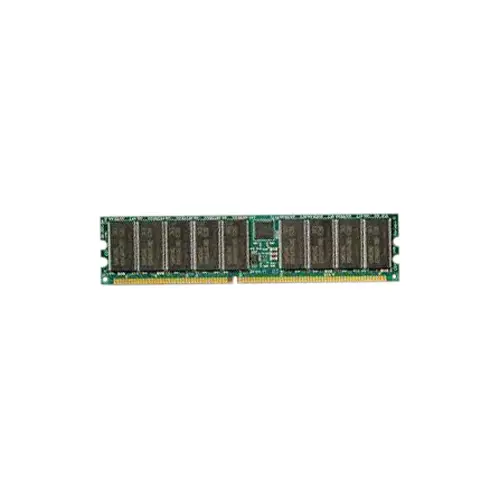
This RDIMM is engineered for server platforms running virtualization, in-memory databases, or any latency-sensitive workload where data integrity is non-negotiable. The registered signal architecture with ECC and dual-rank x4 organization delivers superior signal stability and higher sustained throughput in dense multi-DIMM configurations, while the CL13 latency at 1866MT/s helps keep cache-miss penalties low under heavy memory pressure.
1. ECC correction silently detects and fixes single-bit errors, preserving data integrity for critical workloads like virtualization hosts and financial transaction databases.
2. Registered buffering stabilizes signal integrity across fully populated channels, allowing dense server configurations without compromising memory reliability.
3. 16GB module density strikes an optimal capacity-per-channel balance, enabling higher virtual machine consolidation on hypervisors without exhausting memory slots.
4. 1866 MT/s transfer rate elevates sustained bandwidth, reducing latency in in-memory analytics and accelerating concurrent data access across multiple tenants.
5. Dual-rank x4 organization exploits bank-level parallelism, keeping command pipelines saturated and maintaining consistent throughput under mixed read/write workloads common in cloud infrastructure.
Engineered for mission-critical data centers, the Micron 16GB DDR3-1866 RDIMM (MT36JSF2G72PZ-1G9E1HF) merges four vital features to overcome real server pain points. ECC memory actively corrects single-bit errors, shielding your virtualization cluster from silent data corruption that could corrupt a VM’s memory state and cause unexplained crashes or data loss. The registered clock driver buffers signals, so you can fully populate a server’s memory channels—essential for running dozens of virtual machines or container fleets requiring 256GB+ of stable RAM without signal integrity issues. Its dual-rank x4 architecture interleaves internal banks to reduce access latency, giving in-memory databases like Redis and Memcached a measurable boost in transactions per second, where every microsecond counts. The 1866MHz frequency and CL13 latency deliver 14.9GB/s peak bandwidth, accelerating real-time analytics and business intelligence queries. Simply put, this module translates into uncompromised uptime, enormous density, and consistent low-latency performance for your virtualized and database workloads.
General Virtualization
For consolidated virtualized servers, balance memory channels using identical registered DIMMs. Start with four 16 GB modules (64 GB total) for moderate VM density on a dual-socket system. Scale to eight or sixteen DIMMs (128–256 GB) for heavier workloads; this configuration keeps the 1866 MT/s speed even with two DIMMs per channel when supported, while ECC ensures stability.
In-Memory Database
In-memory databases demand maximum capacity and low latency. Deploy as many of these 16 GB DDR3-1866 Registered DIMMs as the server allows, filling all slots across memory channels. A dual-processor node with 16 modules (256 GB) can host large in-memory datasets, eliminating storage bottlenecks while operating at full 1866 MHz and CL13 timings.
High-Performance Computing (HPC)
HPC workloads thrive on bandwidth. Install a symmetric set of these Dual Rank x4 RDIMMs across all memory channels—typically 8 modules per CPU (128 GB) for quad-channel platforms—to enable full interleaving. This delivers 1866 MT/s per channel, providing the throughput needed for parallel simulations, and registered ECC protects result integrity.
Rigorously tested server DDR3 ECC RDIMM. Compatible with Dell PowerEdge R720/R620, HP ProLiant DL380p Gen8, Lenovo ThinkServer RD630.
Q: Can I mix this MT36JSF2G72PZ-1G9E1HF with other memory modules of different brands or speeds?
A: Mixing is not advised for server environments. Different brands or speeds can cause signal integrity issues, system instability, or boot failures. Always populate channels with identical registered ECC DIMMs.
Q: Is this memory compatible with my system?
A: This is a DDR3-1866 Registered ECC RDIMM intended for servers. Consult your motherboard or system Qualified Vendor List (QVL) to confirm support for this Micron 16GB dual-rank module's specific part number.
Q: What is the recommended DIMM population order for optimal performance?
A: Refer to your server board manual. Typically, populate identical DIMMs per channel starting from the farthest slot from the CPU. This dual-rank x4 module is often installed first for balanced memory configurations.
Q: Does this module support overclocking or XMP profiles?
A: No. This is a server-grade Registered ECC DIMM operating at JEDEC standard DDR3-1866. Overclocking and XMP are unsupported, as enterprise memory prioritizes data integrity and stability over variable speed.
Q: What warranty and typical failure rate can I expect?
A: This module includes a 1-year warranty. As a Micron enterprise RDIMM built to rigorous standards, it delivers a very low annualized failure rate when operated within specified voltage and temperature conditions.