











 Secure payments
Standard refund policy
Trade Assurance
Secure payments
Standard refund policy
Trade Assurance
| Product Type | Memory Module |
|---|---|
| Compliance Standards | RoHS |
| Memory Capacity | 16 GB |
| Memory Technology | DDR3 |
| Product Voltage | 1.5V |
| RAM Speed | 1866MHz |
| RAM Standard | DDR3-1866/PC3-14900 |
| Error Identifying | ECC |
| Signal Type | Registered |
| Column Access Strobe (CAS) | CL13 |
| Rank | Dual Rank x4 |
| Quantity of Pins | 240-pin |
| RAM Genre | RDIMM |
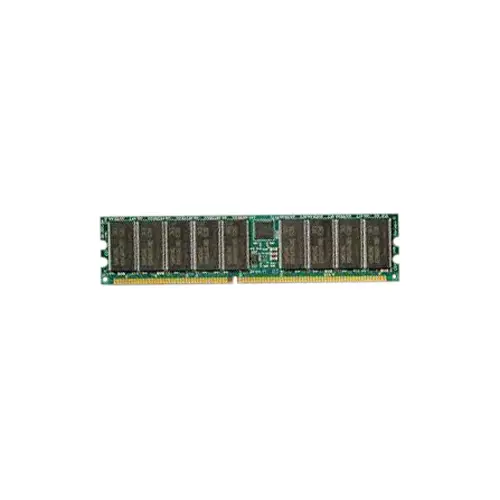
This 16GB DDR3-1866 RDIMM with ECC and registered signaling is engineered for server platforms handling critical workloads such as virtualization, in-memory databases, and data integrity–sensitive applications. Its dual-rank x4 organization boosts bandwidth utilization via memory interleaving, while CL13 low latency and hardware error correction ensure stable, reliable performance under constant 1.5V operation.
1. 16GB capacity provides sufficient headroom for hosting multiple virtual machines on a single node, keeping consolidation ratios high without triggering page-fault stalls.
2. ECC protection transparently corrects single-bit errors in real time, preserving data accuracy for financial ledgers or inventory databases that cannot tolerate silent corruption.
3. Registered buffer reclocks and re-drives signals across fully loaded memory channels, ensuring stable command transmission in 24×7 rack-scale deployments.
4. Dual Rank x4 organization interleaves operations across two internal rank groups, maximizing channel utilization and delivering predictable throughput for in-memory analytics workloads.
5. 1866MHz speed accelerates processor-to-memory throughput, cutting response times for latency-bound cloud services during peak request bursts.
Based on its RDIMM form factor, 240-pin interface, and support for both ECC and registered signaling, the MT36JSF2G72PZ-1G9E3HE is unmistakably built for server-class workloads. For IT architects, its four defining characteristics directly prevent the costly failures that keep them awake at night.
First, ECC error correction continuously detects and corrects single-bit memory errors caused by background radiation. In a dense virtualization cluster hosting dozens of VMs, a silent bit flip in guest memory can corrupt transactions or crash a critical application, yet ECC transforms that risk into a non-event. Second, the registered signal buffer stabilizes the command and address buses when populating all 24 DIMM slots per server. This means your hypervisor can reliably address the 16 GB capacity across multiple channels without signal degradation, a hard requirement when running memory-hungry in-memory databases like SAP HANA or large Redis clusters.
Third, the dual-rank x4 organization interleaves accesses across two internal ranks on the same module, delivering higher sustained bandwidth than single-rank alternatives. For a real-time analytics platform, this translates into faster query responses as the memory controller pipelines data without stalling. Finally, the DDR3-1866 speed at CL13 strikes a deliberate balance between throughput and latency, keeping virtual machine migration times short and database transaction logs flushing smoothly. Instead of theoretical specs, you gain a foundation where data integrity, density, and predictable performance converge to support enterprise services without compromise.
General Virtualization
For moderate-density server virtualization, deploy six of these 16GB RDIMMs across triple-channel memory controllers (96GB total) to comfortably host 20–30 light to medium VMs. Balance DIMMs evenly per CPU socket and leave a few slots open for future expansion, ensuring memory bandwidth does not become a bottleneck for hypervisor overhead.
In-Memory Database
In-memory database engines like Redis or Memcached benefit from both capacity and low latency. Populate all available memory channels with identical 16GB modules—aim for a minimum of 128GB (eight DIMMs) to keep working sets in DRAM. Match DIMM ranks per channel (dual-rank preferred) to maximize throughput, and avoid mixing capacities that could force NUMA imbalances or reduced clock speeds.
High-Performance Computing (HPC)
HPC workloads demand maximum bandwidth and predictable access patterns. Fully populate each memory channel with one 16GB RDIMM per channel to achieve the highest parallel throughput, targeting 64–128GB per node depending on node count and problem size. Opt for dual-rank x4 modules to extract peak memory bandwidth, and configure identical DIMMs across all sockets to maintain symmetric multiprocessing and avoid performance cliffs under heavy floating-point loads.
Rigorously tested 16GB DDR3-1866 RDIMM; compatible with Dell R720, HP DL380p G8, Lenovo RD630.
Q: Can I mix this MT36JSF2G72PZ-1G9E3HE with other memory modules of different brands or speeds?
A: Mixing different brands or speeds with registered ECC memory is strongly discouraged. It may cause system instability, reduced performance, or POST failures in server environments. Always use identical modules for validated reliability.
Q: Is this memory compatible with my system?
A: This DDR3-1866 registered ECC RDIMM is designed for Intel Xeon E5-2600 v2/v3 or AMD Opteron 6300 series platforms. Please verify your server board supports 1.5V 240-pin RDIMMs and 1866MHz operation.
Q: What is the recommended DIMM population order for optimal performance?
A: For dual-rank RDIMMs like this, populate identical modules in matched channels following your server's manual. Typically, balance capacity across memory channels and fill blue slots first to maintain multi-channel interleaving.
Q: Does this module support overclocking or XMP profiles?
A: No. Server-class registered ECC memory operates at JEDEC standard timings only. Enabling XMP or overclocking could jeopardize data integrity, which is unacceptable in mission-critical environments.
Q: What warranty and typical failure rate can I expect?
A: This module includes a one-year warranty and an extremely low annualized failure rate (AFR), typically below 0.5%. Enterprise-grade testing and error correction ensure dependable operation under 24/7 workload conditions.