











 Secure payments
Standard refund policy
Trade Assurance
Secure payments
Standard refund policy
Trade Assurance
| Product Type | Memory Module |
|---|---|
| Memory Capacity | 16 GB |
| Memory Technology | DDR4 |
| Product Voltage | 1.2V |
| RAM Speed | 2133MHz |
| RAM Standard | DDR4-2133/PC4-17000 |
| Error Identifying | ECC |
| Signal Type | Registered |
| Column Access Strobe (CAS) | CL15 |
| Rank | Dual Rank x4 |
| Quantity of Pins | 288-pin |
| RAM Genre | RDIMM |
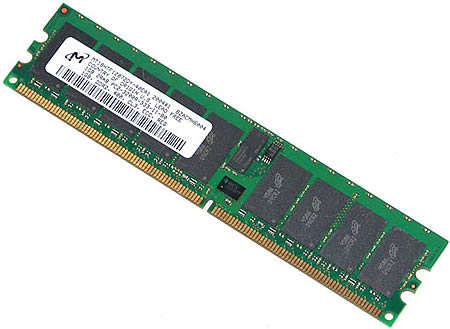
This Micron 16GB DDR4-2133 RDIMM, featuring Registered ECC and a dual-rank x4 organization, delivers the data integrity and signal stability essential for virtualization clusters and in-memory databases. Its CL15 latency and 1.2V low-power operation make it ideally suited for dense server deployments where reliability under sustained, heavy workloads is critical.
1. ECC protection actively detects and corrects single-bit memory errors, safeguarding transactional databases and financial computations from silent data corruption.
2. Registered signaling buffers the command and address lines, enabling large-scale server deployments to populate numerous DIMMs per channel without compromising signal integrity.
3. Dual Rank x4 organization boosts memory bandwidth efficiency through interleaving, which sustains high throughput in virtualized environments running dense containerized workloads.
4. Sixteen-gigabyte capacity per module expands the memory footprint for in-memory analytics and caching tiers, allowing more virtual machines to reside on a single physical host.
5. DDR4-2133 speed with CL15 latency delivers a balanced, power-efficient data rate that aligns with power-conscious data center operations while still feeding modern multi-core server CPUs.
The MTA36ASF2G72PZ-2G1A5 is an enterprise-grade 16GB DDR4-2133 RDIMM built for server workloads. Its four key attributes — ECC, registered buffer, dual-rank x4 design, and 1.2V operation — directly solve critical data center pain points. ECC silently corrects single-bit errors caused by background radiation, preventing silent data corruption that could crash a virtualized SQL database mid-transaction and avoid costly service interruptions. The registered clock driver stabilizes heavy memory loads; you can fully populate all channels in a dual-socket virtualization host with confidence, supporting hundreds of VMs without signal degradation or unexpected reboots. The dual-rank x4 architecture utilizes more internal banks for aggressive bank interleaving, dramatically boosting concurrent throughput for in-memory databases like Redis or SAP HANA where every microsecond of latency counts during real-time analytics. The 1.2V low voltage reduces overall power draw and thermal output across packed server racks, directly lowering your cooling bill and extending component lifespan. In your data center, this module isn’t just memory — it’s a foundation for hardened uptime, massive scalability, and energy-smart performance.
The specified module is a 16GB DDR4-2133 ECC Registered DIMM (RDIMM), clearly targeting server platforms. Its error correction and registered signaling are essential for maintaining data integrity under sustained loads. Below are capacity planning guidelines for typical server workloads.
General Virtualization
Virtualized environments thrive on memory density. Populate all available channels with 16GB RDIMMs to reach 128GB or 256GB per host, balancing VM density with per-core memory ratios. Leave at least one DIMM slot free per channel for future scaling without replacing existing modules.
In-Memory Database
Capacity and reliability are paramount. Fill every DIMM slot with identical 16GB RDIMMs to maximize capacity while maintaining uniform rank interleaving. Configure memory mirroring or sparing if the platform supports it, sacrificing raw capacity for fail-over protection critical to database uptime.
High-Performance Computing
HPC favors bandwidth over capacity in many workloads. Install one DIMM per memory channel across all sockets to enable full interleaving, and keep the same dual-rank x4 configuration for consistent latency. Although 2133MT/s is modest, populating all channels helps achieve the throughput needed for parallel computations.
Rigorously tested server memory. Compatible with Dell PowerEdge R740, HPE ProLiant DL380 Gen10, Lenovo ThinkSystem SR650.
Q: Can I mix this MTA36ASF2G72PZ-2G1A5 with other memory modules of different brands or speeds?
A: Mixing memory in servers is not recommended. Even same-spec modules from different brands can cause stability issues. All DIMMs should match vendor, speed, rank, and timings to ensure reliable operation in registered ECC environments.
Q: Is this memory compatible with my Intel or AMD server platform?
A: This DDR4-2133 RDIMM with ECC is designed for Intel Xeon E5-2600 v3/v4 and select AMD EPYC platforms. Verify your system board’s qualified vendor list, as registered memory requires chipset and processor support for ECC functionality.
Q: What is the recommended DIMM population order for optimal performance?
A: For dual-processor servers, populate identical DIMMs per channel starting with the farthest slot from the CPU. Follow the motherboard manual’s memory configuration guide to balance channels and maximize interleaving with these dual-rank modules.
Q: Does this module support overclocking or XMP profiles?
A: No, this is an enterprise-grade registered DIMM operating at JEDEC-standard DDR4-2133. It does not support overclocking or XMP, as it prioritizes data integrity and 24/7 stability over raw frequency adjustments in server environments.
Q: What warranty and typical failure rate can I expect?
A: This module includes a one-year warranty. Typical annualized failure rate for Micron RDIMMs is below 0.5% under rated conditions, reflecting strict component screening and burn-in testing for mission-critical server deployments.