











 Secure payments
Standard refund policy
Trade Assurance
Secure payments
Standard refund policy
Trade Assurance
| Product Type | Memory Module |
|---|---|
| Memory Capacity | 16 GB |
| Memory Technology | DDR4 |
| Product Voltage | 1.2V |
| RAM Speed | 2133MHz |
| RAM Standard | DDR4-2133/PC4-17000 |
| Error Identifying | ECC |
| Signal Type | Registered |
| Column Access Strobe (CAS) | CL15 |
| Rank | Dual Rank |
| Quantity of Pins | 288-pin |
| RAM Genre | RDIMM |
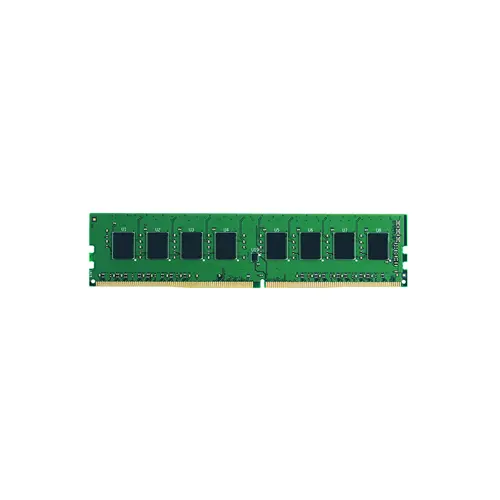
This 16GB DDR4-2133 RDIMM with ECC and registered signal type is ideally suited for server platforms running memory-intensive workloads such as virtualization, in-memory databases, and mission-critical enterprise applications where data integrity is paramount. Its dual-rank configuration enhances memory interleaving for improved bandwidth efficiency, while the CL15 latency ensures consistently low access times under sustained load.
1. ECC detection and correction eliminates single-bit memory errors in real time, ensuring transactional integrity for mission-critical databases and preventing silent data corruption that could destabilize long-running virtualization hosts.
2. Registered signal buffering stabilizes command and address lines under heavy DIMM populations, enabling large-scale server deployments with multi-terabyte capacity while preserving uptime during sustained enterprise workloads.
3. A 16GB per-module density balances slot efficiency and capacity headroom, letting hypervisors host more virtual machines per socket to drive down cost per workload in consolidated cloud environments.
4. Dual Rank interleaving overlaps internal bank accesses to saturate the memory channel, delivering consistent throughput for multi-threaded applications such as in-memory caches and concurrent user request processing.
5. DDR4-2133 speed delivers a steady seventeen gigabyte-per-second peak bandwidth per channel, feeding high-core-count processors with predictable data streams needed for real-time analytics and decision-support systems.
The BZAH7PW002 is a server-grade DDR4-2133 Registered DIMM built for the relentless demands of modern data centers. Its ECC technology actively detects and corrects single-bit memory errors in real time, which means your virtualized database clusters never suffer silent data corruption that could crash financial transactions or corrupt indexing in an in-memory database like Redis. Registered buffering decouples the memory controller from the electrical load of numerous modules, allowing you to fully populate all 24 DIMM slots in a 2U VMware or Hyper-V host without signal degradation. This directly guarantees round-the-clock stability when dozens of virtual machines are competing for resources. The dual-rank design internally interleaves memory banks, effectively boosting accessible bandwidth during large-scale analytical queries in SAP HANA, enabling faster insights and higher user concurrency. Combined with a power-sipping 1.2V operating voltage that cumulatively slashes cooling costs across a full rack, this module turns your infrastructure investment into a predictable, lower-TCO foundation—keeping critical services available and your data accurate at all times.
General Virtualization
For general virtualization hosts, balance memory density and cost by deploying four 16GB RDIMMs per CPU socket, providing 64GB per node. This configuration populates one DIMM per channel in a typical quad-channel architecture, ensuring stable registered ECC operation without over-provisioning memory bandwidth. Scale to eight modules (128GB) when consolidating more VMs, always adhering to identical dual-rank DIMMs for uniform interleaving.
In-Memory Database
In-memory databases demand both capacity and low latency, so populate all channels with 16GB dual-rank RDIMMs to saturate memory bandwidth. A minimum of eight modules (128GB) per socket is recommended for moderate datasets, but plan for 16 x 16GB (256GB) to hold larger working sets entirely in RAM. Maintain 1 DIMM per channel (1DPC) at the rated 2133MHz speed to avoid clock speed downgrades and preserve CL15 timings.
High-Performance Computing
HPC workloads benefit from maximized memory bandwidth, making balanced channel population critical. Install 16GB RDIMMs in a power-of-two count per socket—typically six or eight modules for triple- or quad-channel designs—to enable full memory interleaving. For capacity-bound simulations, scale to 16 x 16GB (256GB) per node, keeping all modules identical dual-rank 1.2V registered ECC DIMMs to ensure uniform thermal characteristics and reliability under sustained load.
This server memory has been rigorously tested and is compatible with Dell PowerEdge R730, HPE DL380 Gen9, Lenovo x3650 M5.
Q: Can I mix this BZAH7PW002 with other memory modules of different brands or speeds?
A: Mixing RDIMMs of different brands or speeds is not recommended, as it may cause signal integrity issues and system instability. For ECC registered memory, uniform modules ensure reliable validation and consistent performance.
Q: Is this memory compatible with my Intel Xeon or AMD EPYC server platform?
A: This DDR4-2133 RDIMM is designed for Intel Xeon E5-2600 v3/v4 and select AMD EPYC platforms with 288-pin slots. Confirm your motherboard’s memory QVL and ECC support for guaranteed compatibility.
Q: What is the recommended DIMM population order for optimal performance?
A: For dual-socket servers, populate identical RDIMMs per channel starting with the furthest slot from the CPU. Follow your system’s memory population guide to balance channels and enable full memory bandwidth.
Q: Does this module support overclocking or XMP profiles?
A: No. This is a JEDEC-compliant registered ECC DIMM operating at fixed 2133MHz with CL15 timings. It does not support XMP or overclocking, which are incompatible with enterprise server stability requirements.
Q: What warranty and typical failure rate can I expect?
A: This module includes a one-year warranty. As an enterprise-grade RDIMM, its AFR (annualized failure rate) is typically below 0.5% under proper thermal conditions, ensuring long-term mission-critical reliability.