











 Secure payments
Standard refund policy
Trade Assurance
Secure payments
Standard refund policy
Trade Assurance
| Model | MTA18ADF2G72PDZ-2G3 |
|---|---|
| Product Type | Memory Module |
| Compliance Standards | RoHS |
| Memory Capacity | 16 GB |
| Memory Technology | DDR4 |
| Product Voltage | 1.2V |
| RAM Speed | 2400MHz |
| RAM Standard | DDR4-2400/PC4-19200 |
| Error Identifying | ECC |
| Signal Type | Registered |
| Column Access Strobe (CAS) | CL17 |
| Rank | Dual Rank x8 |
| Quantity of Pins | 288-pin |
| RAM Genre | VLP RDIMM |
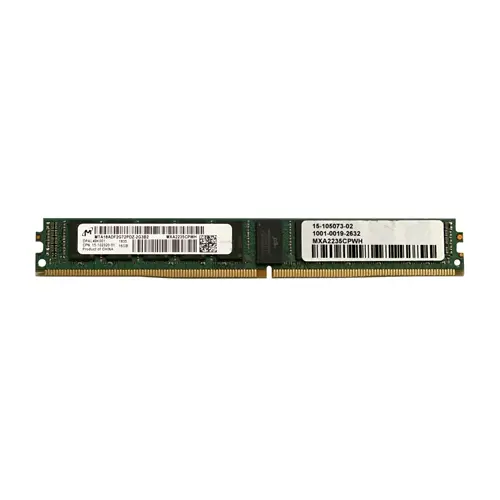
This Micron 16GB VLP RDIMM (DDR4-2400, CL17) is purpose-built for dense server environments, where its 1.2V low-power design, registered signal integrity, and ECC error correction safeguard data in virtualization clusters, in-memory databases, and mission-critical workloads. The dual-rank x8 organization optimizes memory bandwidth and electrical loading on the memory bus, while the very low-profile form factor ensures compatibility with compact 1U rack servers and blade enclosures.
1. ECC protection guards against in-memory bit flips, safeguarding transactional data and preventing silent corruption in mission-critical enterprise applications.
2. Registered signal buffering strengthens command and address integrity across densely populated server motherboards, enabling stable operation with massive memory footprints.
3. Very low profile form factor preserves airflow in compact rackmount enclosures, reducing thermal stress and extending service life in always-on data center environments.
4. Dual rank organization leverages interleaving to boost effective bandwidth, ensuring responsive execution of concurrent virtual machines under sustained load.
5. Sixteen-gigabyte capacity per module allows high-density virtualization hosts to maximize guest-per-node ratios while reserving DIMM slots for future scaling.
When you deploy this Micron MTA18ADF2G72PDZ-2G3 16GB DDR4-2400 VLP RDIMM in your server infrastructure, you are not just installing memory; you are reinforcing the foundation of your data center’s reliability, density, and performance. The module’s ECC technology actively detects and corrects single-bit memory errors caused by background radiation, a silent threat that can corrupt financial transactions or silently flip a database index without warning. Combined with registered signal buffering, it stabilizes the command and address busses when you fully populate a virtualization host with dozens of dual-rank DIMMs, enabling you to run substantially more virtual machines per server without memory-related crashes.
The dual-rank x8 organization utilizes interleaving to parallelize data access, which directly boosts throughput for in-memory databases like Redis or SAP HANA where microsecond latency gaps translate into lost revenue. Moreover, the very low-profile form factor is critical inside 1U rack servers and blade enclosures; it reduces the thermal shadow in front of your cooling airflow, allowing hot-swappable storage and CPUs to breathe. In a dense virtualization cluster or a round-the-clock analytics node, these four attributes work together to keep your services online, your data uncorrupted, and your operating costs lower through improved thermal management and sustained memory bandwidth.
General Virtualization
This 16GB VLP RDIMM is well-suited for dense virtualization hosts. A balanced configuration for a dual-socket server would be 16 identical modules (256GB total), populating one DIMM per channel to maintain one DIMM per channel (1DPC) performance while leaving room for future expansion. This provides ample capacity for 20–30 typical virtual machines without overcommitting memory.
In-Memory Database
For in-memory databases like Redis or SAP HANA, high capacity and data integrity are critical. Start with 16 modules (256GB) across both sockets to leverage full memory bandwidth, then scale to 32 modules (512GB) if larger datasets are needed. ECC and registered signaling ensure stability under persistent, latency-sensitive workloads, and dual-rank DIMMs deliver a good balance between capacity and access speed.
High-Performance Computing
In HPC environments, memory bandwidth often limits performance. Populate all memory channels symmetrically—8 modules per socket (128GB per CPU) for dual-socket nodes—to maximize interleaving. The low-profile (VLP) form factor is ideal for 1U nodes with restricted airflow, while ECC corrects silent data corruption during long-running simulations, safeguarding computational integrity.
Rigorously tested, compatible with Dell PowerEdge R740, HPE ProLiant DL380 Gen10, and similar servers.
Q: Can I mix this MTA18ADF2G72PDZ-2G3 with other memory modules of different brands or speeds?
A: Mixing is not recommended for server environments. Mismatched RDIMMs can cause instability or POST failures. For optimal RAS, use identical modules with the same part number, rank, and speed.
Q: What server platforms support this MTA18ADF2G72PDZ-2G3 memory?
A: It is compatible with Intel Xeon Scalable and AMD EPYC platforms supporting DDR4-2400 ECC RDIMMs. Please consult your motherboard’s memory QVL for validated configurations to ensure correct compatibility.
Q: What is the recommended DIMM population order for optimal performance?
A: Follow your server board guidelines; typically populate identical RDIMMs per channel starting with the furthest slot. For dual-socket systems, balance memory evenly across both CPUs according to the manual.
Q: Does this module support overclocking or XMP profiles?
A: No, it adheres strictly to JEDEC DDR4-2400 standard. ECC Registered memory does not support overclocking or XMP profiles; operational stability and data integrity are critical in server applications.
Q: What warranty and typical failure rate can I expect?
A: This module includes a one-year warranty. It delivers enterprise-grade reliability with a very low AFR (annualized failure rate) under normal operating conditions, ensuring stable long-term server operation.