











 Secure payments
Standard refund policy
Trade Assurance
Secure payments
Standard refund policy
Trade Assurance
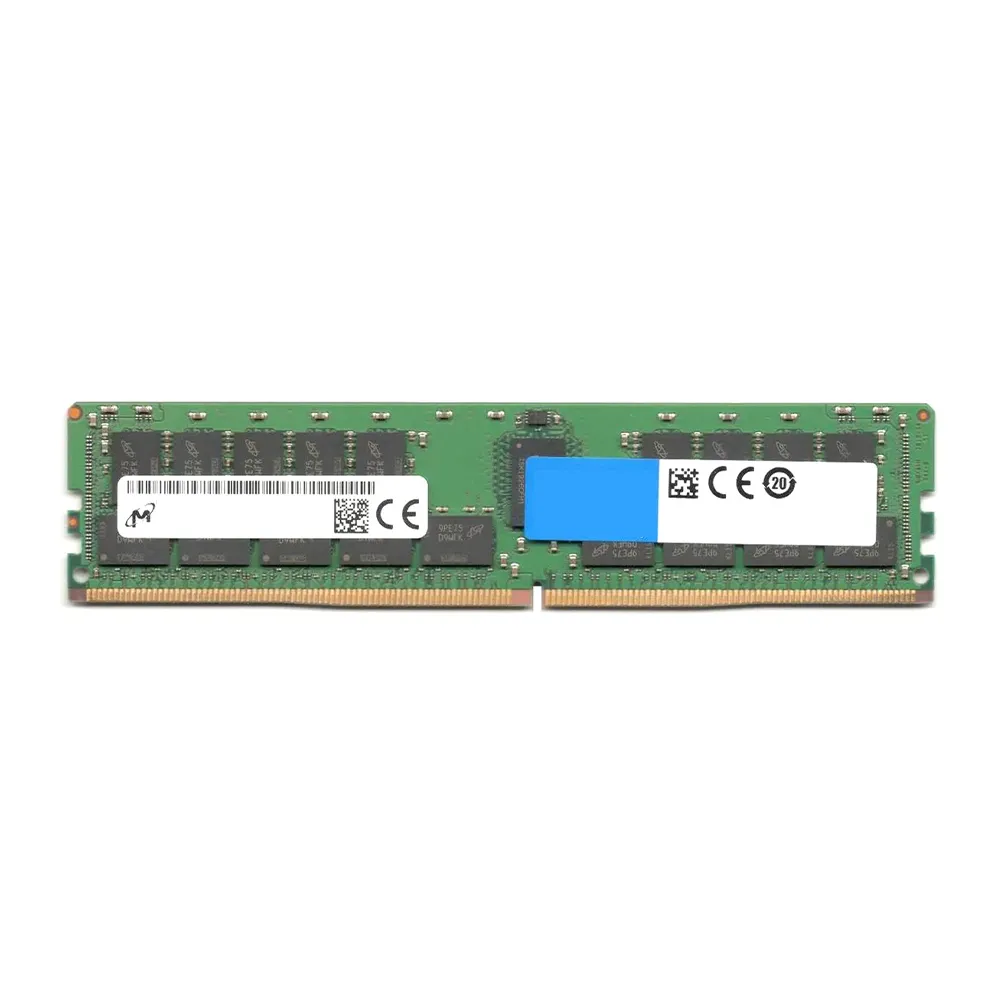
| Product Type | Memory Module |
|---|---|
| Memory Capacity | 16 GB |
| Memory Technology | DDR4 |
| Product Voltage | 1.2V |
| RAM Speed | 2400MHz |
| RAM Standard | DDR4-2400/PC4-19200 |
| Error Identifying | ECC |
| Signal Type | Registered |
| Column Access Strobe (CAS) | CL17 |
| Rank | Dual Rank x8 |
| Quantity of Pins | 288-pin |
| RAM Genre | RDIMM |
Registered ECC memory like this 16GB DDR4-2400 RDIMM is tailored for server platforms demanding uncompromising data integrity, making it ideal for virtualization and in-memory databases where silent data corruption is unacceptable. Its dual-rank x8 organization and registered signal buffering enhance electrical stability and bank-level parallelism, sustaining reliable throughput under heavy, concurrent workloads.
1. ECC error correction safeguards data integrity by detecting and fixing single-bit memory faults, preventing silent data corruption in transactional databases and long-running analytics jobs.
2. Registered signal buffering allows the memory controller to drive more DIMMs per channel reliably, which is fundamental for scaling up memory footprints in virtualization hosts and in-memory computing clusters.
3. Dual Rank x8 organization keeps the memory banks interleaved for higher bandwidth efficiency, helping sustain throughput when multiple VMs compete for shared memory resources.
4. PC4-19200 peak bandwidth delivers 19.2 GB/s of memory throughput, matching the needs of moderate-duty application servers where consistent low-latency access outweighs raw capacity.
5. The 16 GB capacity offers a practical building block for hyper-converged nodes, giving enough headroom for simultaneous OS, caching, and container workloads without overspending on idle DIMM slots.
As a server-class Registered DIMM, the MTA18ASF2G72PDZ-2G3A1MG is purpose-built for enterprise workloads where downtime is not an option. Its ECC technology actively detects and corrects single-bit memory errors, protecting against silent data corruption caused by cosmic radiation or electrical noise — a critical safeguard when a flipped bit in a financial database or a virtualized customer records system could translate into costly miscalculations or transaction rollbacks. The registered signal buffer stabilizes the command and address lines, enabling the memory controller to reliably drive multiple modules per channel. In a dense virtualization cluster running dozens of VMs on a single node, this means you can populate all 24 DIMM slots without sacrificing signal integrity, maintaining consistent low-latency access across the entire memory pool. The dual-rank x8 organization further amplifies performance: by interleaving data accesses across two internal ranks, the module delivers higher sustained bandwidth for memory-intensive in-memory databases like SAP HANA or Redis, where sub-millisecond response times are vital. Combined with the 1.2V DDR4-2400 operation, it delivers a balance of power efficiency and predictable throughput, ensuring your servers stay responsive under peak analytical loads without thermal throttling.
General Virtualization
For dense virtualization hosts, populate at least eight of these 16 GB Registered ECC modules across all memory channels to achieve 128 GB total capacity while maintaining balanced NUMA access. This configuration supports 25–40 moderate VMs per host and leaves spare DIMM slots for future scale-out without sacrificing memory bandwidth.
In-Memory Database
In-memory databases such as Redis or SAP HANA demand large, fault-resilient footprints; install the maximum supported count of these dual-rank RDIMMs to reach 256 GB–512 GB per socket. The combination of ECC and registered signaling protects critical in-flight data and allows the memory controller to sustain high transaction rates under full population.
High-Performance Computing (HPC)
HPC workloads favor bandwidth over raw capacity, so populate one DIMM per channel in every memory channel to unlock peak memory interleaving. A typical dual-socket node would receive twelve 16 GB modules (192 GB total), delivering the low-latency, high-throughput access required by tightly coupled MPI jobs and computational fluid dynamics solvers.
Rigorously tested and certified for Dell PowerEdge R740, R750, HPE DL380 Gen10, Lenovo SR650, Supermicro X11 systems.
Q: Can I mix this MTA18ASF2G72PDZ-2G3A1MG with other memory modules of different brands or speeds?
A: Mixing with other brands or speeds is not recommended for this ECC Registered DIMM. Uniform modules ensure signal integrity, memory channel balance, and reliable server operation. Mismatched timings may lead to instability or uncorrected errors.
Q: Is this memory compatible with my system?
A: This DDR4-2400 ECC RDIMM is designed for server platforms with Intel Xeon E5-2600 v3/v4 or AMD EPYC 7001 series processors. Confirm your server board supports 288-pin Registered DIMMs and a 1.2 V operating voltage.
Q: What is the recommended DIMM population order for optimal performance?
A: Follow your server manual for slot order. Typically, populate identical DIMMs per channel starting from the slots farthest from the CPU, filling all channels symmetrically to enable balanced interleaving and maximum memory bandwidth.
Q: Does this module support overclocking or XMP profiles?
A: No, this is a JEDEC-compliant DDR4-2400 server module without XMP or overclocking capabilities. It prioritizes data integrity and 24/7 stability through ECC and registered signaling, which lock timings to standard specifications.
Q: What warranty and typical failure rate can I expect?
A: The module includes a 1-year warranty. As a Micron enterprise-grade RDIMM, it exhibits a very low annualized failure rate under specified thermal and electrical conditions, ensuring dependable long-term server operation.