











 Secure payments
Standard refund policy
Trade Assurance
Secure payments
Standard refund policy
Trade Assurance
| Product Type | Memory Module |
|---|---|
| Memory Capacity | 16 GB |
| Memory Technology | DDR4 |
| Product Voltage | 1.2V |
| RAM Speed | 2400MHz |
| RAM Standard | DDR4-2400/PC4-19200 |
| Error Identifying | ECC |
| Signal Type | Registered |
| Column Access Strobe (CAS) | CL17 |
| Rank | Dual Rank x8 |
| Quantity of Pins | 288-pin |
| RAM Genre | RDIMM |
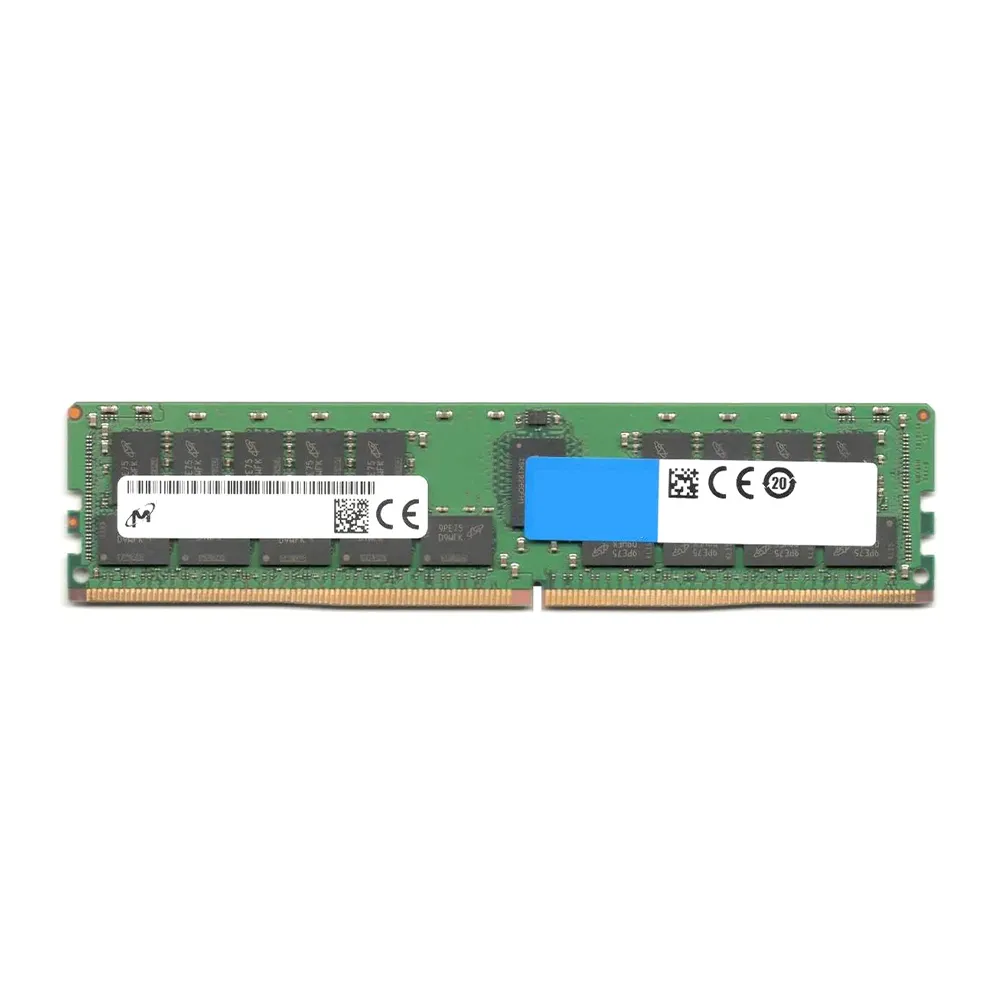
Designed for server platforms, this DDR4-2400 RDIMM is ideally suited for memory-intensive workloads such as virtualization and in-memory databases where data integrity is critical. Its dual-rank x8 organization improves memory interleaving for higher effective bandwidth, while the combination of ECC and registered signal buffering ensures reliable operation and robust error correction in dense, multi-DIMM configurations.
1. ECC protection guards against single-bit memory faults in real time, preserving data integrity for transactional databases and virtualization hosts that cannot tolerate silent corruption.
2. Registered signaling buffers command and address lines, ensuring stable operation when populating high-density server memory channels across multiple DIMMs per channel.
3. Dual-rank x8 organization interleaves memory banks to increase effective bandwidth, directly benefiting consolidated VM throughput and large in-memory workloads.
4. This module’s capacity expands the memory footprint available to hypervisors, raising guest density per node and improving total cost of ownership in scale-out deployments.
5. The rated speed provides consistent DRAM throughput for latency-sensitive caching and analytics engines, sustaining performance under concurrent enterprise workloads.
Engineered for the rigors of enterprise computing, the Micron MTA18ASF2G72PDZ-2G3B1IK is a DDR4-2400 registered DIMM that directly addresses the critical demands of server infrastructure. Its ECC technology continuously detects and corrects single-bit memory errors, an absolute necessity when you are running in-memory databases like SAP HANA or Redis, where even one undetected bit flip can corrupt transactional data, lead to costly application failures, and undermine business decisions. The registered signal buffer provides the electrical stability needed to support large-capacity configurations across multiple DIMMs. In a dense virtualization cluster hosting dozens of VMs on a single node, this buffering prevents signal degradation that would otherwise cause random reboots and mysterious performance lags, ensuring predictable uptime under heavy load. The dual-rank x8 organization further boosts your performance density by enabling interleaved access, which lowers effective latency and increases sustained bandwidth for read-intensive analytics workloads. Finally, the low 1.2-volt operating specification directly reduces power draw per DIMM. Aggregated across a fully-populated server rack, this translates into tangible savings on energy bills and significantly lessened thermal stress, allowing your cooling infrastructure to operate more efficiently and reliably around the clock.
General Virtualization
For a virtualization host, populate six or eight identical 16 GB RDIMMs across balanced memory channels to achieve 96–128 GB total capacity. This registered ECC configuration ensures data integrity under mixed VM workloads and leaves room for moderate overcommitment, while a dual‑rank x8 layout optimizes bandwidth per channel.
In-Memory Database
Low‑latency datasets demand maximum capacity and reliability. Deploy at least twelve modules for 192 GB in a 1 DIMM per channel (1DPC) configuration, preserving 2400 MT/s speed without downgrading to 2DPC. ECC and registered buffering provide the fault tolerance essential for Redis or SAP HANA environments where every bit must be correct.
High Performance Computing
HPC nodes require balanced memory bandwidth for parallel floating‑point throughput. Install eight modules across all channels with one DIMM per channel, delivering a total of 128 GB at full speed. The dual‑rank x8 design and CL17 latency sustain steady stream performance under MPI‑driven simulations, while registered signaling stabilizes dense multi‑socket configurations.
Rigorously tested, this ECC RDIMM is compatible with Dell PowerEdge R640, R740, HPE ProLiant DL380 Gen10, and Lenovo ThinkSystem SR650.
Q: Can I mix this MTA18ASF2G72PDZ-2G3B1IK with other memory modules of different brands or speeds?
A: Mixing RDIMMs with different brands or speeds is not recommended. It can cause system instability, POST failures, or unbootable states. All modules should match in speed, rank, and timings for validated reliability.
Q: Is this memory compatible with my Intel or AMD server platform?
A: This DDR4 ECC Registered DIMM is designed for servers supporting 2400MT/s RDIMMs. It requires a platform with an appropriate chipset and CPU, such as Intel Xeon E5-2600 v3/v4 or AMD EPYC 7001 series.
Q: What is the recommended DIMM population order for optimal performance?
A: Populate identical DIMMs per channel, starting with the farthest slot from the CPU. For dual-processor boards, balance memory across both sockets. Always consult your server’s manual for balanced memory configs and channel interleaving.
Q: Does this module support overclocking or XMP profiles?
A: No. This is an enterprise-grade RDIMM with ECC, built for stability and data integrity at JEDEC standard 2400MHz. It does not support overclocking or XMP profiles, which are typically for unbuffered consumer memory.
Q: What warranty and typical failure rate can I expect?
A: This module comes with a 1-year warranty. Enterprise RDIMMs have very low annualized failure rates (AFR), typically under 0.5%, when operated within specified voltage and temperature ranges in validated server platforms.