











 Secure payments
Standard refund policy
Trade Assurance
Secure payments
Standard refund policy
Trade Assurance
| Product Type | Memory Module |
|---|---|
| Memory Capacity | 16 GB |
| Memory Technology | DDR4 |
| Product Voltage | 1.2V |
| RAM Speed | 2400MHz |
| RAM Standard | DDR4-2400/PC4-19200 |
| Error Identifying | ECC |
| Signal Type | Registered |
| Column Access Strobe (CAS) | CL17 |
| Rank | Dual Rank x8 |
| Quantity of Pins | 288-pin |
| RAM Genre | RDIMM |
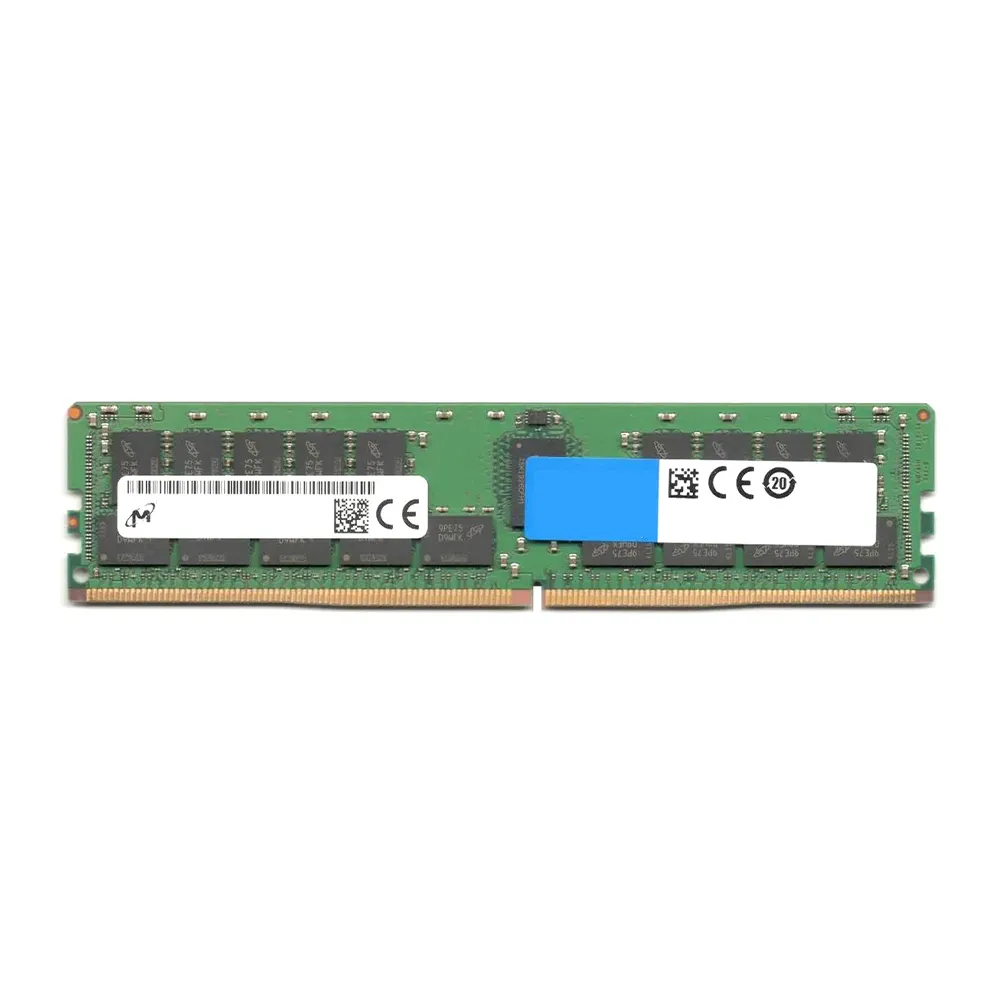
This Micron 16GB DDR4-2400 RDIMM is designed for enterprise server platforms, where its ECC and registered architecture ensure data integrity and signal stability under heavy, multi-DIMM memory configurations typical of virtualization and in-memory database workloads. The dual-rank x8 organization enhances memory bandwidth through interleaving, while the tight CL17 latency and 1.2V power efficiency make it a reliable choice for capacity-optimized deployments.
1. ECC protection performs real-time single-bit error correction, silently preventing memory corruption that would otherwise destabilize transactional databases and critical enterprise applications.
2. The registered signal buffering isolates the memory controller from electrical loading, enabling fully populated server channels with stable command integrity at scale.
3. Dual rank x8 organization alternates access across internal bank groups, saturating throughput to maintain low latency even as virtualization density spikes per host.
4. A 16GB module expands per-slot capacity to support memory-hungry SaaS workloads and large in-memory caches, maximizing container consolidation without immediate platform replacement.
5. The 1.2V supply voltage significantly reduces energy per DIMM, trimming overall rack power consumption and cooling requirements in continuously operating data center environments.
Based on its RDIMM form factor, ECC support, and registered signal type, this is unmistakably a server-grade memory module purpose-built for enterprise environments. The four defining characteristics of the MTA18ASF2G72PDZ-2G3D1SG directly address the non-negotiable demands of data centers and mission-critical workloads.
The integrated ECC engine corrects single-bit memory errors in real time, silently shielding your virtualized clusters and financial transaction databases from the cosmic-ray-induced bit flips that can crash a hypervisor or corrupt a ledger. Registered logic buffers the command and address signals, allowing the memory controller to drive multiple high-capacity DIMMs per channel without electrical degradation; for you, this means confidently populating a 24-slot server running dozens of VMs and never worrying about signal integrity. The dual-rank x8 organization staggers internal bank accesses on each module, delivering a tangible boost in sustained bandwidth under heavy loads; an in-memory database like Redis or SAP HANA can retrieve and update records noticeably faster when rank interleaving is at work. Finally, the DDR4-standard 1.2V operating voltage minimizes power draw and thermal output across a fully loaded node, driving down your TCO through reduced cooling costs and improved energy efficiency in a 24/7 environment where every watt on the balance sheet counts. This memory turns theoretical specifications into reliable, round-the-clock business continuity.
General Virtualization
For dense VM hosting, populate all memory channels symmetrically with these 16 GB RDIMMs to maximize capacity while maintaining balanced interleaving. Aim for one DIMM per channel (1DPC) at 2400 MHz to avoid speed degradation, which typically yields 128–256 GB per socket in dual-socket builds, ensuring ample headroom for moderate overcommitment.
In-Memory Database
Latency-sensitive in-memory databases benefit from the Registered ECC protection and dual‑rank x8 organization, which offers higher bank-level parallelism. Deploy six or eight identical modules per CPU to saturate memory channels, targeting 192–256 GB total per node; this configuration keeps the entire working set in DRAM and prevents swap-induced stalls.
High-Performance Computing
HPC workloads demand maximum bandwidth, so install one DIMM per channel across all available slots to reach peak throughput. Dual‑rank modules at 2400 MHz deliver slightly better sustained bandwidth than single‑rank alternatives, and ECC guarantees result integrity during week-long simulation runs—plan for 128 GB per socket as a sweet spot before scaling out across the cluster.
Rigorously tested. Verified compatible with Dell PowerEdge R760, HPE ProLiant DL380 Gen10, Lenovo ThinkSystem SR650, and more.
Q: Can I mix this MTA18ASF2G72PDZ-2G3D1SG with other memory modules of different brands or speeds?
A: Mixing this ECC Registered RDIMM with modules of different brands or speeds is not recommended. It may cause POST failures or signal integrity issues, compromising server stability. For reliable operation, populate with identical Micron part numbers.
Q: Is this memory compatible with my system?
A: This DDR4-2400 RDIMM is compatible with platforms supporting ECC Registered memory, such as Intel Xeon Scalable or AMD EPYC 7000 series. Always verify your server motherboard's qualified vendor list (QVL) to ensure validated compatibility and optimal performance.
Q: What is the recommended DIMM population order for optimal performance?
A: For dual-socket server boards, populate identical DIMMs per channel starting with the furthest slot from the CPU. Follow your platform's memory population guide to enable balanced interleaving across memory channels and maximize throughput.
Q: Does this module support overclocking or XMP profiles?
A: No. This is a JEDEC-compliant ECC Registered server module running at standard 2400 MHz. It does not support overclocking or Intel XMP profiles, as enterprise reliability and data integrity take precedence over performance tuning.
Q: What warranty and typical failure rate can I expect?
A: This module includes a one-year warranty. Micron RDIMMs demonstrate very low annualized failure rates in server environments, typically under 0.5%, ensuring dependable operation under sustained workloads when installed in compliant systems.