











 Secure payments
Standard refund policy
Trade Assurance
Secure payments
Standard refund policy
Trade Assurance
| Product Type | Memory Module |
|---|---|
| Memory Capacity | 16 GB |
| Memory Technology | DDR4 |
| Product Voltage | 1.2V |
| RAM Speed | 2400MHz |
| RAM Standard | DDR4-2400/PC4-19200 |
| Error Identifying | ECC |
| Signal Type | Registered |
| Column Access Strobe (CAS) | CL17 |
| Rank | Dual Rank x4 |
| Quantity of Pins | 288-pin |
| RAM Genre | RDIMM |
Optimized for virtualized environments and in-memory databases, this 16GB DDR4-2400 RDIMM leverages registered ECC technology to ensure data integrity in multi-DIMM server configurations. Its dual-rank x4 organization and CL17 latency provide a balanced mix of capacity per channel and reliable signal integrity, making it ideal for enterprise-class platforms that demand 24/7 stability under heavy, transactional workloads.
1. ECC memory actively detects and corrects single-bit data errors, preserving the integrity of financial transactions and long-running database operations in always-on enterprise servers.
2. Registered signal buffering stabilizes the command and address buses, allowing densely populated memory configurations without compromising signal quality in multi-socket virtualization hosts.
3. Generous capacity per module supports higher virtual machine consolidation ratios, so more business workloads run simultaneously before a physical server runs short of memory.
4. Dual-rank architecture keeps the memory channel fully saturated, delivering consistent bandwidth for real-time analytics and large in-memory caches under heavy consolidation.
5. Mid-range data rate supplies steady throughput that balances performance with thermal headroom in rack-dense deployments, helping maintain service level agreements without excessive cooling cost.
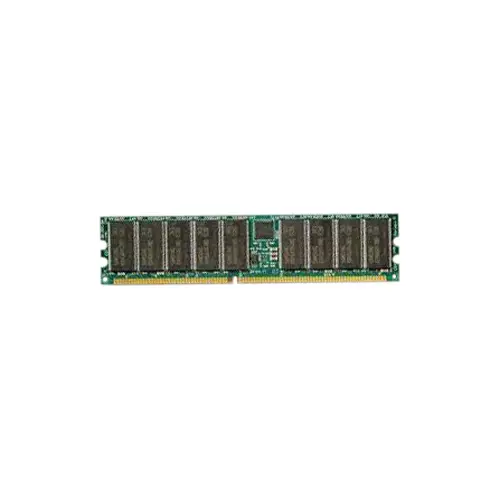
The Micron MTA36ASF2G72PZ-2G3A3IK is an RDIMM engineered for servers, where hours of unplanned downtime are measured in revenue loss. Its ECC technology silently corrects single-bit errors caused by background radiation, a non‑negotiable safeguard when a flipped bit in a virtualized cluster can crash dozens of tenant applications or corrupt an in‑memory financial database. As a registered module, it buffers command and control signals, allowing the platform to scale to massive capacities without electrical degradation; this is what lets a bare‑metal hypervisor confidently pack 512 GB or more across sockets, keeping hundreds of virtual machines responsive under constant load. The dual‑rank x4 organization enables bank‑interleaving that raises effective bandwidth during sustained writes, a critical advantage for analytics platforms like SAP HANA or Redis clusters where stalled memory pipelines directly throttle real‑time query performance. And because it operates at a true 1.2 V, the power envelope per DIMM stays lean—over a fleet of 1,000 nodes in a co‑location cage, that saving compounds into lower cooling costs and a measurable reduction in power usage effectiveness, freeing headroom for more compute without expanding the electrical feed. Together, these four characteristics turn the memory subsystem from a commodity component into a strategic reliability and throughput asset for the data center.
General Virtualization
For general virtualization, balance capacity and consistent performance by populating all memory channels symmetrically. In a dual-socket server with six channels per CPU, install one 16 GB RDIMM per channel (12 modules total) to achieve 192 GB of uniform memory access. If higher consolidation density is required, add a second identical module per channel—filling all 24 slots provides 384 GB, though speed may drop to 2133 MHz at 2 DIMMs per channel.
In-Memory Database
In-memory databases demand maximum capacity with strong data integrity. Populate all available DIMM slots with this 16 GB registered ECC module to build a resilient, high-capacity footprint. In a typical dual-processor platform supporting 2 DIMMs per channel across 12 channels, 24 modules yield 384 GB of reliable, error-corrected memory ideal for large SAP HANA or Redis instances.
High-Performance Computing
Bandwidth-sensitive HPC workloads benefit from the highest attainable memory speed. Use one 16 GB RDIMM per channel (1DPC) to keep the memory bus at the full 2400 MHz frequency. A dual-socket configuration with 12 channels thus delivers 192 GB and peak bandwidth. If the workload scales beyond that capacity, populating a second DIMM per channel increases total memory to 384 GB but enforces a slight speed downshift to 2133 MHz or 1866 MHz, trading raw bandwidth for larger working sets.
Rigorously tested server memory, compatible with Dell PowerEdge R750, R650, HPE ProLiant DL380 Gen10, and Lenovo ThinkSystem SR650 V2.
Q: Can I mix this MTA36ASF2G72PZ-2G3A3IK with other memory modules of different brands or speeds?
A: Mixing brands or speeds is not advised for enterprise RDIMMs. Mismatched modules can cause signal integrity issues and system instability. For mission-critical servers, always use identical part numbers to ensure validated compatibility and reliability.
Q: Is this memory compatible with my system?
A: This DDR4-2400 ECC Registered DIMM is designed for Intel Xeon E5-2600 v4/Scalable or AMD EPYC 7001 series platforms. Please consult your server motherboard's Qualified Vendor List (QVL) to confirm specific model support.
Q: What is the recommended DIMM population order for optimal performance?
A: Follow your server's platform guide. Generally, populate identical DIMMs in the first slot of each memory channel (often blue slots), then the second slot, to achieve balanced interleaving and maximum memory bandwidth across all channels.
Q: Does this module support overclocking or XMP profiles?
A: No. As an enterprise-grade ECC Registered DIMM, it strictly adheres to JEDEC DDR4-2400 standards for maximum stability and data integrity. Overclocking and XMP profiles are not supported on server-class memory.
Q: What warranty and typical failure rate can I expect?
A: This module includes a one-year warranty. Enterprise RDIMMs undergo rigorous screening and typically exhibit an annualized failure rate (AFR) well below 0.5%, ensuring exceptional reliability for 24/7 server operations.