











 Secure payments
Standard refund policy
Trade Assurance
Secure payments
Standard refund policy
Trade Assurance
| Model | MTA18ASF2G72PDZ-2G3A |
|---|---|
| Product Type | Memory Module |
| Compliance Standards | RoHS |
| Memory Capacity | 16 GB |
| Memory Technology | DDR4 |
| Product Voltage | 1.2V |
| RAM Speed | 2400MHz |
| RAM Standard | DDR4-2400/PC4-19200 |
| Error Identifying | ECC |
| Signal Type | Registered |
| Column Access Strobe (CAS) | CL17 |
| Rank | Dual Rank x8 |
| Quantity of Pins | 288-pin |
| RAM Genre | RDIMM |
This 16GB DDR4-2400 Registered ECC module, with its dual-rank x8 organization and CL17 latency, ensures rock-solid data integrity and signal stability in dense server environments. It is ideally suited for virtualization, in-memory databases, and latency-sensitive enterprise workloads where error correction and reliable multi-DIMM configurations are critical.
1. Registered signal type stabilizes command and address signals across heavily populated server channels, preventing signal degradation that could otherwise crash critical workloads on a multi-DIMM virtualization host.
2. ECC error correction actively detects and corrects single-bit memory faults in real time, safeguarding transactional databases and in-memory analytics against silent data corruption that leads to costly application errors.
3. 16 GB capacity per module strikes a cost-effective density sweet spot for scale-out cloud nodes, allowing operators to pack more lightweight containers or VMs into each server without wasting memory slots on overprovisioning.
4. DDR4-2400 speed delivers a balanced memory bandwidth of 19.2 GB/s per module, keeping latency-sensitive enterprise applications like ERP and OLTP responsive even under concurrent peak-hour requests.
5. Dual Rank x8 architecture interleaves accesses across two internal ranks per DIMM, sustaining higher effective throughput and ensuring consistent VM performance when consolidating multiple virtualized services onto a single physical node.
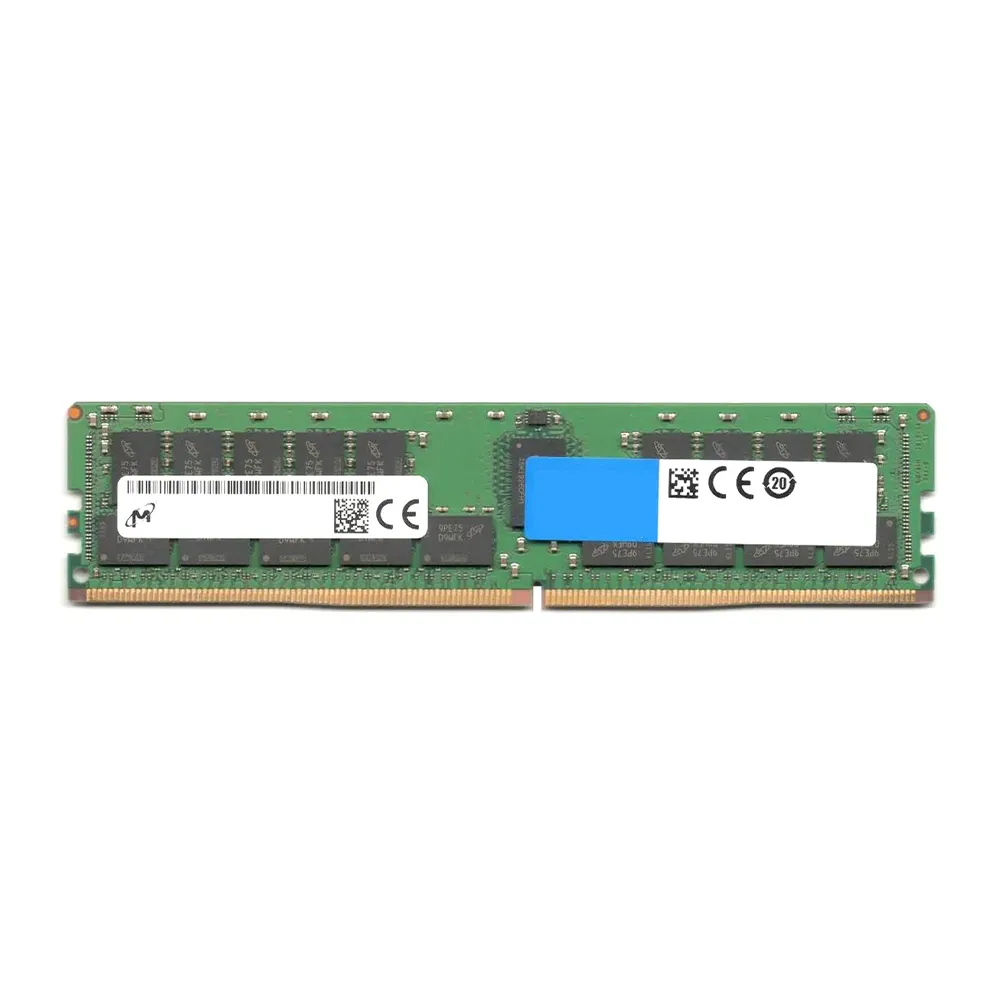
The Micron MTA18ASF2G72PDZ-2G3A is a 16GB DDR4-2400 RDIMM designed explicitly for server platforms, where uptime and data integrity are non-negotiable. Its four defining characteristics directly address the most critical pain points of modern data centers. First, ECC error correction continuously detects and corrects single-bit memory errors, preventing silent data corruption that could crash a virtualization host or poison a financial transaction database. Second, the registered interface buffers command and address signals, allowing multiple DIMMs per channel without electrical instability — essential when scaling VMware clusters or in-memory analytics engines to hundreds of gigabytes. Third, its dual-rank x8 organization interleaves internal memory banks, boosting bandwidth and latency performance during heavy mixed workloads like concurrent virtual machine migration and real-time query processing. Operating at 1.2V, this module also reduces thermal load across dense server racks. In an in-memory database such as Redis or SAP HANA, even a single uncorrected bit flip can cascade into dataset corruption; the registered ECC architecture ensures every transaction is accurate. For virtualized environments running dozens of VMs, the combination of robust signal integrity and dual-rank throughput means predictable low-latency response, even under peak contention, protecting service-level agreements and revenue streams.
General Virtualization
For general virtualization hosts, deploy modules in multiples of 8 to populate all channels of a typical 2-socket platform, achieving balanced memory bandwidth. Start with sixteen 16 GB RDIMMs (256 GB total) to comfortably host 25–40 moderate VMs, and scale by adding identical DIMMs per channel to preserve symmetric interleaving.
In-Memory Database
In-memory databases demand large capacity and high reliability; use 16 GB registered ECC DIMMs to populate every slot in a single-socket or dual-socket server, delivering 512 GB–1 TB with full error correction. Configure memory channels identically and select x8 dual-rank modules to maximize bandwidth while maintaining deterministic latency under heavy Redis or SAP HANA workloads.
High-Performance Computing (HPC)
HPC clusters benefit from populating one DIMM per channel for peak frequency and latency-sensitive throughput. Equip each node with twelve 16 GB RDIMMs (192 GB total) to supply 6–8 cores per task, keeping the 2400 MT/s speed steady; add a second identical module per channel only if capacity-hungry CFD or genome assembly requires up to 384 GB without dropping the memory clock.
Rigorously tested server RDIMM: compatible with Dell PowerEdge R760, HPE ProLiant DL380 Gen10, and Lenovo ThinkSystem SR650.
Q: Can I mix this MTA18ASF2G72PDZ-2G3A with other memory modules of different brands or speeds?
A: Mixing brands or speeds is not advised. It risks system instability and ECC errors. For reliable server operation, use identical MTA18ASF2G72PDZ modules.
Q: Is this memory compatible with my system?
A: It is compatible with servers using Intel Xeon E5-2600 v4 or AMD EPYC platforms that support DDR4-2400 Registered DIMMs. Verify your system’s memory QVL list.
Q: What is the recommended DIMM population order for optimal performance?
A: Follow your server motherboard manual. Typically, populate DIMMs sequentially per channel, starting with the first slot (often blue) to enable balanced memory interleaving.
Q: Does this module support overclocking or XMP profiles?
A: No. This is a JEDEC-standard server RDIMM with fixed CL17 timings. It does not support XMP or any overclocking to ensure mission-critical stability.
Q: What warranty and typical failure rate can I expect?
A: It includes a 1-year limited warranty. Enterprise-class RDIMMs like this demonstrate very low annualized failure rates, typically under 0.5% in controlled environments.