











 Secure payments
Standard refund policy
Trade Assurance
Secure payments
Standard refund policy
Trade Assurance
| Product Type | Memory Module |
|---|---|
| Memory Capacity | 16 GB |
| Memory Technology | DDR4 |
| Product Voltage | 1.2V |
| RAM Speed | 2400MHz |
| RAM Standard | DDR4-2400/PC4-19200 |
| Error Identifying | ECC |
| Signal Type | Registered |
| Column Access Strobe (CAS) | CL17 |
| Rank | Dual Rank x8 |
| Quantity of Pins | 288-pin |
| RAM Genre | RDIMM |
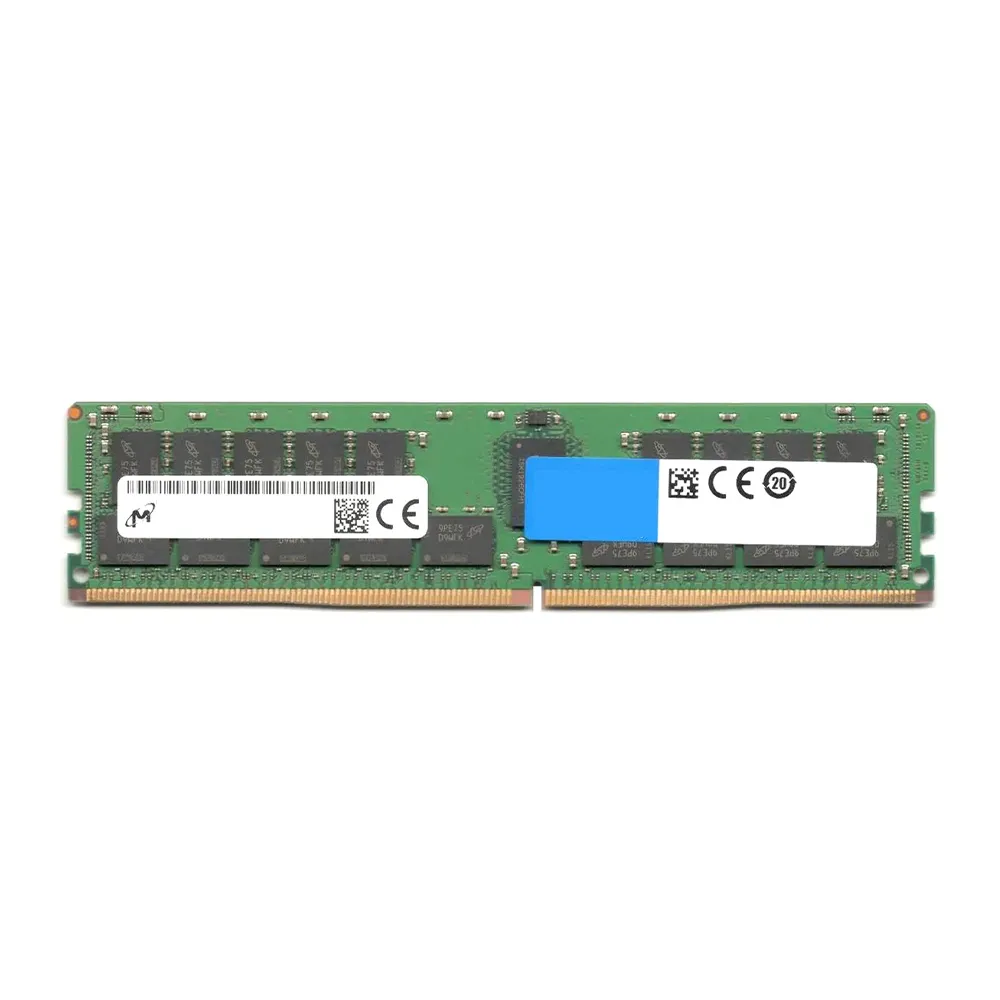
This 16GB DDR4-2400 RDIMM is built for server platforms, excelling in virtualization and in-memory database workloads that demand uncompromising data integrity. The registered ECC signaling combined with a dual-rank x8 organization strengthens signal stability across populated memory channels and leverages rank interleaving for improved throughput under heavy, sustained loads.
1. ECC protection detects and corrects single-bit memory errors, preventing silent data corruption in transactional databases and ensuring long-running analytics jobs complete with trustworthy results.
2. Registered buffer technology reduces electrical loading on the memory bus, enabling servers to reliably populate all DIMM slots and maximize total memory capacity for dense virtualization farms.
3. A 16-gigabyte module capacity delivers sufficient headroom per channel to host more virtual machines or containers on a single physical node without sacrificing performance consistency.
4. The 2400 mega-transfer data rate supplies steady bandwidth for concurrent query streams, cutting response times in real-time business intelligence dashboards and in-memory caches.
5. Dual-rank x8 organization interleaves memory accesses across two internal ranks, raising effective throughput under heavy multi-threaded workloads and maintaining snappy responsiveness during peak consolidation hours.
The MTA18ASF2G72PDZ-2G3B1MI is an enterprise DDR4 Registered DIMM engineered for around-the-clock dependability in servers and workstations. Its four core attributes—ECC error correction, registered buffering, dual-rank x8 design, and 1.2V operation—directly address the real anxieties of data center operators. In a dense virtualization cluster, a single cosmic-ray-induced bit flip can silently corrupt a financial database or crash a hypervisor, causing hours of recovery. ECC actively detects and corrects these errors, preserving data integrity and preventing costly unplanned outages. When you need to scale capacity, the register buffer stabilizes command and address signals, enabling all DIMM slots to be populated without signal degradation—essential for hosting dozens of virtual machines with 512 GB or more. For in-memory databases like SAP HANA or Redis, the dual-rank architecture interleaves access across bank groups, markedly boosting sustained bandwidth and reducing access collisions. Your real-time analytics dashboards and transaction logs return results faster even under massive concurrent loads. Meanwhile, low 1.2V operation curbs power draw and heat in high-density racks, lowering cooling costs and total cost of ownership. This module gives you a resilient, high-throughput foundation where data accuracy, scalability, and efficiency are non-negotiable.
General Virtualization
For general virtualization hosts, balance cost and density by installing six or eight of these 16 GB RDIMMs across a dual-socket platform to achieve 96–128 GB total capacity. This configuration comfortably supports 20–30 moderate VMs, leaving headroom for memory overcommitment when ECC protection is required. Populate equal DIMMs per channel to preserve NUMA balance and memory bandwidth.
In-Memory Database
In-memory databases demand the lowest latency and high availability, so deploy at least eight identical 16 GB modules per socket for a fully balanced population, targeting 128 GB or more. Use all memory channels (e.g., six or eight per CPU) with dual-rank DIMMs to maximize bandwidth and interleaving. Scale to 256 GB by using sixteen modules in a two-socket server to keep large datasets entirely in ECC-protected RAM.
High-Performance Computing (HPC)
HPC workloads need maximum throughput, so fill every memory channel with one 16 GB dual-rank RDIMM to obtain peak bandwidth—often six or eight modules per node. For capacity-sensitive HPC jobs, double to two DIMMs per channel (12 or 16 modules) while acknowledging the slight speed trade-off from increased loading. Always match module model and rank across nodes to ensure uniform, predictable execution performance.
Rigorously tested and verified for server compatibility: Dell PowerEdge R740, HPE ProLiant DL380 Gen10, Lenovo ThinkSystem SR650.
Q: Can I mix this MTA18ASF2G72PDZ-2G3B1MI with other memory modules of different brands or speeds?
A: Mixing RDIMMs is not recommended. Differing brands or speeds may cause signal integrity issues and system instability. Always populate with identical modules to ensure reliable ECC operation and validated performance.
Q: Is this memory compatible with my Intel Xeon or AMD EPYC server platform?
A: This DDR4-2400 ECC RDIMM is compatible with server boards using Intel Xeon Scalable (Purley) or AMD EPYC platforms that support 288-pin registered DIMMs at 1.2V. Confirm your board’s memory QVL for exact support.
Q: What is the recommended DIMM population order for optimal performance?
A: Follow your server board’s manual. Generally, populate identical DIMMs across memory channels for balanced bandwidth, starting with slot 1 in each channel. This ensures proper interleaving and ECC coverage.
Q: Does this module support overclocking or XMP profiles?
A: No. As an enterprise DDR4 RDIMM, it runs strictly at JEDEC-standard 2400MHz with no XMP or overclocking support. Reliability and data integrity take precedence over speed tuning.
Q: What warranty and typical failure rate can I expect for this module?
A: It comes with a 1-year warranty. The module is built with Micron premium components, delivering an extremely low annualized failure rate (AFR) typical of enterprise-class memory, ensuring long-term stability.