











 Secure payments
Standard refund policy
Trade Assurance
Secure payments
Standard refund policy
Trade Assurance
| Model | MTA18ADF2G72PZ-2G3 |
|---|---|
| Product Type | Memory Module |
| Compliance Standards | RoHS |
| Memory Capacity | 16 GB |
| Memory Technology | DDR4 |
| Product Voltage | 1.2V |
| RAM Speed | 2400MHz |
| RAM Standard | DDR4-2400/PC4-19200 |
| Error Identifying | ECC |
| Signal Type | Registered |
| Column Access Strobe (CAS) | CL17 |
| Rank | Single Rank x4 |
| Quantity of Pins | 288-pin |
| RAM Genre | VLP RDIMM |
This VLP RDIMM is a registered server memory module with ECC, optimized for dense virtualization and in-memory database workloads where data integrity and signal stability across high-capacity configurations are critical. Its single-rank x4 organization and 1.2V low-profile design reduce power consumption and thermal load, making it ideal for 1U and blade servers that demand reliable 24/7 operation with minimal airflow clearance.
1. ECC protection silently corrects single-bit memory errors, safeguarding transactional integrity for financial databases and virtualized workloads that cannot tolerate data corruption.
2. Registered signal buffering stabilizes command and address buses, allowing dense memory arrays to be populated without signal degradation—critical when scaling to terabytes in a single server.
3. The very low-profile design fits seamlessly into 1U and blade enclosures, reducing airflow impedance and enabling cooler, higher-density deployments in space-constrained data centers.
4. A 16-gigabyte module capacity provides an optimal building block for memory-heavy hypervisors, supporting more virtual machines per node while keeping per-gigabyte costs efficient.
5. DDR4-2400 throughput ensures consistent multi-channel bandwidth, accelerating simultaneous analytics queries and reducing latency in shared cloud-infrastructure services.
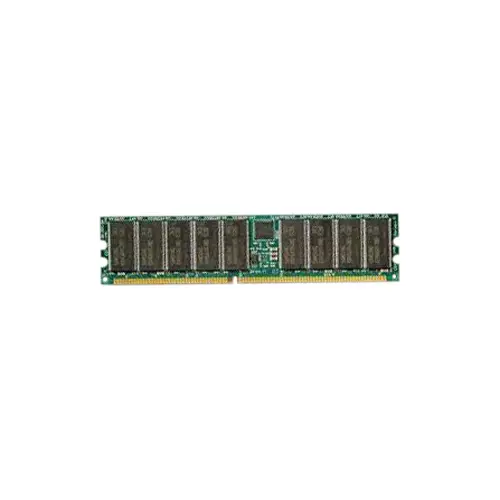
The Micron MTA18ADF2G72PZ-2G3 is a server-class DDR4-2400 VLP RDIMM purpose-built for mission-critical enterprise infrastructure. Its ECC actively detects and corrects single-bit memory errors, preventing silent data corruption that could otherwise crash an entire virtualized cluster or silently poison an in-memory database like SAP HANA—a catastrophic risk in financial or healthcare environments. The registered signal buffer stabilizes command and address lines, enabling you to fully populate all memory channels without signal degradation. This means a single hypervisor host can reliably support dozens of virtual machines, maintaining performance consistency under heavily consolidated loads. The very-low-profile form factor frees critical vertical clearance inside dense 1U rack servers and blade enclosures, significantly improving airflow and reducing thermal throttling so your nodes run cool during peak transaction processing. Operating at an energy-efficient 1.2V, the module directly shrinks your datacenter power footprint, lowering both electricity bills and cooling demands at scale. With a single-rank x4 organization, it balances latency and bandwidth for highly transactional workloads, ensuring every SQL query completes with both speed and absolute accuracy. These engineering choices translate directly into higher uptime, scalable memory capacity, and a measurably lower total cost of ownership for your server farm.
General Virtualization
This 16GB VLP RDIMM, with ECC and registered signaling at 2400MHz, fits dense virtualization hosts where memory reliability and capacity per channel matter. For general server consolidation, deploy six or eight modules on a dual‑socket platform to reach 96‑128 GB, allowing comfortable overcommit of lightweight VMs. Stagger modules across memory channels to sustain bandwidth under mixed‑workload bursts while single‑rank x4 DIMMs help maintain lower latency at 1.2V.
In‑Memory Database
In‑memory databases such as Redis or SAP HANA demand both capacity and data integrity. Populate all available channels with identical MTA18ADF2G72PZ-2G3 modules to build a 128‑256 GB pool, matching the workload’s dataset size. Use one DIMM per channel in a balanced configuration to maximize throughput and avoid rank contention, since ECC and registered buffers protect critical in‑flight data without adding refresh overhead.
High‑Performance Computing
HPC workloads stress memory bandwidth and resilience. Install eight or twelve of these VLP RDIMMs uniformly across a dual‑socket node, targeting 128‑192 GB for simulation or modeling jobs. The very low‑profile design eases airflow in dense clusters, while registered ECC ensures silent data corruption is caught during long‑running parallel tasks. Keep channels populated symmetrically to achieve peak DDR4‑2400 bandwidth per core and reduce NUMA imbalances.
Stringently tested for compatibility with Dell PowerEdge R760, HPE ProLiant DL380 Gen10, Lenovo ThinkSystem SR650, and more.
Q: Can I mix this MTA18ADF2G72PZ-2G3 with other memory modules of different brands or speeds?
A: Mixing ECC RDIMMs from different brands or speeds is strongly discouraged. It may cause instability, POST failures, or silent data corruption. For reliable operation, populate all channels with identical modules validated for your server.
Q: Is this memory compatible with my system?
A: This DDR4-2400 ECC Registered VLP RDIMM is designed for servers. It is compatible with Intel Xeon E5-2600 v3/v4 and select Xeon Scalable platforms, as well as AMD EPYC systems that support 2400MT/s RDIMMs. Always verify against your motherboard’s memory QVL.
Q: What is the recommended DIMM population order for optimal performance?
A: Optimal population order is defined in your server motherboard manual. Typically, you should populate identical DIMMs in the first slot of each memory channel (e.g., A1, B1, C1, D1) to enable balanced interleaving and full memory bandwidth.
Q: Does this module support overclocking or XMP profiles?
A: No. As an enterprise-grade ECC Registered DIMM, it operates exclusively at JEDEC standard DDR4-2400 (PC4-19200) with CL17 timings. Overclocking and XMP are not supported, prioritizing data integrity and 24/7 stability over performance tuning.
Q: What warranty and typical failure rate can I expect?
A: This module is backed by a 1-year warranty. It meets stringent reliability standards with a very low annualized failure rate (AFR) typical of Tier-1 OEM server memory, ensuring dependable operation in demanding data center environments.