











 Secure payments
Standard refund policy
Trade Assurance
Secure payments
Standard refund policy
Trade Assurance
| Product Type | Memory Module |
|---|---|
| Memory Capacity | 16 GB |
| Memory Technology | DDR4 |
| Product Voltage | 1.2V |
| RAM Speed | 2400MHz |
| RAM Standard | DDR4-2400/PC4-19200 |
| Error Identifying | ECC |
| Signal Type | Registered |
| Column Access Strobe (CAS) | CL17 |
| Rank | Dual Rank x8 |
| Quantity of Pins | 288-pin |
| RAM Genre | RDIMM |
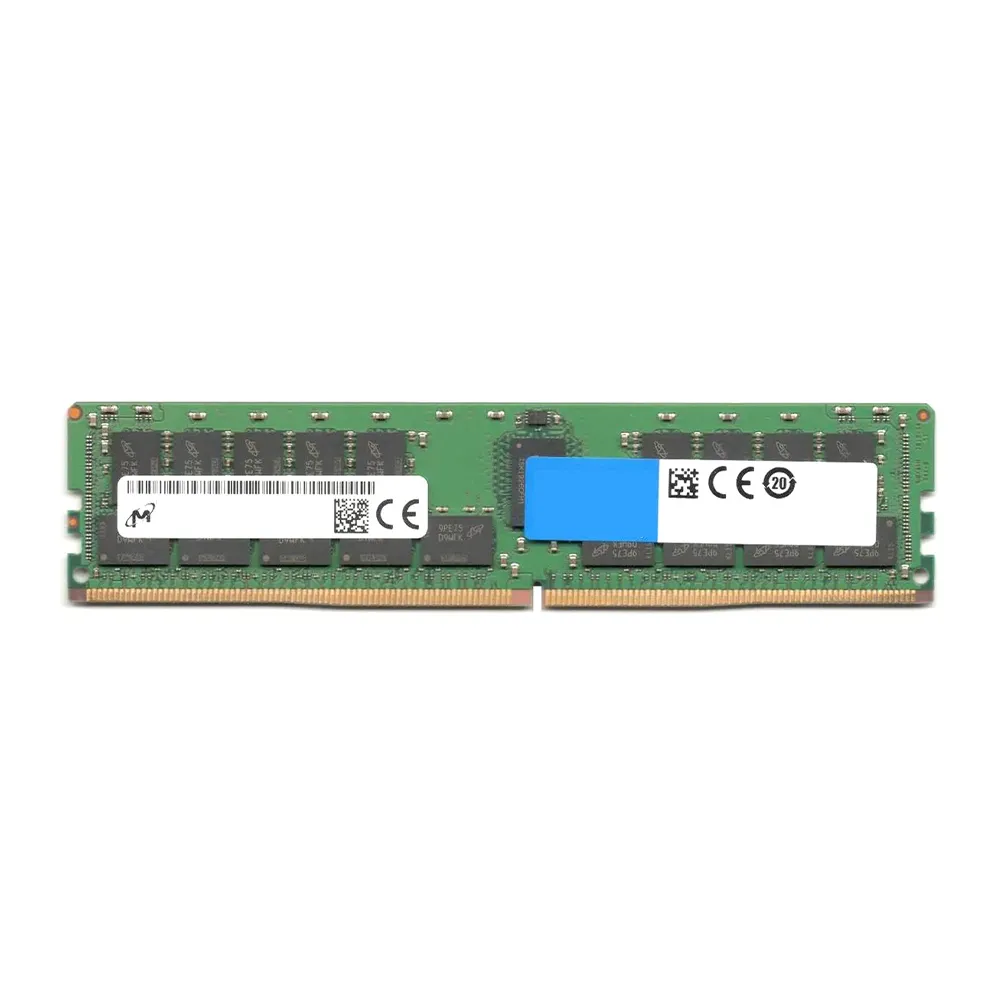
This Micron 16GB DDR4-2400 RDIMM is engineered for enterprise servers and virtualization platforms where ECC and registered buffering are critical for data integrity under sustained memory workloads. Its dual-rank x8 organization maximizes memory interleaving for improved bandwidth efficiency, while the CL17 latency and 1.2V low-power operation ensure reliable, energy-efficient performance in dense deployments like in-memory databases and multi-tenant hypervisors.
1. ECC protection detects and corrects single-bit errors in real time, safeguarding transactional data integrity and preventing silent data corruption in always-on enterprise servers.
2. Registered signal buffering stabilizes command and address lines across high-density memory configurations, enabling seamless scaling to hundreds of gigabytes without compromising platform reliability.
3. A 16-gigabyte capacity per module strikes a proven density sweet spot for virtualization hosts, allowing more simultaneous virtual machines per rack unit without immediate oversubscription.
4. Operating at a balanced DDR4-2400 speed delivers sufficient sustained memory bandwidth for database queries and concurrent container workloads while maintaining thermal headroom inside dense server chassis.
5. Dual Rank x8 organization interleaves accesses across internal banks, boosting effective throughput under heavy memory pressure and reducing latency spikes during multi-tenant cloud operations.
When you deploy this Micron MTA18ASF2G72PDZ-2G3B1IG, you are not simply adding 16GB of DDR4; you are equipping a server with the resilience it demands. Its ECC error correction silently thwarts single-bit upsets triggered by background radiation or voltage noise, which is critical in a dense virtualization cluster where one flipped bit inside a hypervisor can cascade into corruption across dozens of business-critical VMs. The registered architecture buffers control signals, enabling your platform to populate all memory channels with multiple DIMMs while preserving rock-steady signal integrity, meaning a memory-hungry in-memory database like Redis or SAP HANA can expand to massive datasets without risking data loss or unexpected reboots under peak OLTP loads. That dual-rank x8 design further interleaves access across internal banks, sustaining higher bandwidth and lowering transaction latency exactly when your analytics queries spike. Operating at an energy-conscious 1.2V, it reduces thermal strain in your data center, trimming both power bills and cooling demands. In production, that translates directly into predictable uptime, consistent query performance, and a lower total cost of ownership for the workloads that keep your business running.
General Virtualization
For general virtualization hosts, deploy four or six of these 16 GB Registered ECC modules to achieve 64–96 GB total capacity. Distribute DIMMs evenly across all memory channels (balanced population) to maximize memory bandwidth and ensure stable performance for moderate VM densities of 20–40 lightweight virtual machines.
In-Memory Database
In-memory databases demand high capacity and data integrity. Fully populate all memory channels with these Dual Rank x8 RDIMMs — a common target is 256 GB (16 x 16 GB) on a dual-socket server. The combination of ECC, registered signaling, and dual-rank interleaving reduces latency and guards against data corruption during large RAM-resident workloads.
High-Performance Computing (HPC)
HPC clusters rely on peak memory bandwidth. Install one RDIMM per channel (e.g., 8 modules for 128 GB on an 8-channel platform) to avoid rank contention penalties. The 2400 MHz clock and CL17 latency provide consistent throughput for simulation and modeling codes, while ECC ensures long-running jobs are not compromised by silent memory errors.
Rigorously tested and compatible with Dell PowerEdge R740, HPE ProLiant DL380 Gen10, Lenovo ThinkSystem SR650.
Q: Can I mix this MTA18ASF2G72PDZ-2G3B1IG with other memory modules of different brands or speeds?
A: Mixing RDIMMs of different brands or speeds is not recommended. The system will downclock all modules to the lowest common speed, potentially compromising stability and ECC functionality in server environments.
Q: Is this memory compatible with my Intel Xeon or AMD EPYC server platform?
A: This DDR4-2400 ECC Registered DIMM is compatible with Intel Xeon E5-2600 v4 and AMD EPYC 7001 series platforms using DDR4. Verify your board supports 1.2V RDIMMs.
Q: What is the recommended DIMM population order for optimal performance?
A: For dual-processor servers, populate identical DIMMs per channel starting with the farthest slot from the CPU. Follow your motherboard’s guide to balance memory across all memory channels for peak bandwidth.
Q: Does this module support overclocking or XMP profiles?
A: No, enterprise DDR4-2400 RDIMMs do not support overclocking or XMP. They strictly adhere to JEDEC standard timings (CL17) to guarantee signal integrity and reliability in mission-critical server applications.
Q: What warranty and typical failure rate can I expect?
A: This Micron module includes a one-year warranty. DDR4 server RDIMMs typically exhibit an annualized failure rate (AFR) well below 0.5%, reflecting their rigorous testing and long-term reliability under 24/7 workloads.