











 Secure payments
Standard refund policy
Trade Assurance
Secure payments
Standard refund policy
Trade Assurance
| Product Type | Memory Module |
|---|---|
| Memory Capacity | 16 GB |
| Memory Technology | DDR4 |
| Product Voltage | 1.2V |
| RAM Speed | 2400MHz |
| RAM Standard | DDR4-2400/PC4-19200 |
| Error Identifying | ECC |
| Signal Type | Registered |
| Column Access Strobe (CAS) | CL17 |
| Rank | Dual Rank x8 |
| Quantity of Pins | 288-pin |
| RAM Genre | RDIMM |
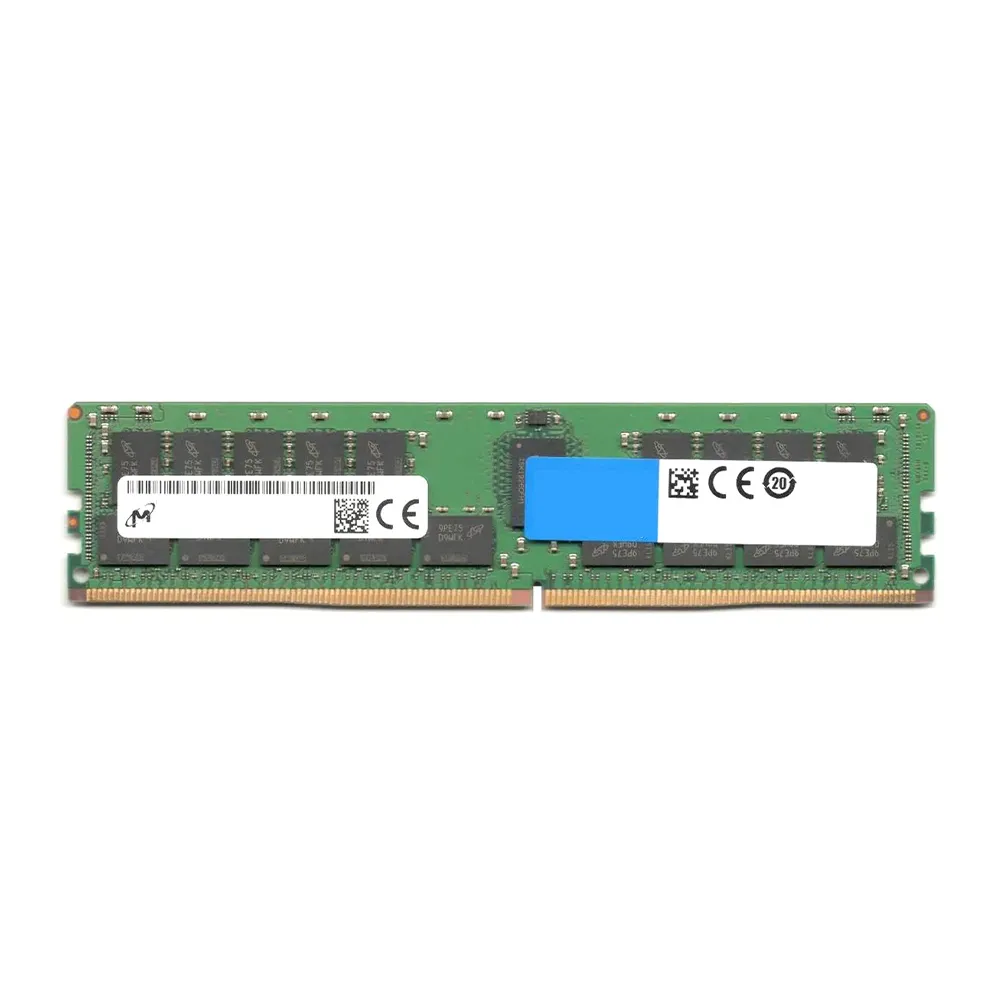
Designed for server platforms, this 16GB DDR4-2400 RDIMM with ECC and registered signal ensures data integrity and reliability in virtualization and in-memory database workloads. Its dual-rank x8 configuration enhances memory interleaving for improved bandwidth, while the 1.2V operating voltage promotes energy efficiency in dense data center deployments.
1. Registered signal buffering stabilizes command and address pathways, allowing large memory populations to be deployed reliably in virtualization-centric servers.
2. Single-bit error correction actively prevents silent data corruption, which is essential for preserving transaction accuracy in database and financial processing environments.
3. Dual-rank x8 organization interleaves memory bank accesses, sustaining higher effective bandwidth under the concurrent loads of heavily consolidated virtual machines.
4. A sixteen-gigabyte module density enables fine-grained capacity scaling, helping blade and rack servers reach multi-terabyte footprints without sacrificing DIMM slot count.
5. Operating at a balanced DDR4-2400 speed, the module delivers adequate throughput for multi-threaded enterprise applications while staying within the low power envelope required by energy-conscious data centers.
The MTA18ASF2G72PDZ-2G3B1RI is a server-grade Registered DIMM engineered for data center reliability, and its four defining characteristics translate directly into real-world operational advantages. In virtualization farms, the integrated ECC protection eliminates silent data corruption at the hardware level: a single uncorrected bit flip can crash dozens of VMs or poison hypervisor state, so ECC becomes your frontline defence for continuous uptime and transactional consistency. For memory-intensive databases like Redis or SAP HANA, the dual-rank x8 organization exploits rank interleaving to deliver higher sustained bandwidth, accelerating query execution when microsecond latencies directly impact revenue. The registered buffer redrives address and command signals, enabling you to fully populate every channel without signal degradation—this is what makes large 512 GB or terabyte-class footprints stable during heavy workload consolidation. Finally, the 1.2 V operating voltage trims per-slot power draw and thermal stress, reducing both your cooling load and monthly power bills across the rack. For you, these features converge into a memory foundation that never compromises data integrity, scaling agility, or energy efficiency in always-on enterprise environments.
General Virtualization
For a typical hypervisor hosting mixed workloads, begin with a balanced configuration of four to eight 16 GB RDIMMs per socket to achieve 64–128 GB total capacity. Populate identical modules across all memory channels to leverage the dual-rank x8 design for optimal throughput and avoid performance penalties from unbalanced DIMM populations. Scale in matched sets, leaving room for future expansion as virtual machine density grows.
In-Memory Database
Low latency and high reliability are critical; deploy a minimum of 256 GB using sixteen 16 GB registered ECC modules across all memory channels to keep the entire working set in RAM. The dual-rank organization improves bank-level parallelism, boosting transaction rates under heavy concurrent loads. Strictly populate identical DIMMs per memory controller to maintain lockstep memory interleaving and avoid NUMA imbalances in multi-socket servers.
High-Performance Computing
Maximize memory bandwidth by installing one 16 GB RDIMM per channel, filling all available channels (typically eight or twelve per socket) to reach 128–192 GB capacity. A balanced dual-rank configuration per channel provides a sweet spot between capacity and sustained bandwidth for simulation and modeling codes. For memory-bandwidth-bound workloads, consider slightly fewer ranks per channel only if peak frequency scaling is required, but dual-rank x8 modules remain an excellent baseline for most HPC clusters.
Rigorously tested for compatibility with Dell PowerEdge R740, HPE ProLiant DL380 Gen10, and Lenovo ThinkSystem SR650 servers.
Q: Can I mix this MTA18ASF2G72PDZ-2G3B1RI with other memory modules of different brands or speeds?
A: Mixing different brands or speeds with this RDIMM is not recommended. Inconsistent DIMM attributes may cause signal integrity issues, prevent proper ECC functionality, or lead to server instability.
Q: Is this memory compatible with my server system?
A: It is compatible with servers supporting DDR4-2400 Registered ECC RDIMMs. Confirm your Intel Xeon E5-2600 v4 or AMD EPYC platform supports 1.2V, 288-pin, dual-rank modules before installation.
Q: What is the recommended DIMM population order for optimal performance?
A: Populate identical DIMMs per memory channel, starting with slots farthest from the CPU. Follow your server board's specific guidelines, usually filling blue slots first or matching 1 DIMM per channel for peak bandwidth.
Q: Does this module support overclocking or XMP profiles?
A: No, this is a JEDEC-compliant server RDIMM built for stability. It does not support overclocking or XMP, as reliable 24/7 operation with ECC error correction takes priority over frequency scaling.
Q: What warranty and typical failure rate can I expect?
A: This module is covered by a one-year warranty. Under normal server operating conditions, enterprise DDR4 RDIMMs typically show a very low failure rate of under 0.3% annually, ensuring long-term mission-critical reliability.