











 Secure payments
Standard refund policy
Trade Assurance
Secure payments
Standard refund policy
Trade Assurance
| Product Type | Memory Module |
|---|---|
| Memory Capacity | 16 GB |
| Memory Technology | DDR4 |
| Product Voltage | 1.2V |
| RAM Speed | 2666MHz |
| RAM Standard | DDR4-2666/PC4-21300 |
| Signal Type | Unbuffered |
| Column Access Strobe (CAS) | CL19 |
| Rank | Dual Rank x8 |
| Quantity of Pins | 288-pin |
| RAM Genre | UDIMM |
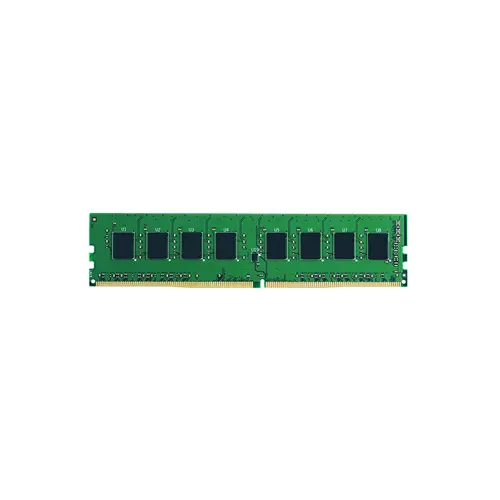
This unbuffered DDR4-2666 UDIMM is optimized for desktop platforms, delivering reliable performance for productivity, content creation, and gaming workloads. Its dual-rank x8 organization improves memory interleaving efficiency, while the 1.2V operating voltage and CL19 latency strike a balance between thermal headroom and responsive data access.
1. A 16 GB capacity comfortably handles modern gaming and content creation workloads, preventing stutter when running memory-hungry applications side by side.
2. 2666 MHz frequency supplies ample bandwidth to keep multi-core processors fed, reducing frame time spikes in fast-paced gaming scenarios.
3. CL19 latency helps minimize access delays, sharpening system responsiveness during real-time editing and reducing input lag in competitive play.
4. Dual Rank x8 organization increases effective concurrency within the memory channel, yielding smoother multitasking performance when streaming or recording.
5. The UDIMM form factor with unbuffered signaling guarantees drop-in compatibility across mainstream desktop platforms, making it an effortless upgrade for DIY enthusiasts.
Based on the UDIMM form factor, 288-pin layout, and unbuffered signal type, the MTA18ASF2G72AZ-2G6E2 is a desktop memory module purpose‑built for high‑performance PC environments. Its four defining characteristics translate directly into fewer workflow disruptions and a more responsive system under heavy loads.
The 2666MHz frequency combined with a CL19 latency drives snappier command execution, which in competitive AAA gaming reduces the gap between a frame being called and rendered, helping eliminate micro‑stutters during fast camera pans. The dual‑rank x8 organization interleaves memory access across two internal ranks, effectively widening the data pipeline. When you are editing 4K video in DaVinci Resolve while simultaneously handling color grading and a live preview, that extra bandwidth prevents timeline lag and dropped frames. The unbuffered architecture removes the register delay found in server memory, so the CPU can communicate directly with the DRAM chips; this becomes critical in real‑time rendering and audio production where every millisecond of latency matters. Even the 1.2V operating voltage plays a role during prolonged rendering sessions, keeping thermals in check so your overclocked CPU and GPU can sustain turbo frequencies without the memory controller adding extra heat. Together, these traits ensure your workstation or gaming rig stays predictable and fluid when it matters most.
Gaming Build
For a modern gaming system, dual‑channel operation is essential, so purchase this module as a matched pair (2×16 GB) to form a 32 GB kit. 32 GB eliminates stuttering in memory‑intensive titles while streaming, and the 2666 MHz speed provides stable, low‑latency frame delivery on mainstream platforms. If your budget only allows 16 GB initially, start with a single DIMM and add an identical second stick later, but never mix different ranks or speeds.
Content Creation
Video editing, 3D rendering, and complex compositing thrive on capacity. Combine four of these 16 GB UDIMMs to reach 64 GB, a sweet spot for 4K timelines and moderate scene rendering without disk paging. The dual‑rank x8 design improves interleaving efficiency, giving a slight bandwidth boost under heavy multi‑threaded workloads. For entry‑level creators, a 2×16 GB (32 GB) configuration still handles 1080p projects smoothly and leaves two slots free for future expansion.
General Productivity
For office multitasking, web browsing, and light spreadsheets, a single 16 GB module is the cost‑effective choice—it runs in single‑channel mode yet delivers ample headroom for dozens of browser tabs and Office applications. If you occasionally run virtual machines or large databases, upgrade to 2×16 GB for dual‑channel bandwidth and extra capacity without overspending. This DDR4‑2666 UDIMM’s 1.2 V standard voltage also helps keep power and thermals low in always‑on desktops.
Rigorously tested desktop memory. Compatible with Dell OptiPlex, HP EliteDesk, Lenovo ThinkCentre, and Intel/AMD DDR4 systems.
Q: Can I mix this MTA18ASF2G72AZ-2G6E2 with other memory modules of different brands or speeds?
A: Mixing is possible but not recommended. The system will downclock all modules to the slowest common speed and loosest timings, often causing stability issues on desktop platforms.
Q: Is this memory compatible with my system?
A: This DDR4 UDIMM is compatible with most desktop motherboards using Intel 100–300 series or AMD 300–400 series chipsets. Please verify your board supports 2666MHz non-ECC unbuffered memory.
Q: What is the recommended DIMM population order for optimal performance?
A: For a typical dual-channel desktop board, install identical modules into the same-colored slots—usually A2 and B2 first. This ensures dual-channel operation with this dual-rank module.
Q: Does this module support overclocking or XMP profiles?
A: No, this is a JEDEC-standard DDR4-2666 CL19 module without XMP. It runs reliably at the rated speed and does not support overclocking beyond the standard JEDEC profile.
Q: What warranty and typical failure rate can I expect?
A: This module comes with a 1-year warranty. The typical annualized failure rate (AFR) is well below 0.5%, reflecting Micron's high quality and rigorous testing for desktop UDIMMs.