











 Secure payments
Standard refund policy
Trade Assurance
Secure payments
Standard refund policy
Trade Assurance
| Product Type | Memory Module |
|---|---|
| Memory Capacity | 16 GB |
| Memory Technology | DDR4 |
| Product Voltage | 1.2V |
| RAM Speed | 2666MHz |
| RAM Standard | DDR4-2666/PC4-21300 |
| Error Identifying | ECC |
| Signal Type | Registered |
| Column Access Strobe (CAS) | CL19 |
| Rank | Dual Rank x8 |
| Quantity of Pins | 288-pin |
| RAM Genre | RDIMM |
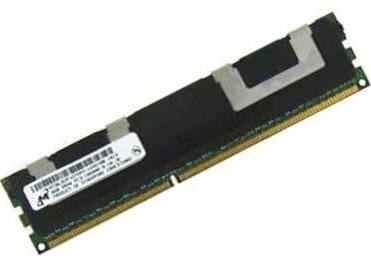
This is a server-class DDR4 RDIMM engineered for enterprise platforms such as virtualization clusters, in-memory databases, and mission-critical workloads that demand uncompromising data integrity. The dual-rank x8 organization maximizes interleaving for higher sustained throughput, while registered signaling and ECC at CL19 deliver rock-solid stability by actively correcting single-bit errors under continuous heavy load.
1. ECC error correction catches and rectifies single-bit faults on the fly, safeguarding data integrity for mission-critical databases and financial transaction servers that run nonstop.
2. The registered buffer architecture decouples the memory controller from electrical loading, enabling fully populated channels to scale to terabyte-class footprints without compromising signal quality in dense virtualization hosts.
3. Dual Rank x8 interleaving overlaps row activations across internal banks, sustaining peak bandwidth utilization so that clusters of VM vCPUs never stall waiting for data under heavy consolidation.
4. A 16 GB module serves as an efficient capacity building block, letting IT operators achieve high memory-per-core ratios for container farms while staying within tight thermal and power envelopes.
5. The 2666 MHz clock rate supplies ample sustained throughput for bandwidth-sensitive workloads such as in-memory analytics and large-scale caching, reducing CPU idle cycles in real-time decision engines.
In the data center, the Micron MTA18ASF2G72PDZ-2G6D1RI RDIMM transforms how you mitigate risk and scale performance. Its ECC protection directly counters silent data corruption, a critical factor when a single uncorrected bit flip in your virtualization cluster could crash a transaction processing VM, violating uptime SLAs for banking or reservation platforms. The registered buffer enables high-density configurations by isolating electrical loads; populating all channels with 512 GB for an in-memory database like SAP HANA or Redis remains stable under thousands of concurrent queries. Dual-rank x8 architecture interleaves bank groups, delivering roughly 10% more bandwidth than single-rank, which accelerates table scans and index rebuilds in your real-time analytics workloads. Finally, DDR4-2666 at 1.2V draws less power per DIMM, reducing cooling overhead in dense 2U servers and helping you meet energy budgets without sacrificing capacity.
General Virtualization
For a balanced virtualization host, populate the server with at least eight identical 16 GB RDIMMs (128 GB total) to provide ample memory for dozens of moderate VMs. Deploy modules in multiples of the memory channel count — typically six or eight per CPU socket — to maximize interleaving and bandwidth. Leave half the DIMM slots free for future scaling without sacrificing current performance.
In-Memory Database
In-memory workloads such as Redis or SAP HANA demand both capacity and reliability, making ECC registered memory mandatory. Start with a fully populated memory channel configuration using sixteen 16 GB modules (256 GB) per socket to achieve low latency and high throughput. Scale vertically to the platform’s maximum supported capacity by using 32 GB or 64 GB RDIMMs in the remaining slots, ensuring data sets fit entirely in DRAM.
High-Performance Computing
HPC clusters benefit from bandwidth-optimized configurations: install one 16 GB RDIMM per channel across all available memory channels to saturate memory bandwidth per core. For dual-socket nodes, a symmetrical 12-DIMM (192 GB) or 16-DIMM (256 GB) layout using these dual-rank x8 modules ensures balanced NUMA access. Prioritize population order per the motherboard manual to maintain rated 2666 MT/s speed on all channels while keeping power overhead predictable.
Rigorously tested, this server memory guarantees compatibility with Dell PowerEdge R760, HPE ProLiant DL380 Gen10, Lenovo ThinkSystem SR650, and more.
Q: Can I mix this MTA18ASF2G72PDZ-2G6D1RI with other memory modules of different brands or speeds?
A: Mixing RDIMMs of different brands or speeds is not recommended. Mismatched modules may cause stability issues, ECC errors, or system failure. For optimal reliability in server environments, populate all channels with identical, validated modules.
Q: Is this memory compatible with my system?
A: This DDR4-2666 ECC Registered RDIMM is designed for server platforms supporting DDR4 RDIMM at 2666MT/s, such as Intel Xeon Scalable and AMD EPYC. Please verify your server board’s qualified vendor list (QVL) for this specific Micron part number.
Q: What is the recommended DIMM population order for optimal performance?
A: Follow your server motherboard’s population guide. Typically, install matching pairs per channel, starting with the farthest slots from the CPU. Balanced configuration across all memory channels maximizes bandwidth and ensures reliable ECC operation.
Q: Does this module support overclocking or XMP profiles?
A: No. This is a JEDEC-compliant ECC Registered DIMM strictly running at 2666MT/s. It does not support overclocking or Intel XMP profiles. Server-class memory prioritizes data integrity and stability over performance tuning.
Q: What warranty and typical failure rate can I expect?
A: This module carries a one-year warranty. Enterprise-grade DDR4 RDIMMs typically have an annualized failure rate (AFR) below 0.5%. Micron’s stringent testing ensures high reliability for mission-critical server deployments.