











 Secure payments
Standard refund policy
Trade Assurance
Secure payments
Standard refund policy
Trade Assurance
| Product Type | Memory Module |
|---|---|
| Memory Capacity | 16 GB |
| Memory Technology | DDR4 |
| Product Voltage | 1.2V |
| RAM Speed | 2666MHz |
| RAM Standard | DDR4-2666/PC4-21300 |
| Error Identifying | ECC |
| Signal Type | Registered |
| Column Access Strobe (CAS) | CL19 |
| Rank | Dual Rank x8 |
| Quantity of Pins | 288-pin |
| RAM Genre | RDIMM |
Designed for server platforms, this 16 GB DDR4-2666 RDIMM with ECC and a registered signal type ensures data integrity in virtualization and in-memory database workloads. Its dual-rank x8 organization improves memory interleaving for higher sustained bandwidth, while the 1.2 V operating voltage and CL19 latency deliver an optimal balance of performance and power efficiency.
1. A 16GB capacity per module allows dense memory configurations in multi-slot servers, supporting more virtual machines and memory-hungry enterprise applications without immediate scaling limits.
2. 2666MHz data rate delivers solid throughput for mainstream server workloads, balancing high-speed data access with thermal and power efficiency in rack environments.
3. ECC error correction safeguards data integrity by detecting and correcting single-bit errors, crucial for preventing silent data corruption in financial transactions and mission-critical databases.
4. Registered signal buffering stabilizes high-density memory setups, enabling multiple DIMMs per channel at rated speeds without compromising reliability in 24/7 operation.
5. Dual-rank x8 organization boosts bandwidth utilization via rank interleaving, reducing latency under concurrent access patterns typical in virtualized and analytics workloads.
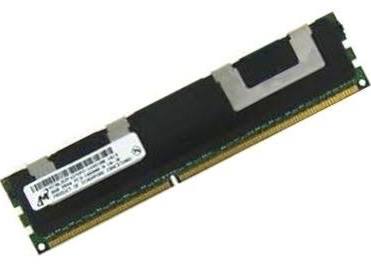
The Micron MTA18ASF2G72PDZ-2G6J1RI is unmistakably a server memory module—a DDR4 RDIMM built for enterprise infrastructure where downtime is measured in lost revenue. Its four defining characteristics translate directly into operational resilience for your data center.
First, ECC error correction safeguards against single-bit memory errors caused by background radiation, which become statistically inevitable when you run hundreds of gigabytes 24/7. In a virtualisation cluster hosting mission-critical VMs, an uncorrected bit flip can silently corrupt a financial transaction or crash a hypervisor; ECC ensures computational integrity your users can trust. Second, the registered signal buffer stabilises command and address lines, allowing you to fully populate all memory channels without degrading signal quality. This means you can confidently scale to 512 GB or beyond for an in-memory database like SAP HANA, where half-loaded channels would throttle real-time analytics.
The dual-rank x8 design interleaves accesses across two internal ranks, markedly improving bandwidth under heavy concurrency—vital when dozens of query threads compete for data in a Redis cluster. Finally, the 1.2 V DDR4 voltage reduces power draw per module, and at rack scale that difference cuts cooling overhead and operating cost while preserving clock-per-clock responsiveness. This RDIMM does not just meet a spec sheet; it directly prevents data corruption, enables denser configurations, and keeps your transactional workloads performing predictably under pressure.
General Virtualization
For general virtualization hosts, stability and capacity are key. Deploy six to eight of these 16 GB ECC RDIMMs to build a 96–128 GB memory pool, which comfortably supports dozens of mixed-workload VMs. Balance the modules equally across the server’s memory channels (for example, one DIMM per channel) to maintain optimal throughput while leaving room for future expansion.
In-Memory Database
In-memory databases demand both high capacity and uncompromising data integrity. Populate all available memory channels with these registered DIMMs to maximize interleaving and capacity—on a dual-socket server with six channels per CPU, twelve modules deliver 192 GB. The ECC and registered signal type help prevent silent data corruption in mission-critical transactional or analytical workloads.
High-Performance Computing (HPC)
HPC nodes need balanced bandwidth and low latency to feed parallel compute engines. Install eight or sixteen of these dual-rank x8 2666 MT/s RDIMMs per node (128–256 GB) in a symmetric channel population to avoid performance penalties from unbalanced configurations. This density supports large datasets in memory while the registered architecture ensures signal integrity across many modules under sustained heavy load.
Rigorously tested server memory, compatible with Dell PowerEdge R740, HPE ProLiant DL380 Gen10, Lenovo ThinkSystem SR650.
Q: Can I mix this MTA18ASF2G72PDZ-2G6J1RI with other memory modules of different brands or speeds?
A: Mixing is not recommended; RDIMMs require identical ECC, registered type, speed, and rank. Combining different brands or speeds risks instability and is unsupported in mission-critical servers.
Q: Is this memory compatible with my system?
A: This RDIMM is compatible with DDR4 servers using Intel Xeon Scalable or AMD EPYC processors that support 2666MHz registered ECC memory. Verify your motherboard supports 288-pin RDIMM.
Q: What is the recommended DIMM population order for optimal performance?
A: Follow your server motherboard manual; generally, populate identical DIMMs in the same-colored slots per channel, starting with the farthest slot from the CPU to enable balanced interleaving.
Q: Does this module support overclocking or XMP profiles?
A: No. This server RDIMM adheres to JEDEC DDR4-2666 standards only. Overclocking or XMP is not supported, ensuring 24/7 stability and data integrity in enterprise environments.
Q: What warranty and typical failure rate can I expect?
A: This module carries a one-year warranty. As an enterprise-class RDIMM, it boasts an extremely low annualized failure rate (AFR) typically under 0.5%, ensuring reliable operation.