











 Secure payments
Standard refund policy
Trade Assurance
Secure payments
Standard refund policy
Trade Assurance
| Product Type | Memory Module |
|---|---|
| Memory Capacity | 16 GB |
| Memory Technology | DDR4 |
| Product Voltage | 1.2V |
| RAM Speed | 2666MHz |
| RAM Standard | DDR4-2666/PC4-21300 |
| Error Identifying | ECC |
| Signal Type | Registered |
| Column Access Strobe (CAS) | CL19 |
| Rank | Dual Rank x4 |
| Quantity of Pins | 288-pin |
| RAM Genre | RDIMM |
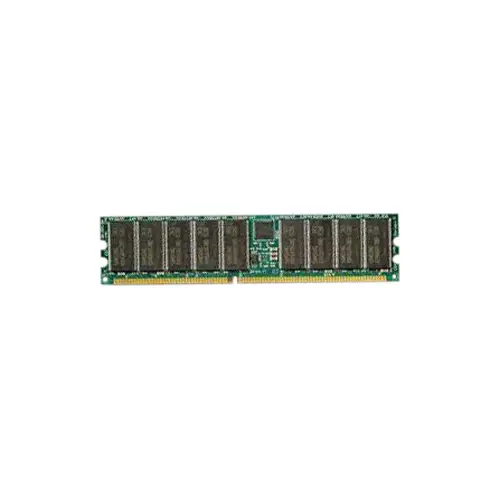
This DDR4-2666 Registered ECC module with dual-rank x4 organization is engineered for server platforms, delivering the data integrity and signal stability required by memory-intensive workloads such as virtualization and in-memory databases. Its 1.2V operating voltage and CL19 latency, combined with registered logic, ensure reliable performance in dense, multi-DIMM configurations where consistent error correction and reduced electrical loading are critical.
1. Registered signal type ensures stable command and address signaling across populated server channels, enabling seamless scaling for memory-intensive virtualization without compromising reliability.
2. ECC error correction actively detects and repairs bit-flip errors, preserving data integrity in always-on financial transactions and critical database operations.
3. Dual Rank x4 organization uses bank interleaving to maintain peak bandwidth utilization, reducing latency spikes when multiple VMs contend for memory access.
4. A 16-gigabyte capacity per stick serves as a dense building block for hyper-converged infrastructure, allowing higher guest density per rack unit while balancing power and cooling.
5. DDR4-2666 speed provides consistent throughput that keeps pace with modern multi-core server CPUs, preventing memory bottlenecks during simultaneous big-data analytics jobs.
The Micron MTA36ASF2G72PZ-2G6F1SI is a server-grade RDIMM engineered for mission-critical workloads, and its four defining characteristics translate directly into infrastructure resilience. True ECC error correction means silent data corruption from single-bit cosmic radiation events never compromises your financial transaction ledgers or in-memory database caches—every calculation stays provably accurate. Registered buffering with a dedicated command/address register stabilizes high-density server boards, allowing you to populate all 24 DIMM slots without signal degradation. That matters when your virtualized cluster running dozens of VMs cannot tolerate sporadic memory training failures during online capacity expansion. The dual-rank x4 architecture harnesses interleaved access to deliver consistent 2666MT/s bandwidth under parallel query storms; a Redis or memcached node serving millions of operations per second feels no latency cliffs even at near-peak utilization. Operating at 1.2V, it also trims thermal load in dense 1U nodes, helping sustain baseline frequency during sustained analytics runs. This module is not just compliant silicon—it directly preserves uptime, throughput, and result fidelity in hyperconverged and OLAP environments where a single uncorrected error translates into revenue loss.
General Virtualization
For a balanced virtualization host, populate six or eight identical 16GB RDIMMs across all memory channels to maximize bandwidth while leaving room for growth. A six-module configuration delivers 96GB, comfortably supporting 20–30 light-to-medium VMs. Always install modules in matched sets per CPU memory controller to maintain NUMA balance and optimal ECC performance.
In-Memory Database
In-memory databases like Redis or SAP HANA demand large, contiguous capacity and high reliability. Equip your server with at least 16 of these 16GB dual-rank RDIMMs (256GB) per socket, fully populating one DIMM per channel for maximum throughput. Scale to 384–512GB per socket if dataset growth is expected, and always leverage the ECC and registered features to prevent silent data corruption under sustained load.
HPC
High-performance computing clusters benefit from the combination of low-latency CL19 and registered ECC stability. Deploy one 16GB RDIMM per channel (typically 8 modules per node) to deliver 128GB of memory while sustaining 2666MT/s across all ranks. For bandwidth-sensitive simulations, avoid mixing ranks within a channel: keep configurations homogeneous to eliminate timing conflicts and ensure reproducible computational results.
Rigorously tested, compatible with Dell PowerEdge R740, HPE ProLiant DL380 Gen10, Lenovo ThinkSystem SR650.
Q: Can I mix this MTA36ASF2G72PZ-2G6F1SI with other memory modules of different brands or speeds?
A: Mixing RDIMMs of different brands or speeds is strongly discouraged in server environments. This module adheres to strict JEDEC specifications; mismatched DIMMs may force lower speeds, cause POST failures, or compromise ECC data integrity.
Q: Is this memory compatible with my Intel Xeon Scalable or AMD EPYC server platform?
A: This DDR4-2666 ECC Registered DIMM is compatible with platforms supporting 288-pin RDIMM at 1.2V, including Intel Xeon Scalable (Purley/Whitley) and AMD EPYC 7001/7002 series. Verify your board's Qualified Vendor List for this exact part.
Q: What is the recommended DIMM population order for optimal performance?
A: For balanced memory interleaving, populate identical DIMMs per channel, starting with the farthest slot from the CPU (usually slot 1). Follow your server motherboard's manual for specific slot numbering, ensuring symmetric configurations across all populated memory channels.
Q: Does this module support overclocking or XMP profiles?
A: No. As an enterprise-grade Registered ECC DIMM, this module runs strictly at the JEDEC standard DDR4-2666 speed. Overclocking and XMP are not supported; reliability and data integrity are prioritized over adjustable frequency.
Q: What warranty and typical failure rate can I expect?
A: This Micron memory module carries a 1-year warranty. It delivers enterprise-class reliability with an extremely low annualized failure rate (AFR) under typical server workloads, backed by rigorous factory testing.