











 Secure payments
Standard refund policy
Trade Assurance
Secure payments
Standard refund policy
Trade Assurance
| Product Type | Memory Module |
|---|---|
| Memory Capacity | 16 GB |
| Memory Technology | DDR4 |
| Product Voltage | 1.2V |
| RAM Speed | 2666MHz |
| RAM Standard | DDR4-2666/PC4-21300 |
| Error Identifying | ECC |
| Signal Type | Registered |
| Column Access Strobe (CAS) | CL19 |
| Rank | Dual Rank x4 |
| Quantity of Pins | 288-pin |
| RAM Genre | RDIMM |
Ideal for virtualization and in-memory database workloads, this 16GB DDR4-2666 RDIMM with ECC ensures critical data integrity in demanding server environments. Its dual-rank x4 architecture and registered signal type enhance signal stability and memory bandwidth, allowing reliable scaling across dense server configurations.
1. Registered buffering isolates the command/address bus from electrical loading, enabling large-scale server deployments to populate massive memory configurations without sacrificing signal integrity or uptime.
2. ECC protection corrects single-bit errors in real time, preserving data integrity for financial transactions, virtualization clusters, and mission-critical databases.
3. Dual-rank x4 organization interleaves memory accesses across internal banks, keeping channels fully utilized and delivering consistent bandwidth under heavy VM consolidation.
4. The 16 GB per DIMM density allows dense scaling to multi-terabyte footprints, maximizing guest instance density and accelerating in-memory analytics on a single server node.
5. DDR4-2666 transfer rates deliver the throughput needed to feed multi-core server CPUs, reducing memory stalls during simultaneous database queries and large-scale data processing.
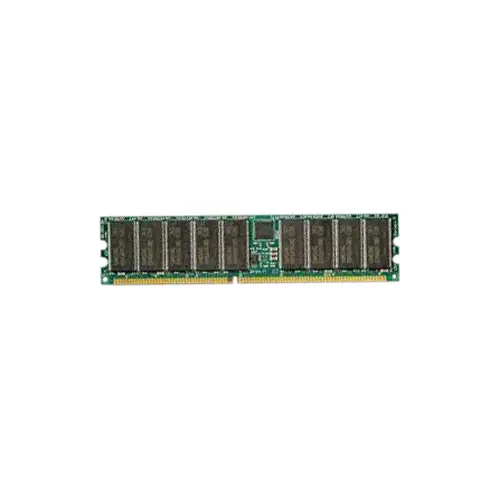
The MTA36ASF2G72PZ-2G6B1RI is a 16GB DDR4-2666 RDIMM purpose‑built for enterprise servers, and its four defining characteristics directly resolve real‑world pain points. ECC memory automatically corrects single‑bit errors induced by cosmic radiation or electrical noise, preventing silent data corruption that could crash a virtual machine or compromise a financial transaction record in a database. The registered interface buffers command signals, enabling you to fully populate all memory channels—up to 24 DIMMs—while maintaining rock‑solid signal integrity. This is essential in large virtualization clusters where hundreds of virtual desktops must run without stability degradation. The dual‑rank x4 organization leverages bank interleaving to substantially boost effective bandwidth; for an in‑memory analytics platform like Redis or SAP HANA, this translates directly into higher queries per second and lower latency under concurrent load. Operating at just 1.2V, it also reduces power consumption per module, which cumulatively cuts energy and cooling costs across dense server farms. When uptime is your KPI and every bit of data matters, this memory eliminates the hidden risks that gamble with your data integrity and performance.
General Virtualization
For a typical hypervisor hosting multiple VMs, populate the server with at least eight of these 16GB RDIMMs (128GB total) across all memory channels. Distribute the modules evenly per CPU socket to maintain balanced memory access and maximize bandwidth. This configuration provides ample headroom for memory overcommitment while preserving ECC protection against data corruption.
In-Memory Database
Latency-sensitive in-memory databases benefit from the high capacity and dual-rank design, but capacity is king. Deploy twelve or more modules (192GB+) to keep entire datasets resident in RAM, preferably in a symmetric population across channels. The registered ECC feature ensures data integrity during aggressive caching, and the x4 organization offers strong chip-level error correction for 24/7 operation.
High-Performance Computing
HPC workloads demand both bandwidth and reliability, so install one DIMM per channel across all available channels (typically 8 or 16 modules per node). The dual-rank x4 construction yields higher sustained bandwidth compared to single-rank DIMMs, which is critical for tightly coupled parallel tasks. Use identical 16GB RDIMMs in every slot to avoid performance penalties from unbalanced configurations and to ensure predictable runtimes under heavy floating-point loads.
Engineered for servers, rigorously validated. Compatible: Dell PowerEdge R760, HPE ProLiant DL380 Gen11, Lenovo ThinkSystem SR650 V3, and more.
Q: Can I mix this MTA36ASF2G72PZ-2G6B1RI with other memory modules of different brands or speeds?
A: Mixing RDIMMs of different brands or speeds is not recommended. It may cause instability, force lower speeds, or prevent boot. For guaranteed reliability, use identical modules.
Q: Is this memory compatible with my Intel Xeon Scalable or AMD EPYC server platform?
A: This DDR4-2666 ECC Registered DIMM is validated for Intel Xeon Scalable and AMD EPYC platforms supporting 288-pin RDIMMs. Verify your motherboard’s memory QVL for specific board compatibility.
Q: What is the recommended DIMM population order for optimal performance in a dual-socket server?
A: Follow your server motherboard’s manual. Typically, populate identical DIMMs per channel, starting with the slots farthest from the CPU, balancing across all memory channels for best interleaving and bandwidth.
Q: Does this module support overclocking or XMP profiles?
A: No. This is a JEDEC-compliant, registered server memory module operating at fixed 2666MHz with CL19. It does not support overclocking, XMP, or SPD-based performance profiles.
Q: What warranty and typical failure rate can I expect with this memory kit?
A: This module includes a 1-year warranty. As an enterprise-grade RDIMM built with Micron components, it delivers high reliability with a very low annualized failure rate, suitable for mission-critical workloads.