











 Secure payments
Standard refund policy
Trade Assurance
Secure payments
Standard refund policy
Trade Assurance
| Product Type | Memory Module |
|---|---|
| Compliance Standards | RoHS |
| Memory Capacity | 16 GB |
| Memory Technology | DDR4 |
| Product Voltage | 1.2 V |
| RAM Speed | 2666 MHz |
| RAM Standard | DDR4-2666/PC4-21300 |
| Error Identifying | ECC |
| Signal Type | Registered |
| Column Access Strobe (CAS) | CL19 |
| Rank | Dual Rank x8 |
| Quantity of Pins | 288-pin |
| RAM Genre | RDIMM |
This 16GB DDR4-2666 Registered DIMM, with ECC and a dual-rank x8 organization, is purpose-built for server platforms handling virtualization, in-memory databases, and mission-critical workloads where end-to-end data integrity is non-negotiable. Its registered signal architecture and dual-rank interleaving boost memory channel stability and bandwidth efficiency under heavy load, while the low 1.2V operating voltage and CL19 latency help balance power and responsiveness in dense rack deployments.
1. Registered signal buffering decouples the electrical load from the memory controller, enabling stable operation across fully populated server nodes even under maximum DIMM counts.
2. ECC protection provides real-time single-bit error correction, preserving data integrity for financial transactions and database workloads where silent corruption is unacceptable.
3. Dual Rank x8 organization interleaves access across multiple internal banks, sustaining high throughput for virtualized environments that run dozens of VMs per host.
4. A 16 GB capacity per module maximizes memory density in dual-socket platforms, allowing cloud providers to pack more tenant workloads per physical rack unit.
5. DDR4-2666 frequency balances cost-effective bandwidth with low latency, ideal for scale-out web servers and content delivery networks that demand consistent response times under steady traffic.
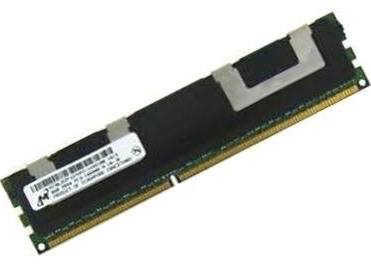
Built on the RDIMM architecture, the Micron MTA18ASF2G72PDZ-2G6B1 is a server-grade memory module engineered for environments where every transaction matters. In a dense virtualization cluster, its ECC technology silently corrects single-bit errors caused by background radiation; without this, a flipped bit in a running VM could corrupt hypervisor memory or crash a database instance, turning a silent hardware glitch into a costly service outage. The registered signal buffer then ensures electrical stability when all DIMM slots are populated, letting you confidently scale a host to 256 GB or more to run dozens of virtual machines without signal degradation. For an in-memory database handling thousands of concurrent queries, the dual-rank x8 organization interleaves access across internal banks, boosting effective bandwidth and lowering latency so real-time analytics return results faster under peak load. Finally, the 1.2 V operating voltage keeps thermal output low in dense 1U or 2U servers, reducing cooling strain and improving long-term energy efficiency in a 24/7 data center. It is not just memory; it is a reliability contract for your mission-critical infrastructure.
General Virtualization
For a typical hypervisor hosting 10–15 moderate VMs, a balanced 2-DIMM-per-channel configuration is ideal. Install four of these 16GB RDIMMs (64GB total) across two memory channels to avoid bottlenecks while leaving headroom for future scaling. This setup provides sufficient capacity for RAM overcommitment and live migration without excessive latency.
In-Memory Database
In-memory databases like Redis or SAP HANA demand both capacity and fault tolerance. Deploy a minimum of eight modules (128GB) in a balanced multi-channel layout, preferably one DIMM per channel, to maximize bandwidth. The ECC and registered features are critical here—they protect against silent data corruption during large in-memory table scans and ensure system stability under persistent load.
High-Performance Computing (HPC)
HPC workloads benefit from maximum memory bandwidth and moderate capacity per node. Populate all available channels symmetrically with one of these dual-rank 16GB RDIMMs per channel; for a dual-socket server with 8 channels per CPU, that yields 256GB. Dual-rank x8 modules offer a good compromise between signal integrity and rank interleaving, sustaining high throughput for tightly coupled parallel simulations.
Rigorously tested server memory compatible with Dell PowerEdge R740, HPE ProLiant DL380 Gen10, Lenovo ThinkSystem SR650, and more.
Q: Can I mix this MTA18ASF2G72PDZ-2G6B1 with other memory modules of different brands or speeds?
A: Mixing is not recommended. Mismatched modules may cause instability or force downclocking. For optimal reliability, populate all slots with identical Micron RDIMMs of the same speed, rank, and part number.
Q: Is this memory compatible with my system?
A: This DDR4-2666 RDIMM targets servers with Intel Xeon Scalable or AMD EPYC platforms supporting Registered ECC. Confirm your board’s QVL accepts 16GB dual-rank x8 modules.
Q: What is the recommended DIMM population order for optimal performance?
A: Follow your server’s manual. Typically, populate identical DIMMs in the first slot of each memory channel (e.g., A1, B1) to balance interleaving. Balanced configurations maximize bandwidth and RAS features.
Q: Does this module support overclocking or XMP profiles?
A: No. As an enterprise RDIMM, this memory operates strictly at JEDEC standard DDR4-2666 with no XMP or overclocking support. Stability and data integrity are prioritized over clock speed adjustments.
Q: What warranty and typical failure rate can I expect?
A: This module includes a one-year warranty. Enterprise RDIMMs exhibit extremely low failure rates under normal operating conditions, typically with an annualized failure rate (AFR) well below 1%. Proper cooling and qualified platforms ensure longevity.