











 Secure payments
Standard refund policy
Trade Assurance
Secure payments
Standard refund policy
Trade Assurance
| Product Type | Memory Module |
|---|---|
| Memory Capacity | 16 GB |
| Memory Technology | DDR4 |
| Product Voltage | 1.2 V |
| RAM Speed | 2666 MHz |
| RAM Standard | DDR4-2666/PC4-21300 |
| Error Identifying | ECC |
| Signal Type | Registered |
| Column Access Strobe (CAS) | CL19 |
| Rank | Single Rank x4 |
| Quantity of Pins | 288-pin |
| RAM Genre | RDIMM |
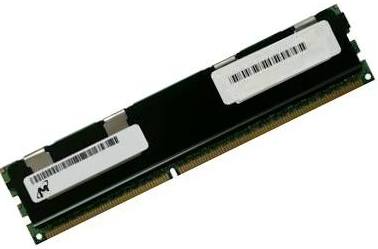
This Micron 16GB DDR4-2666 RDIMM, with its registered signal type and ECC, ensures robust data integrity and system stability crucial for virtualization and in-memory database workloads. Its single-rank x4 configuration reduces electrical loading on the memory bus, enabling higher population densities and consistent performance at a low 1.2V operating voltage.
1. ECC memory detects and corrects single-bit errors in real time, safeguarding transactional data integrity for mission-critical enterprise applications.
2. Registered signal buffering stabilizes command and address lines across fully loaded server boards, enabling reliable operation at scale in dense rack deployments.
3. 16 GB capacity per module allows higher memory density per channel, essential for consolidating more virtual machines without sacrificing guest performance.
4. 2666 MHz bandwidth sustains high throughput under parallel workloads, preventing memory bottlenecks during peak database access and multi-tenant cloud processing.
5. Single Rank x4 organization leverages x4 DRAM devices for finer-grained error containment and optimized channel utilization, critical for maintaining consistent latency in storage and compute nodes.
Built for the rigors of enterprise computing, the Micron MTA18ASF2G72PZ-2G6J1 is a 16GB DDR4-2666 RDIMM where four architectural features directly address the real-world pain points of data center operators. First, ECC error correction silently detects and corrects single-bit memory errors caused by background radiation—this means no silent data corruption in a virtualized cluster hosting dozens of financial transaction databases, eliminating costly application crashes. Second, the registered signal buffer stabilizes command and address lines when populating all memory channels in a hypervisor server, allowing you to confidently scale to 512GB or more for dense virtual machine consolidation without boot failures. Third, the 2666 MT/s speed with a bandwidth of 21.3 GB/s translates into noticeably faster in-memory database operations, such as Redis sorting massive user session tables or SAP HANA running real-time analytics, shaving critical milliseconds off query responses. Finally, the single-rank x4 organization reduces electrical loading on the memory bus compared to dual-rank alternatives, keeping the module stable at full speed even in fully loaded 24-DIMM systems. In virtualized infrastructure and memory-intensive databases, this combination delivers rock-solid data integrity, uncompromised scalability, and the sustained high bandwidth that your workload uptime depends on.
General Virtualization
For a typical hypervisor hosting mixed VMs, populate at least four of these 16 GB RDIMMs across dual-socket memory channels to achieve 64 GB total capacity. Deploy in a balanced configuration (e.g., 2 modules per CPU) to maintain uniform memory access and full ECC protection, which guards against soft errors during live migration.
In-Memory Database
In-memory databases demand both capacity and data integrity. For moderate datasets, install six to eight modules (96–128 GB) evenly across all memory channels, using the registered ECC feature to correct single-bit errors silently. For larger, mission-critical instances, fill every channel with a single 16 GB RDIMM to maximize bandwidth while leaving room for later scale‑out.
High-Performance Computing
HPC workloads benefit from high bandwidth and low latency. Equip each compute node with eight of these 16 GB DIMMs (128 GB total), placing one module per channel to enable eight‑channel parallelism. The 2666 MT/s speed and single‑rank x4 organization help maintain stable timings under sustained floating‑point loads, while ECC prevents data corruption throughout long simulation runs.
Rigorously tested for Dell PowerEdge R760, HPE ProLiant DL380 Gen10, Lenovo ThinkSystem SR650, and compatible servers.
Q: Can I mix this MTA18ASF2G72PZ-2G6J1 with other memory modules of different brands or speeds?
A: Mixing RDIMMs of different brands or speeds is not recommended in server environments. It often leads to signal integrity issues, forced downclocking, or system instability. Use identical Micron modules for validated reliability.
Q: Is this memory compatible with my Intel Xeon or AMD EPYC server platform?
A: Yes, this DDR4-2666 ECC Registered RDIMM complies with JEDEC standards and is validated for platforms like Intel Xeon Scalable (Skylake-SP/Cascade Lake) and AMD EPYC 7001/7002 series. Please verify your motherboard's QVL for specific support.
Q: What is the recommended DIMM population order for optimal performance?
A: Follow your server motherboard's manual. Generally, populate identical single-rank x4 DIMMs per channel starting with the farthest slot from the CPU. Balanced configurations (e.g., 1 DIMM per channel) maximize memory bandwidth.
Q: Does this module support overclocking or XMP profiles?
A: No. Server RDIMMs are locked to JEDEC standard timings at 2666 MT/s. Overclocking and XMP profiles are not supported, as stability and data integrity are prioritized in enterprise environments.
Q: What warranty and typical failure rate can I expect?
A: This module includes a one-year warranty. It is built with Micron’s enterprise-grade components and rigorous testing, yielding a very low annualized failure rate (AFR) typical of mission-critical server memory.