











 Secure payments
Standard refund policy
Trade Assurance
Secure payments
Standard refund policy
Trade Assurance
| Product Type | Memory Module |
|---|---|
| Memory Capacity | 16 GB |
| Memory Technology | DDR4 |
| Product Voltage | 1.2 V |
| RAM Speed | 2666 MHz |
| RAM Standard | DDR4-2666/PC4-21300 |
| Error Identifying | ECC |
| Signal Type | Registered |
| Column Access Strobe (CAS) | CL19 |
| Rank | Dual Rank x8 |
| Quantity of Pins | 288-pin |
| RAM Genre | RDIMM |
Designed specifically for server environments, this 16GB DDR4-2666 RDIMM with ECC and registered signal technology ensures robust data integrity and system stability critical for virtualization and in-memory databases. Its dual-rank x8 configuration improves interleaving efficiency to boost memory bandwidth under heavy multi-threaded workloads.
1. ECC protection silently corrects memory errors in real time, safeguarding transactional integrity for financial databases and virtualized workloads where even a single-bit flip could cause costly corruption.
2. The registered buffer relieves electrical loading on the memory controller, allowing fully populated server nodes to operate with unwavering signal stability across all DIMM slots.
3. Ample module capacity provides the headroom needed to consolidate numerous virtual machines or containers on a single host, maximizing consolidation ratios without triggering performance-sapping swapping.
4. The memory’s rated frequency sustains high sustained bandwidth for concurrent analytics and in-memory caching, preventing throughput bottlenecks when multiple tenants hammer the data path simultaneously.
5. Dual rank interleaving orchestrates parallel access across internal bank groups, saturating the channel efficiently and reducing average access latency under the heavily multi-threaded workloads typical of enterprise servers.
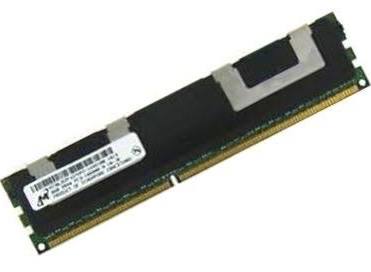
The Micron MTA18ASF2G72PDZ-2G6J1R is a 16GB DDR4-2666 RDIMM purpose-built for enterprise servers. Its ECC engine detects and corrects single-bit errors, eliminating silent data corruption that could crash a virtual machine or poison transactional records in an in-memory database like Redis. The registered buffer isolates the CPU’s memory controller from electrical loads, so you can fill every DIMM slot in a hypervisor cluster and maintain unwavering stability—directly raising VM density. The dual-rank x8 organization leverages rank interleaving, surging effective bandwidth to accelerate massive table scans in analytics platforms such as SAP HANA. Running at a lean 1.2V and 2666MT/s, it combines a robust 21.3 GB/s throughput with exceptional energy efficiency that shrinks your cooling envelope. For IT managers, this translates into fewer service interruptions, more containers or VMs per node, and significantly reduced operational cost over the lifecycle of mission-critical infrastructure.
General Virtualization
For a hypervisor hosting multiple VMs, populate at least four of these 16 GB RDIMMs (64 GB total) across balanced memory channels to maximize throughput and leave room for growth. Use identical dual-rank x8 modules and install them in matched sets per CPU socket to maintain NUMA locality and avoid performance penalties on memory-intensive guest workloads.
In‑Memory Database
Deploy six to eight modules per server node to reach 96–128 GB, enabling large datasets to reside entirely in RAM while leveraging registered ECC protection against bit-flips. Fill all available channels with uniform RDIMMs and keep one DIMM per channel initially to sustain high bandwidth; scale by adding a second DIMM per channel only if latency requirements permit the slight speed trade-off.
High‑Performance Computing
Equip each compute node with a full set of eight 16 GB modules (128 GB) configured in a balanced multi‑channel layout to feed data-hungry MPI jobs. The registered ECC design at 1.2 V and 2666 MT/s delivers stable, low‑power operation under sustained load, and the dual‑rank construction helps saturate memory bandwidth—critical for tightly coupled parallel simulations.
Rigorously tested server memory, compatible with Dell R760, HPE DL380, Lenovo SR650.
Q: Can I mix this MTA18ASF2G72PDZ-2G6J1R with other memory modules of different brands or speeds?
A: Mixing registered ECC modules is strongly discouraged. Differing brands, speeds or ranks can cause signal integrity issues, system instability or even prevent boot on server platforms. Always use identical matched kits for validated reliability.
Q: Is this memory compatible with my system? Which Intel or AMD server platforms are supported?
A: It is compatible with servers using Intel Xeon Scalable or AMD EPYC processors that support DDR4-2666 ECC Registered DIMMs. Please consult your motherboard’s qualified vendor list to confirm dual-rank x8 RDIMM support.
Q: What is the recommended DIMM population order for optimal performance?
A: Follow your server vendor’s specific memory population guide. Typically, populate identical modules per channel, starting with the farthest slot from the CPU socket (often blue or white) to balance interleaving and maximize bandwidth.
Q: Does this module support overclocking or XMP profiles?
A: No. This is a JEDEC-compliant DDR4-2666 registered ECC server memory module. It does not support user overclocking, memory tuning profiles such as XMP, or voltage adjustments to guarantee platform-level data integrity.
Q: What warranty and typical failure rate can I expect?
A: This module carries a one-year warranty. As an enterprise-grade RDIMM, it exhibits very low annualized failure rates, typically under 0.5%, and is backed by rigorous testing to deliver high mission-critical reliability.