











 Secure payments
Standard refund policy
Trade Assurance
Secure payments
Standard refund policy
Trade Assurance
| Product Type | Memory Module |
|---|---|
| Memory Capacity | 16 GB |
| Memory Technology | DDR4 |
| Product Voltage | 1.2V |
| RAM Speed | 2666MHz |
| RAM Standard | DDR4-2666/PC4-21300 |
| Error Identifying | ECC |
| Signal Type | Unbuffered |
| Column Access Strobe (CAS) | CL19 |
| Rank | Dual Rank x8 |
| Quantity of Pins | 288-pin |
| RAM Genre | UDIMM |
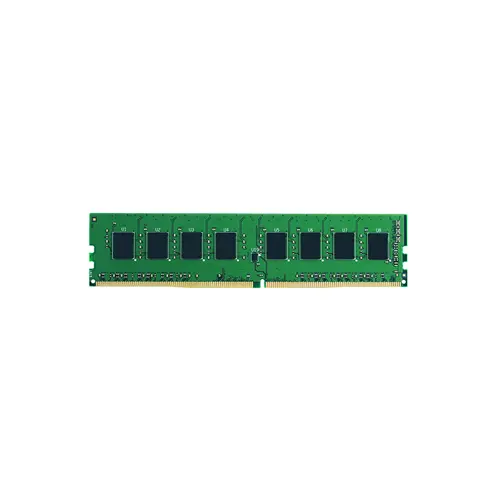
This 16GB DDR4-2666 ECC Unbuffered DIMM, built with a dual-rank x8 organization, is engineered for entry-level servers and workstations where data integrity in applications like file serving, virtualization, or CAD is non-negotiable. Its 1.2V operating voltage and unbuffered signal type maintain broad chipset compatibility, while the ECC and dual-rank architecture work together to enhance memory bandwidth efficiency and silently correct single-bit errors for sustained stability under continuous load.
1. A 16 GB per module capacity equips compact single-socket servers with the memory footprint to host more virtual machines, raising consolidation density without occupying all DIMM slots.
2. The 2666 MT/s throughput sustains concurrent multi-threaded database transactions, preventing memory bottlenecks when query volumes spike in always-on business applications.
3. ECC protection actively corrects single-bit errors, preserving end-to-end data integrity for critical workloads in financial and healthcare server environments that cannot tolerate silent corruption.
4. Unbuffered signal topology shaves off access latency, making it a pragmatic fit for entry-level servers and edge compute nodes where responsiveness and cost-per-transaction outweigh raw scalability.
5. Dual rank x8 organization amplifies effective bandwidth through rank interleaving, accelerating in-memory analytics and virtualized service response under mixed load.
In virtualized server clusters and in-memory databases, data integrity is non-negotiable. The Micron MTA18ASF2G72AZ-2G6D1ZG, a 16GB DDR4-2666 ECC Unbuffered DIMM, is built to eliminate silent data corruption that can crash hypervisors or poison transactional caches. Its ECC corrects single-bit errors in real time, keeping your VMs and Redis instances error-free even under 24/7 operation. The dual-rank x8 design overlaps data streams across rank boundaries, boosting effective bandwidth for concurrent workloads: picture multiple VMs migrating live or a database executing high-frequency queries without stutter. Because the module uses an unbuffered architecture, it avoids the extra clock cycle penalties of registered memory, directly reducing latency for financial trading algorithms or real-time analytics. Operating at just 1.2V, it further lowers power draw and cooling overhead in dense 1U servers, cutting energy costs while sustaining 2666MT/s throughput. For IT teams managing lean budgets and demanding uptime targets, this means predictable service continuity, snappier application response, and a cost-efficient infrastructure that scales reliably.
Based on the specifications—DDR4-2666, ECC, Unbuffered, 288-pin UDIMM—this is server memory designed for entry-level servers and workstations that support ECC UDIMMs. Below is the capacity planning guidance for typical server workloads.
General Virtualization
With a 16 GB ECC UDIMM, populate at least four identical modules (64 GB total) across all memory channels to maximize bandwidth and maintain balanced virtual machine density. For modest hypervisor hosts running 10–15 light VMs, a 4x16 GB configuration provides headroom while ECC protects against data corruption in multi-tenant environments.
In-Memory Database
In-memory databases demand both capacity and data integrity. Deploy eight 16 GB modules (128 GB total) across both CPU memory controllers in a dual-socket capable platform, populating one DIMM per channel to avoid latency penalties from mixed ranks. The CL19 dual-rank x8 design helps sustain throughput under heavy read/write workloads, but ensure your dataset fits entirely in RAM to avoid swapping.
High-Performance Computing (HPC)
For memory-bandwidth-sensitive HPC jobs, fill all available channels symmetrically—ideally six or eight identical 16 GB ECC UDIMMs for a per-socket configuration of 96–128 GB. This balanced population enables maximum interleaving and minimizes NUMA latencies. ECC is critical for long-running simulations where silent memory errors could invalidate results, and the 2666 MT/s speed provides a reliable baseline for compute-bound applications.
Rigorously tested server-grade ECC UDIMM, compatible with Dell PowerEdge T140/T340, HP Z4 G4, Lenovo ThinkStation P520.
Q: Can I mix this MTA18ASF2G72AZ-2G6D1ZG with other memory modules of different brands or speeds?
A: Mixing is not recommended for server-class ECC UDIMMs. Different brands or speeds may force the memory controller to downclock all DIMMs to the lowest common speed, compromise ECC stability, and cause system instability.
Q: Is this memory compatible with my system? (Please specify Intel or AMD server platform)
A: This 16GB DDR4-2666 ECC UDIMM is compatible with platforms supporting unbuffered ECC memory, such as Intel Xeon E-2100/E-2200 series or AMD Ryzen Pro processors. Verify your motherboard's QVL for official support.
Q: What is the recommended DIMM population order for optimal performance?
A: Populate identical DIMMs in matching slots (usually same color) per the server board's manual, starting with the first channel. For dual-rank modules, populate one DIMM per channel to achieve full 2666MHz speed and dual-channel operation.
Q: Does this module support overclocking or XMP profiles?
A: No, this server-grade ECC UDIMM strictly adheres to JEDEC standard DDR4-2666 timings (CL19). It does not support XMP or manual overclocking to ensure data integrity and long-term reliability in mission-critical environments.
Q: What warranty and typical failure rate can I expect?
A: This Micron module includes a 1-year warranty. Enterprise-class modules undergo rigorous screening, yielding an extremely low annualized failure rate (typically <0.1%), ensuring dependable 24/7 operation.