











 Secure payments
Standard refund policy
Trade Assurance
Secure payments
Standard refund policy
Trade Assurance
| Product Type | Memory Module |
|---|---|
| Memory Capacity | 16 GB |
| Memory Technology | DDR4 |
| Product Voltage | 1.2V |
| RAM Speed | 2666MHz |
| RAM Standard | DDR4-2666/PC4-21300 |
| Error Identifying | ECC |
| Signal Type | Unbuffered |
| Column Access Strobe (CAS) | CL19 |
| Rank | Dual Rank x8 |
| Quantity of Pins | 288-pin |
| RAM Genre | UDIMM |
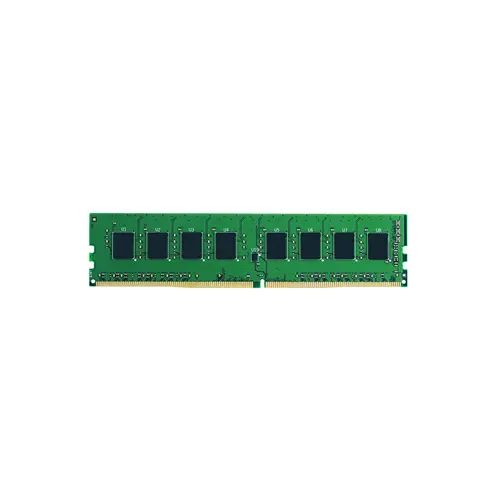
This UDIMM with ECC is tailored for entry-level servers and workstations, providing reliable data integrity for virtualized environments and memory-intensive applications. Its dual-rank x8 organization and unbuffered signal path deliver low latency alongside efficient error correction, ensuring stable performance at DDR4-2666 with a CAS latency of 19.
1. ECC protection actively detects and corrects single-bit memory errors, safeguarding transactional data integrity in always-on server environments where even silent corruption is unacceptable.
2. Dual Rank x8 organization increases bank-level parallelism, delivering higher sustained bandwidth for virtualized workloads and containerized microservices under concurrent access.
3. 16 GB capacity enables denser consolidation of lightweight VMs or edge analytics containers, optimizing cost-per-instance on entry-level server nodes.
4. 2666 MHz speed provides ample throughput for common IT infrastructure tasks, ensuring responsive performance in file serving, DNS, and directory services roles.
5. Unbuffered signaling eliminates the register latency of RDIMMs, reducing memory access delays for latency-sensitive applications deployed on small-business or branch-office servers.
Designed as a server-grade UDIMM with ECC, the MTA18ASF2G72AZ-2G6 is purpose-built for entry-level servers, small business virtualized hosts, and workstations running memory-intensive applications where data integrity and uptime are non-negotiable. In a virtualization cluster hosting multiple VMs, a single undetected bit flip can corrupt databases or crash services. ECC actively detects and corrects single-bit errors, preventing silent data corruption and dramatically reducing the risk of unexplained outages during financial transactions or customer-facing operations. Meanwhile, the unbuffered architecture delivers lower latency by directly connecting memory chips to the CPU, which is critical for an in-memory database like Redis or Memcached. Every microsecond saved on each query compounds into a tangible performance gain under heavy concurrent loads. The dual-rank x8 organization further interleaves memory accesses, boosting bandwidth by enabling the controller to pipeline commands across ranks without stalling—this keeps response times tight when analytics dashboards refresh during peak hours. Operating at 1.2V standard DDR4 voltage, the module also reduces thermal stress inside compact 1U enclosures, preserving long-term reliability and lowering cooling costs without sacrificing the 2666MHz throughput that feeds modern multi-core Xeon E or Ryzen Pro platforms.
Based on the specifications—DDR4-2666, ECC, Unbuffered, 288-pin UDIMM—this is a server-grade memory module commonly used in entry-level servers and small business systems. Below is the capacity planning guidance for typical server workloads.
General Virtualization
For a small virtualization host, start with two 16GB modules (32GB total) to enable dual-channel operation and leave room for growth. Populate identical modules in pairs across memory channels to maintain balanced performance. This configuration comfortably supports 8–10 lightweight VMs. Scale by adding matched pairs up to the board’s maximum; avoid single-channel setups that bottleneck memory throughput.
In-Memory Database
In-memory databases thrive on capacity and memory bandwidth. Install four 16GB UDIMMs (64GB total) to populate all primary channels of a typical single-socket server, ensuring maximum throughput via symmetric population. For larger datasets, use the highest supported population count—often up to 8 modules—in balanced groups. Prioritize identical ranks and speeds: these dual-rank x8 DIMMs offer good latency, but mixing capacities breaks interleaving and hurts performance.
High-Performance Computing (HPC)
HPC nodes benefit from both bandwidth and capacity. In a dual-socket server, install six or eight 16GB modules (96–128GB) evenly across processors to exploit all memory channels. Follow the motherboard’s population guide strictly—usually one DIMM per channel first—to maximize bandwidth. Use identical ECC UDIMMs throughout; mismatched configurations disable optimal interleaving and can cause node-level performance anomalies in tightly coupled parallel jobs.
Rigorously tested, proven compatible with Dell PowerEdge T140/T340, HPE ProLiant ML30 Gen10, Lenovo ThinkSystem ST50.
Q: Can I mix this MTA18ASF2G72AZ-2G6 with other memory modules of different brands or speeds?
A: Mixing with different brands or speeds is not recommended. Even if the system boots, ECC server platforms require strictly matched modules to guarantee data integrity and stable operation. Use identical part numbers for optimal reliability.
Q: Is this memory compatible with my server or workstation system?
A: This is a DDR4-2666 ECC UDIMM for Intel Xeon E-2100/E-2200, or AMD Ryzen/Threadripper with ECC-enabled motherboards (e.g., C242, C246, B550, X570). Verify your board supports unbuffered ECC memory before purchase.
Q: What is the recommended DIMM population order for optimal performance?
A: Follow your motherboard manual: typically populate one DIMM per channel first, starting from the slot farthest from the CPU. For dual-channel systems, install modules in identical pairs to achieve full memory bandwidth.
Q: Does this module support overclocking or XMP profiles?
A: No. This JEDEC-standard ECC UDIMM operates at a fixed 2666MHz with CL19 latency. It does not support XMP or manual overclocking, as it is engineered for maximum stability in always-on server and workstation environments.
Q: What warranty and typical failure rate can I expect?
A: This module includes a 1-year warranty. Built with Micron qualified ECC components, its failure rate is extremely low under normal server operating conditions, ensuring dependable long-term data protection in mission-critical applications.