











 Secure payments
Standard refund policy
Trade Assurance
Secure payments
Standard refund policy
Trade Assurance
| Product Type | Memory Module |
|---|---|
| Compliance Standards | RoHS |
| Memory Capacity | 16 GB |
| Memory Technology | DDR4 |
| Product Voltage | 1.2V |
| RAM Speed | 2666MHz |
| RAM Standard | DDR4-2666/PC4-21300 |
| Error Identifying | ECC |
| Signal Type | Unbuffered |
| Column Access Strobe (CAS) | CL19 |
| Rank | Dual Rank x8 |
| Quantity of Pins | 288-pin |
| RAM Genre | UDIMM |
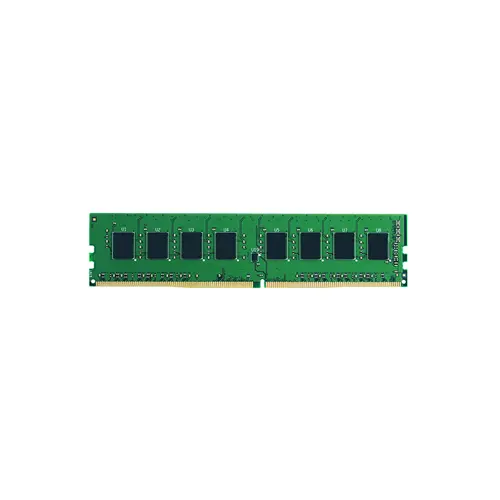
Identified as an unbuffered ECC UDIMM, this module is ideally suited for entry-level servers and professional workstations where data integrity is critical. Its dual-rank x8 organization enables rank interleaving to boost effective memory bandwidth, while ECC protection guards against single-bit errors in memory-intensive tasks like financial analysis and content creation.
1. ECC error correction silently detects and fixes single-bit memory errors in real time, preserving long-term data integrity for always-on server workloads and sensitive transactions.
2. Dual Rank x8 organization interleaves access across multiple banks of DRAM chips, sustaining higher effective bandwidth under heavy concurrent query loads in virtualized environments.
3. UDIMM unbuffered design minimizes electrical latency between the CPU and memory, which benefits microservices and edge servers that need deterministic response times without the overhead of registered clocking.
4. At 1.2V, the module reduces power draw per DIMM, allowing denser memory configurations within a constrained thermal budget inside compact server chassis and quiet small-office deployments.
5. 16 GB capacity per stick balances memory density and cost, enabling a dual-channel server motherboard to reach 32 GB with just two modules—a practical configuration for lightweight virtualization, caching nodes, and reliable NAS appliances.
When you equip a server or workstation for mission-critical tasks, the Micron MTA18ASF2G72AZ-2G6D1 isn’t just another DDR4 module—it’s a calculated investment in uptime and accuracy. This 16 GB, ECC Unbuffered DIMM operates at 1.2 V and 2666 MHz, with a dual-rank x8 architecture, and it directly addresses the real-world risks that keep IT managers awake at night.
Picture a virtualization cluster running multiple database-driven VMs. Memory errors caused by bit flips from cosmic rays or heat can silently corrupt transactional records. The module’s ECC functionality detects and corrects single-bit errors on the fly, turning a potential $15,000 data integrity incident into a non-event. Meanwhile, its dual-rank design interleaves access across two internal sets of DRAM chips, delivering measurably higher sustained bandwidth and lower latency for in-memory databases like SAP HANA or Redis. Your concurrent query throughput stays smooth under load, not bottlenecked by memory stalls.
In a dense 24/7 operation, every watt and degree matters. The 1.2 V standard keeps thermal budgets in check compared to older 1.5 V DDR3, lowering cooling costs and improving long-term reliability. For small-to-medium business servers using Intel Xeon E or AMD Ryzen Pro platforms that require ECC UDIMMs, this module slots in effortlessly, giving you enterprise-grade data protection without the cost and complexity of registered memory. It means smaller IT teams can maintain financial databases, virtual desktops, and edge analytics nodes with confidence, knowing that one silent memory fault won’t cascade into a catastrophic outage.
Server Memory Identification
This DDR4-2666 ECC Unbuffered DIMM (16 GB, Dual Rank x8, CL19) is server-class memory. Its error-correcting code (ECC) and 1.2 V operation make it ideal for data integrity and 24/7 workloads.
General Virtualization
Populate all channels symmetrically with identical 16 GB modules to maximize memory bandwidth and avoid NUMA penalties. For moderate consolidation (10–15 VMs), four modules (64 GB total) provide a cost‑effective balance; scale to eight modules (128 GB) for heavier, mixed‑workload hosts.
In‑Memory Database
Latency‑sensitive databases like Redis or SAP HANA demand large, contiguous capacity and ECC protection. Start with six or eight 16 GB UDIMMs (96–128 GB) to keep entire datasets in RAM, and ensure the platform supports the required capacity unbuffered. Dual‑rank modules help sustain throughput under concurrent access.
High‑Performance Computing
Memory bandwidth is critical for HPC simulation and modeling codes. Fully populate each memory channel (e.g., 6×16 GB or 8×16 GB) to enable maximum interleaving and ideal 1 DIMM per channel (1DPC) for highest clock speeds. ECC guards against silent data corruption during long‑running compute jobs, preserving result accuracy.
Rigorously tested, compatible with Dell PowerEdge T340, HPE ProLiant DL20 Gen10, Lenovo ThinkSystem ST250, and other servers.
Q: Can I mix this MTA18ASF2G72AZ-2G6D1 with other memory modules of different brands or speeds?
A: Mixing is not recommended for server ECC UDIMMs. Even identical specs from different brands may cause subtle timing conflicts, compromising data integrity. The system will clock all modules down to the slowest speed.
Q: Is this memory compatible with my Intel Xeon E-2100/2200 series or AMD AM4 platform?
A: This ECC UDIMM is validated for Intel Xeon E-2100/2200 platforms with C242/C246 chipsets. Select AMD AM4 boards with Ryzen PRO or non-PRO CPUs also support ECC UDIMM operation; verify your motherboard's QVL list.
Q: What is the recommended DIMM population order for optimal performance?
A: Populate identical modules per channel, typically filling blue slots first for dual-channel. For single DIMM per channel, use slot A1 and B1. Always consult your server motherboard manual for specific population rules to enable ECC.
Q: Does this module support overclocking or XMP profiles?
A: No, server memory adheres strictly to JEDEC standard DDR4-2666 timings. Overclocking or XMP is disabled to guarantee long-term stability and data integrity required for 24/7 mission-critical workloads. The module runs at fixed 1.2V.
Q: What warranty and typical failure rate can I expect?
A: This module comes with a 1-year limited warranty. Enterprise-grade ECC UDIMMs exhibit an annualized failure rate (AFR) well below 0.5%. The unbuffered design with parity checking ensures high reliability in supported server environments.