











 Secure payments
Standard refund policy
Trade Assurance
Secure payments
Standard refund policy
Trade Assurance
| Product Type | Memory Module |
|---|---|
| Memory Capacity | 16 GB |
| Memory Technology | DDR4 |
| Product Voltage | 1.2V |
| RAM Speed | 2933MHz |
| RAM Standard | DDR4-2933/PC4-23400 |
| Error Identifying | ECC |
| Signal Type | Registered |
| Column Access Strobe (CAS) | CL21 |
| Rank | Single Rank x4 |
| Quantity of Pins | 288-pin |
| RAM Genre | NVDIMM |
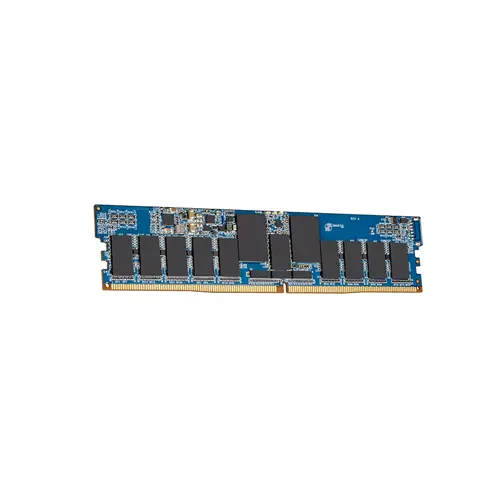
This 16GB DDR4-2933 registered NVDIMM with ECC is designed for enterprise servers that demand data persistence, making it an optimal fit for in-memory databases and heavily virtualized infrastructures. Its single-rank x4 architecture minimizes bus loading for signal integrity at speed, while the integrated NAND flash and on-module power backup autonomously commit critical DRAM contents to non-volatile storage during a power failure, safeguarding transactional data without software intervention.
1. NVDIMM technology empowers the module to retain critical data during unexpected power failures, ensuring transactional integrity for financial databases and low-latency storage caches.
2. ECC protection continuously corrects single-bit errors, preventing silent data corruption in high-availability virtualization clusters that run 24/7.
3. Registered signal architecture stabilizes command and address lines across fully populated memory channels, enabling large-capacity server configurations with dozens of DIMMs per node.
4. Sixteen-gigabyte capacity per stick provides the right density sweet spot for virtualized infrastructure, balancing ample guest memory per socket with manageable rank populations.
5. 2933 MT/s throughput elevates interleaved bandwidth across multi-core Xeon processors, directly accelerating in-memory analytics and heavy containerized workloads.
The Micron MTA18ASF2G72XF1Z-2G9 is a server-class DDR4-2933 Registered ECC NVDIMM, purpose-built for data centers where every bit matters and downtime is not an option. Its four defining characteristics translate directly into business resilience. First, Error Correcting Code (ECC) silently detects and corrects single-bit memory errors, preventing cosmic-ray-induced data corruption that can crash a virtual machine or poison a database transaction. Paired with Registered (RDIMM) signal buffering, this module keeps voltage stable across fully populated 24-DIMM slots, so you can confidently scale virtualization clusters without intermittent memory faults under heavy load. Second, the 2933 MT/s speed with a low 1.2V operating envelope delivers high bandwidth for in-memory databases like SAP HANA or Redis, accelerating real-time analytics. Most critically, NVDIMM persistence changes the game: in a virtualized farm, a power loss no longer wipes the entire memory state—vital VMs can recover in seconds rather than hours. For an in-memory database, a restart means instant data availability from the persistent module, not a painful reload from slow storage. This memory is not just an upgrade; it is a safety net and a performance multiplier for mission-critical workloads.
This memory is a server-class module: 16GB DDR4-2933, ECC, Registered, NVDIMM (288-pin, Single Rank x4). It’s designed for data integrity, persistence, and high-reliability platforms. Below is the capacity planning guidance for typical server workloads.
General Virtualization
Populate at least one DIMM per memory channel to maximize bandwidth and balance across NUMA nodes. A common configuration uses 8 to 16 identical 16GB modules (128–256 GB total) per dual-socket host, allowing you to run 20–30 typical VMs with ample headroom for ballooning and failover. Leave at least 2 DIMM slots free for future scaling without disrupting existing architectures.
In-Memory Database
Capacity is king. Fill all available channels and aim for the maximum supported DIMM-per-channel (DPC) count while maintaining acceptable speed—often 2 DPC with these 16GB modules. For example, a 24-slot server equipped entirely with these modules yields 384 GB, enabling large in-memory datasets, fast Redis or SAP HANA instances, and minimizing NUMA latencies by grouping memory close to the CPU socket that hosts the database process.
High-Performance Computing
Bandwidth-sensitive HPC jobs benefit from a balanced, one-DIMM-per-channel configuration to maintain the 2933 MT/s speed and avoid interleaving penalties. Install 8 or 12 identical 16GB modules in a fully populated channel layout (128–192 GB) on a dual-socket platform. If the workload demands more capacity, scale symmetrically by adding a second DIMM to each channel to preserve uniform memory access and consistent performance across all cores.
Validated for Dell PowerEdge R740, HPE ProLiant DL380 Gen10, Lenovo ThinkSystem SR650 — rigorously tested.
Q: Can I mix this MTA18ASF2G72XF1Z-2G9 with other memory modules of different brands or speeds?
A: Mixing Registered ECC NVDIMMs from different brands or speeds is not advised. It often causes POST failures and system instability. For guaranteed reliability, always populate with identical Micron modules.
Q: Is this memory compatible with my Intel Xeon or AMD EPYC server platform?
A: This DDR4-2933 Registered ECC NVDIMM is validated for Intel Xeon Scalable and AMD EPYC 7002/7003 series. Ensure your board supports persistent memory and check the qualified vendor list for exact model support.
Q: What is the recommended DIMM population order for optimal performance?
A: Follow your server's memory population guide. Typically, install identical modules in matched slots per channel, filling blue slots first. Balanced configuration across CPU memory controllers ensures maximum throughput and NVDIMM data persistence.
Q: Does this module support overclocking or XMP profiles?
A: No. This is a JEDEC-standard DDR4-2933 CL21 Registered ECC NVDIMM. Overclocking and XMP are not supported on server-class memory. Timings are fixed to ensure data integrity and platform stability.
Q: What warranty and typical failure rate can I expect?
A: This Micron NVDIMM carries a 1-year warranty. Enterprise-grade modules demonstrate an annualized failure rate (AFR) below 0.2%, backed by rigorous testing for 24/7 mission-critical operations.