











 Secure payments
Standard refund policy
Trade Assurance
Secure payments
Standard refund policy
Trade Assurance
| Product Type | Memory Module |
|---|---|
| Memory Capacity | 16 GB |
| Memory Technology | DDR4 |
| Product Voltage | 1.2 V |
| RAM Speed | 2933 MHz |
| RAM Standard | DDR4-2933/PC4-23400 |
| Error Identifying | ECC |
| Signal Type | Registered |
| Column Access Strobe (CAS) | CL21 |
| Rank | Dual Rank x8 |
| Quantity of Pins | 288-pin |
| RAM Genre | RDIMM |
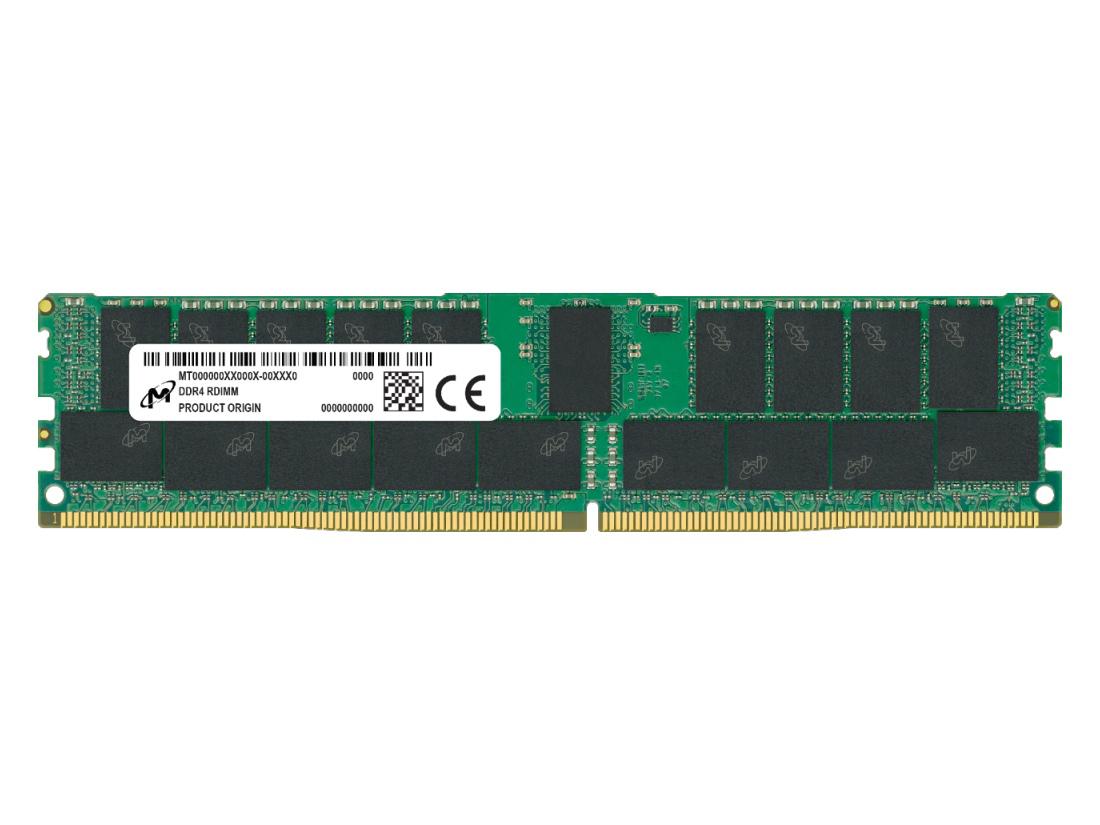
This is a server-grade DDR4-2933 Registered DIMM with ECC, optimized for virtualization, in-memory databases, and mission-critical workloads that demand uncompromising data integrity. Its dual-rank x8 organization maximizes interleaving and memory bandwidth, while the registered signal type stabilizes signal integrity in densely populated platforms, ensuring reliable operation under sustained heavy loads.
1. ECC protection corrects single-bit errors and detects multi-bit corruption, safeguarding financial transactions and database integrity in mission-critical server environments.
2. Registered signal buffering stabilizes command and address lines, enabling large memory populations across many DIMM slots without compromising system reliability under sustained load.
3. Dual Rank x8 organization interleaves memory accesses across two internal rank groups, boosting effective bandwidth for heavily consolidated virtualization workloads.
4. A 2933 MHz clock rate elevates per-channel throughput, reducing latency in memory-hungry analytics platforms and in-memory caching clusters.
5. Sixteen-gigabyte capacity per module strikes a dense yet cost-efficient balance, allowing a 1U dual-socket server to host dozens of moderate-memory VMs without exhausting DIMM slots.
Engineered for enterprise servers, the Micron MTA18ASF2G72PDZ-2G9J1 RDIMM transforms how your data center tackles demanding workloads. Its ECC technology continuously detects and corrects single-bit memory errors, preventing silent data corruption that could crash an in-memory database like SAP HANA or Redis during peak transaction processing—this means no lost orders or compromised analytics. The registered buffer stabilizes signal integrity when you fully populate server slots, so a virtualized cluster running dozens of VMs on VMware or Hyper‑V scales seamlessly to 512 GB and beyond without boot failures or unpredictable reboots. A dual‑rank x8 design activates internal banks in parallel, elevating bandwidth and concurrency so multi‑threaded database queries and container orchestration platforms like Kubernetes run noticeably faster even under heavy load. With a 2933 MT/s transfer speed and a sensible CL21 latency, data flows into the CPU swiftly, shrinking query response times and letting you squeeze every ounce of performance from modern Xeon processors. Every feature directly protects uptime, accelerates mission‑critical applications, and extends the usable lifespan of your server investment.
This 16 GB DDR4-2933 ECC Registered DIMM is server-grade memory designed for reliable, high-density deployments. The following planning guidance addresses three common enterprise workloads.
General Virtualization
Populate memory channels evenly to maximize bandwidth for hypervisor hosts running numerous VMs. In a dual-socket server, install eight identical 16 GB modules per processor (128 GB per CPU) to support dozens of general-purpose VMs, leaving room for scale. Use balanced DIMM quantities across channels to avoid bottlenecks.
In-Memory Database
In-memory databases require large capacity and consistent low latency. Fully populate all memory channels with identical 16 GB RDIMMs for optimal interleaving. Begin with 256 GB (16 × 16 GB) per node for platforms like SAP HANA or Redis, and scale to 512 GB or more, maintaining NUMA-aware configurations to prevent remote memory access penalties.
High-Performance Computing (HPC)
HPC workloads benefit from balanced, high-bandwidth memory configurations. Install six or eight identical 16 GB modules per socket (96–128 GB) across all channels to saturate the memory controller. Match total capacity to a typical 2–4 GB per core ratio for simulation, modeling, or AI training, ensuring peak throughput for parallel tasks.
Compatibility verified: Dell PowerEdge R750, HPE ProLiant DL380 Gen10, Lenovo ThinkSystem SR650 — rigorously tested.
Q: Can I mix this MTA18ASF2G72PDZ-2G9J1 with other memory modules of different brands or speeds?
A: Mixing different brands or speeds is not recommended for this registered ECC server memory. It may cause POST failures or system instability. For mission‑critical environments, always use identical modules to ensure reliable synchronous operation.
Q: Is this memory compatible with my system? I am using an Intel Xeon Scalable / AMD EPYC platform.
A: This DDR4‑2933 RDIMM is compatible with servers using Intel Xeon Scalable (2nd Gen and newer) or AMD EPYC 7002/7003 series processors. Please verify your motherboard supports 288‑pin ECC Registered DIMMs and 1.2 V operation.
Q: What is the recommended DIMM population order for optimal performance?
A: For dual‑rank RDIMMs, follow your server motherboard’s memory configuration guide. Typically, populate identical blue or white slots first per channel, balancing across CPU memory controllers. This maximizes interleaving and bandwidth while maintaining signal integrity.
Q: Does this module support overclocking or XMP profiles?
A: No. As a JEDEC‑compliant, ECC Registered server DIMM, this module does not support overclocking or XMP. It operates strictly at its native DDR4‑2933 speed to guarantee data integrity, which is essential for enterprise and data‑center workloads.
Q: What warranty and typical failure rate can I expect?
A: This Micron module comes with a 1‑year warranty. Enterprise‑grade RDIMMs exhibit an extremely low annualized failure rate (typically well under 0.5%), backed by rigorous testing and screening for 24/7 server environments.