











 Secure payments
Standard refund policy
Trade Assurance
Secure payments
Standard refund policy
Trade Assurance
| Product Type | Memory Module |
|---|---|
| Memory Capacity | 16 GB |
| Memory Technology | DDR4 |
| Product Voltage | 1.2 V |
| RAM Speed | 2933 MHz |
| RAM Standard | DDR4-2933/PC4-23400 |
| Error Identifying | ECC |
| Signal Type | Registered |
| Column Access Strobe (CAS) | CL21 |
| Rank | Dual Rank x8 |
| Quantity of Pins | 288-pin |
| RAM Genre | RDIMM |
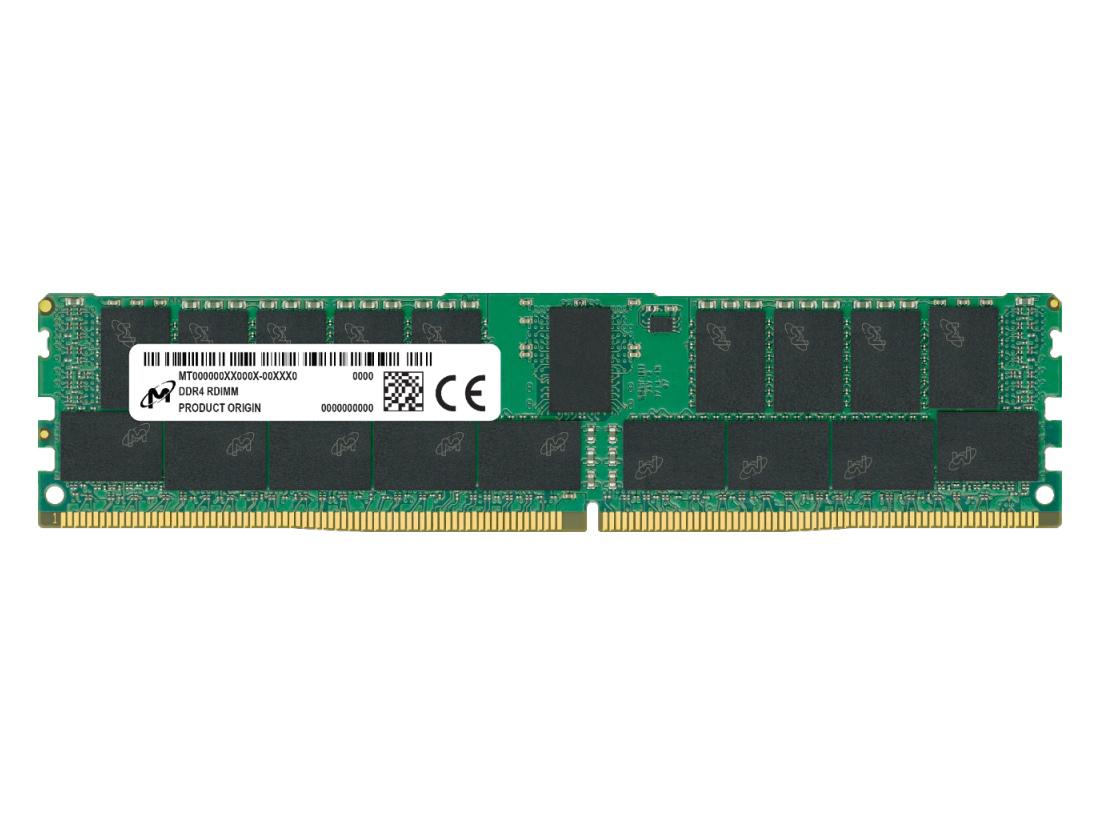
This RDIMM is optimized for server platforms requiring high data integrity under sustained loads, with ECC and registered signal buffering ensuring reliable operation in virtualized environments and in-memory databases. Its dual-rank x8 configuration and 2933 MHz speed deliver a strong balance of capacity and bandwidth, making it well-suited for memory-intensive enterprise workloads where stability is non-negotiable.
1. ECC protection automatically detects and corrects single-bit errors, ensuring data integrity for financial transactions and mission-critical databases where even silent corruption is unacceptable.
2. Registered signal buffering stabilizes the command and address buses under heavy DIMM populations, enabling large-memory servers to scale without compromising signal quality during peak virtualization workloads.
3. The 16GB module density strikes an optimal balance for virtualized environments, allowing a single server to consolidate more guest machines without immediate budget overreach on memory costs.
4. A transfer rate of 2933MT/s elevates memory bandwidth by a notable margin over baseline DDR4 speeds, directly accelerating in-memory analytics and reducing latency for frequently queried datasets.
5. Dual rank x8 organization interleaves accesses across internal banks, sustaining high throughput under concurrent multi-threaded loads and helping maintain predicable response times in dense cloud hosting scenarios.
The MTA18ASF2G72PDZ-2G9J3 is an RDIMM engineered specifically for server deployments, where downtime is measured in revenue loss and data accuracy is non-negotiable. Its ECC technology actively detects and corrects single-bit memory errors — silent data corruption that, in an in-memory database like SAP HANA, could cascade into flawed financial calculations or corrupted transaction logs. In a dense virtualization cluster running dozens of virtual machines, this protection ensures that a stray cosmic particle does not crash an entire guest operating system unnoticed.
Registered signal buffering on this 288-pin module stabilizes the electrical load on the memory bus, enabling a server to populate all channels with high-capacity DIMMs without sacrificing signal integrity. For a hypervisor host managing a 300-VM environment, that means predictable performance even under extreme memory population. The dual-rank x8 organization further boosts throughput by allowing concurrent page accesses, delivering higher sustained bandwidth for latency-sensitive, read-intensive workloads such as real-time analytics. Clocked at 2933 MHz, this module injects a critical responsiveness edge into every query hitting the dataset, turning raw capacity into actionable speed.
General Virtualization
For a typical hypervisor hosting multiple VMs, populate all memory channels symmetrically to maximize bandwidth. A balanced configuration using six or eight identical 16 GB RDIMMs (96 GB to 128 GB total) often provides the optimal ratio of memory per core for moderate consolidation. Avoid single-channel or unbalanced layouts, as registered ECC modules rely on interleaving to sustain latency-sensitive VM performance.
In-Memory Database
In-memory databases such as Redis or SAP HANA demand both capacity and error resilience. Deploy the 16 GB RDIMMs in a fully populated configuration across all memory channels, aiming for at least 256 GB (16×16 GB) to hold large datasets entirely in RAM. The ECC and registered buffer guard against silent data corruption, while dual-rank x8 construction improves throughput under heavy write loads.
HPC
HPC workloads benefit from high bandwidth, thus install matched sets of 16 GB RDIMMs in multiples of the platform’s channel count (e.g., 8 or 12 modules per socket). The 2933 MT/s speed and dual-rank design deliver strong sustained memory throughput for finite element analysis or climate modeling. Using identical modules across nodes ensures predictable scaling and prevents performance variance in tightly coupled MPI jobs.
Rigorously tested server memory, compatible with Dell PowerEdge R760, HPE ProLiant DL380 Gen10, Lenovo ThinkSystem SR650.
Q: Can I mix this MTA18ASF2G72PDZ-2G9J3 with other memory modules of different brands or speeds?
A: Mixing RDIMMs of different brands, speeds, or ranks is strongly discouraged. Inconsistent signal integrity may cause POST failures, ECC errors, or instability. For reliable server operation, install identical modules with the same Micron part number throughout all channels.
Q: Is this memory compatible with my Intel Xeon or AMD EPYC server platform?
A: This DDR4-2933 ECC Registered DIMM is validated for Intel Xeon Scalable (2nd/3rd Gen) and AMD EPYC 7002/7003 series. Always check your system board's qualified vendor list for the specific MPN MTA18ASF2G72PDZ-2G9J3 to confirm full compatibility.
Q: What is the recommended DIMM population order for optimal performance?
A: Populate identical DIMMs symmetrically across memory channels, filling the slots farthest from the CPU first. Balanced configuration ensures maximum interleaving and bandwidth. Consult your server's topology guide; using identical dual-rank modules per channel is critical.
Q: Does this module support overclocking or XMP profiles?
A: No, this server-grade RDIMM strictly follows JEDEC DDR4-2933 (CL21) standard. It does not support overclocking or XMP. Stability and 24/7 error correction via ECC take priority over adjustable profiles in this registered memory design.
Q: What warranty and typical failure rate can I expect?
A: This module is covered by a 1-year limited warranty. In properly cooled, standard server environments, the annualized failure rate is typically under 0.5%. ECC technology further mitigates potential data errors, ensuring mission-critical reliability.