











 Secure payments
Standard refund policy
Trade Assurance
Secure payments
Standard refund policy
Trade Assurance
| Product Type | Memory Module |
|---|---|
| Memory Capacity | 16 GB |
| Memory Technology | DDR4 |
| Product Voltage | 1.2V |
| RAM Speed | 3200MHz |
| RAM Standard | DDR4-3200/PC4-25600 |
| Error Identifying | Non-ECC |
| Signal Type | Unbuffered |
| Column Access Strobe (CAS) | CL22 |
| Rank | Dual Rank x8 |
| Quantity of Pins | 288-pin |
| RAM Genre | UDIMM |
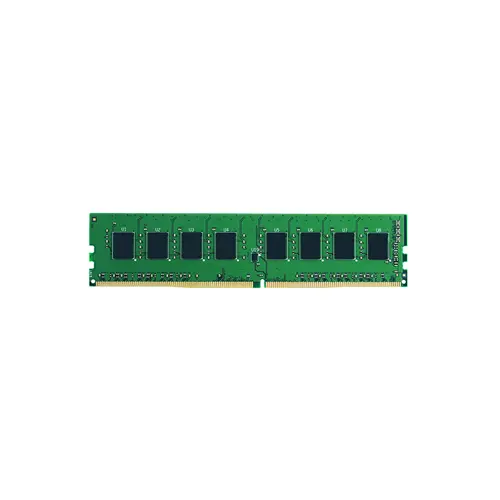
Ideal for high-performance desktops, this 16 GB DDR4-3200 UDIMM excels in gaming, content creation, and heavy multitasking, where its dual-rank x8 organization boosts bandwidth through rank interleaving for smoother data throughput. The non-ECC, unbuffered design and 1.2 V standard voltage ensure broad platform compatibility and stable operation at CL22 latency, making it a reliable plug-and-play upgrade for enthusiast and productivity systems alike.
1. A 16GB capacity provides ample headroom for running memory-hungry creative suites alongside background apps, reducing swap usage and keeping content creation workflows fluid.
2. The 3200MHz frequency pushes peak bandwidth high enough to raise minimum frame rates in CPU-intensive gaming and accelerate video encoding tasks.
3. CL22 latency strikes a balance between speed and stability, delivering responsive in-game actions and faster level loads without compromising compatibility.
4. Dual Rank x8 organization interleaves memory banks for enhanced parallelism, which directly benefits multitasking smoothness and 3D rendering throughput.
5. Non-ECC design eliminates error-correction overhead, preserving every cycle for raw speed—critical for competitive gaming and aggressive memory tuning.
The Micron MTA16ATF2G64AZ-3G2J1 is a 16 GB DDR4-3200 UDIMM built for desktop users who demand consistent high performance in intensive workloads. Its 3200 MHz speed and dual‑rank x8 organization together raise effective memory bandwidth through rank interleaving, allowing the memory controller to overlap accesses across ranks and reduce idle cycles. In a triple‑A gaming scenario, this translates into tighter frame pacing and fewer micro‑stutters when the engine streams massive textures and geometry, keeping your competitive play fluid. The same dual‑rank bandwidth advantage becomes critical during 4K video rendering and timeline scrubbing, where the system continuously accesses large media assets; the module sustains higher throughput so previews stay responsive and export times drop.
Operating at just 1.2 V, the module keeps thermals and power draw under control even during prolonged rendering marathons, helping maintain system stability without stressing the motherboard VRM. The 16 GB density on a single unbuffered DIMM leaves two slots open for future expansion, giving content creators and power users a practical path to 32 GB or more. With a 288‑pin UDIMM form factor and straightforward non‑ECC signaling, installation is plug‑and‑play across a wide range of desktop platforms, making it a dependable upgrade that directly improves real‑world workflow agility and gaming immersion.
Gaming Build
For a dual-channel configuration, install two of these 16 GB UDIMMs in matched slots to form a 32 GB kit, which eliminates the bandwidth bottleneck for modern titles and background tasks. If your budget is tighter, a single 16 GB module still handles most AAA games, but you leave dual-channel performance on the table. Always populate slots according to the motherboard manual to enable symmetrical interleaving.
Content Creation
Maximize capacity by populating all four DIMM slots with these modules for a total of 64 GB, giving video editing, 3D rendering, and large texture work the headroom they demand. With 3200 MHz and dual-rank x8 organization, the setup balances capacity and memory rank interleaving, sustaining high throughput in sustained renders and timeline scrubbing.
General Productivity
A pair of these 16 GB sticks in dual-channel (32 GB total) strikes the best cost-per-gigabyte ratio for heavy multitasking, dozens of browser tabs, and office suites. For more basic email and document workflows, a single 16 GB UDIMM keeps the upgrade path open without overspending, yet still feels responsive under Windows 11 or macOS.
Laptop Upgrade
Check if your laptop supports DDR4 SODIMM; this 288-pin UDIMM is for desktops—verify the slot type before purchase. For a typical notebook, replacing a single 8 GB module with a compatible 16 GB SODIMM version doubles capacity, while installing two gives 32 GB and enables dual-channel benefits for integrated graphics.
Mobile Workstation
If the workstation takes full-size DIMMs, populating all sockets with these 16 GB sticks (e.g., 4×16 GB for 64 GB) satisfies memory-hungry CAD, simulation, and development VMs. The Non-ECC unbuffered design suits mobile Xeon or Core platforms, and the standard 1.2 V reduces thermal stress inside constrained chassis.
Ultrabook Power Saving
This is a standard-voltage 1.2 V desktop DIMM, not an LPDDR low-power memory; ultrabooks require soldered or low-voltage SODIMM modules. For thin-and-light systems, prioritize DDR4L (1.2 V) or LPDDR variants to extend battery runtime, as a full-size UDIMM is physically incompatible. Always consult the laptop’s qualified vendor list for power-optimized replacements.
Rigorously tested, compatible with Dell OptiPlex 7080, HP EliteDesk 800 G6, Lenovo ThinkCentre M70q.
Q: Can I mix this MTA16ATF2G64AZ-3G2J1 with other memory modules of different brands or speeds?
A: Mixing modules may cause instability. For reliable operation, use identical sticks with matching 3200MHz speed, CL22 timings, 1.2V voltage, and dual‑rank x8 organization.
Q: Is this memory compatible with my system's motherboard chipset?
A: It fits mainstream desktop boards supporting DDR4 UDIMMs, such as Intel 300/400/500 series or AMD AM4 platforms. Verify your board’s QVL and ensure a 288‑pin DDR4 slot.
Q: What is the recommended DIMM population order for optimal performance?
A: Install in matched pairs for dual‑channel mode, typically slots A2 and B2. Consult your motherboard manual, as populating all four slots may limit speed to maintain signal integrity.
Q: Does this module support overclocking or XMP profiles?
A: No. This is a JEDEC‑standard DDR4‑3200 module running at CL22. It does not include an XMP profile and is not designed for overclocking, but offers plug‑and‑play stability.
Q: What warranty and typical failure rate can I expect?
A: It includes a one‑year warranty. Quality DDR4 UDIMMs like this exhibit a very low annualized failure rate, typically under 0.5%, ensuring high long‑term reliability.