











 Secure payments
Standard refund policy
Trade Assurance
Secure payments
Standard refund policy
Trade Assurance
| Product Type | Memory Module |
|---|---|
| Memory Capacity | 16 GB |
| Memory Technology | DDR4 |
| Product Voltage | 1.2V |
| RAM Speed | 3200MHz |
| RAM Standard | DDR4-3200/PC4-25600 |
| Error Identifying | ECC |
| Signal Type | Registered |
| Column Access Strobe (CAS) | CL22 |
| Rank | Dual Rank x8 |
| Quantity of Pins | 288-pin |
| RAM Genre | RDIMM |
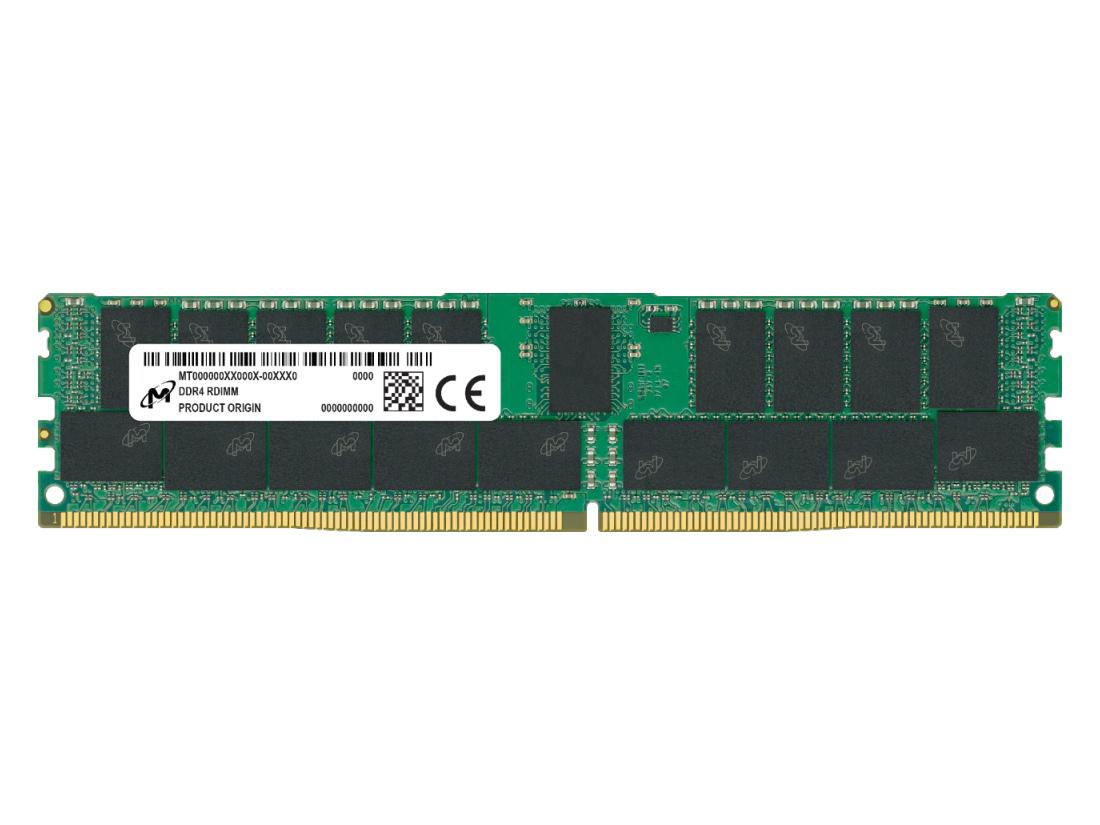
This RDIMM is engineered for server platforms, delivering 16 GB of DDR4-3200 capacity with ECC and a registered signal type to ensure data integrity and signal stability in dense, multi-DIMM configurations. Its dual-rank x8 organization boosts memory bandwidth through rank interleaving, making it ideal for virtualization, in-memory databases, and other latency‑sensitive enterprise workloads.
1. ECC memory detects and corrects single-bit errors in real time, preserving data integrity for mission-critical database transactions and financial computations.
2. Registered signal buffering stabilizes high-density server configurations, allowing fully populated memory channels without compromising command signal quality.
3. Dual Rank x8 organization boosts interleaving efficiency, which elevates sustained bandwidth under concurrent virtual machine workloads and large in-memory analytics.
4. The sixteen-gigabyte capacity per module strikes a balance between density and cost, maximizing the number of containers or VMs per server node in scale-out deployments.
5. A transfer rate of thirty-two hundred megatransfers per second delivers the memory throughput required to keep pace with multi-core server CPUs during heavy simultaneous request processing.
When you are running a business-critical virtualization cluster or an in-memory database where every transaction must be flawless, the Micron MTA18ASF2G72PDZ-3G2E1TK RDIMM is not just a memory module, it is the foundation of your data integrity and uptime. Its ECC technology actively detects and corrects single-bit errors, effectively neutralizing the silent data corruption caused by cosmic radiation or electrical interference that can crash a financial transaction or poison a long-running analytics query. The registered signal buffer is equally vital in dense server deployments, stabilizing the command bus when you populate all 24 DIMM slots to run dozens of virtual machines—without it, electrical loading would lead to boot failures and unpredictable crashes under heavy consolidation workloads. Operating at 3200MHz with a dual-rank x8 organization, the module delivers the high sustained bandwidth and interleaving efficiency that memory-hungry applications like Redis or SAP HANA demand, allowing the CPU to stream data with minimal latency. At 1.2V, it keeps thermal and power budgets in check across a 24/7 datacenter floor, delivering performance without silently eroding the reliability that your SLAs depend on.
General Virtualization
Populate at least four identical 16GB RDIMMs per CPU socket to take advantage of quad-channel memory architectures, delivering balanced bandwidth for multiple concurrent VMs. Distribute modules evenly across sockets to avoid NUMA latency penalties, aiming for 128–256GB total per host for moderate VM densities.
In-Memory Database
For platforms like SAP HANA or Redis, fill all available DIMM slots with these dual-rank x8 RDIMMs to maximize interleaving and overall memory capacity. A 12-DIMM or 24-DIMM configuration yields 192GB or 384GB, providing significant headroom for growing datasets while maintaining stable CL22 latency.
High-Performance Computing (HPC)
Install 8 or 16 identical registered DIMMs per node to fully saturate the memory channels and deliver uniform, high-bandwidth access critical for parallel simulations. The dual-rank design enhances rank interleaving, and targeting 128–256GB per node prevents swap bottlenecks; always follow the motherboard population order to preserve peak throughput.
Rigorously tested for server compatibility, verified with Dell PowerEdge R750, HPE ProLiant DL380 Gen10, Lenovo ThinkSystem SR650 V2, and more.
Q: Can I mix this MTA18ASF2G72PDZ-3G2E1TK with other memory modules of different brands or speeds?
A: Mixing different brands or speeds is not recommended. It can cause instability or failure to POST. For guaranteed compatibility and reliable ECC operation, use identical Micron RDIMMs.
Q: Is this memory compatible with my server? Which platforms are supported?
A: This DDR4-3200 ECC Registered DIMM is designed for Intel Xeon Scalable and AMD EPYC 7000/7002/7003 series platforms. Verify your motherboard supports 16GB RDIMMs with 1.2V and 288-pin.
Q: What is the recommended DIMM population order for optimal performance?
A: Follow your server board's manual, but generally populate identical DIMMs in the first slot of each memory channel (e.g., A1, B1, C1…). This balances interleaving and maximizes throughput with ECC.
Q: Does this module support overclocking or XMP profiles?
A: No. This is a JEDEC-compliant server RDIMM. It runs strictly at DDR4-3200 CL22 for stability and data integrity. Overclocking or XMP is neither supported nor advisable in enterprise environments.
Q: What warranty and typical failure rate can I expect for this Micron module?
A: It carries a 1-year limited warranty. As a server-grade RDIMM meeting rigorous testing, its annualized failure rate (AFR) is extremely low under specified conditions, typically well below 1%.