











 Secure payments
Standard refund policy
Trade Assurance
Secure payments
Standard refund policy
Trade Assurance
| Product Type | Memory Module |
|---|---|
| Memory Capacity | 16 GB |
| Memory Technology | DDR4 |
| Product Voltage | 1.2V |
| RAM Speed | 3200MHz |
| RAM Standard | DDR4-3200/PC4-25600 |
| Error Identifying | ECC |
| Signal Type | Registered |
| Column Access Strobe (CAS) | CL22 |
| Rank | Dual Rank |
| Quantity of Pins | 288-pin |
| RAM Genre | RDIMM |
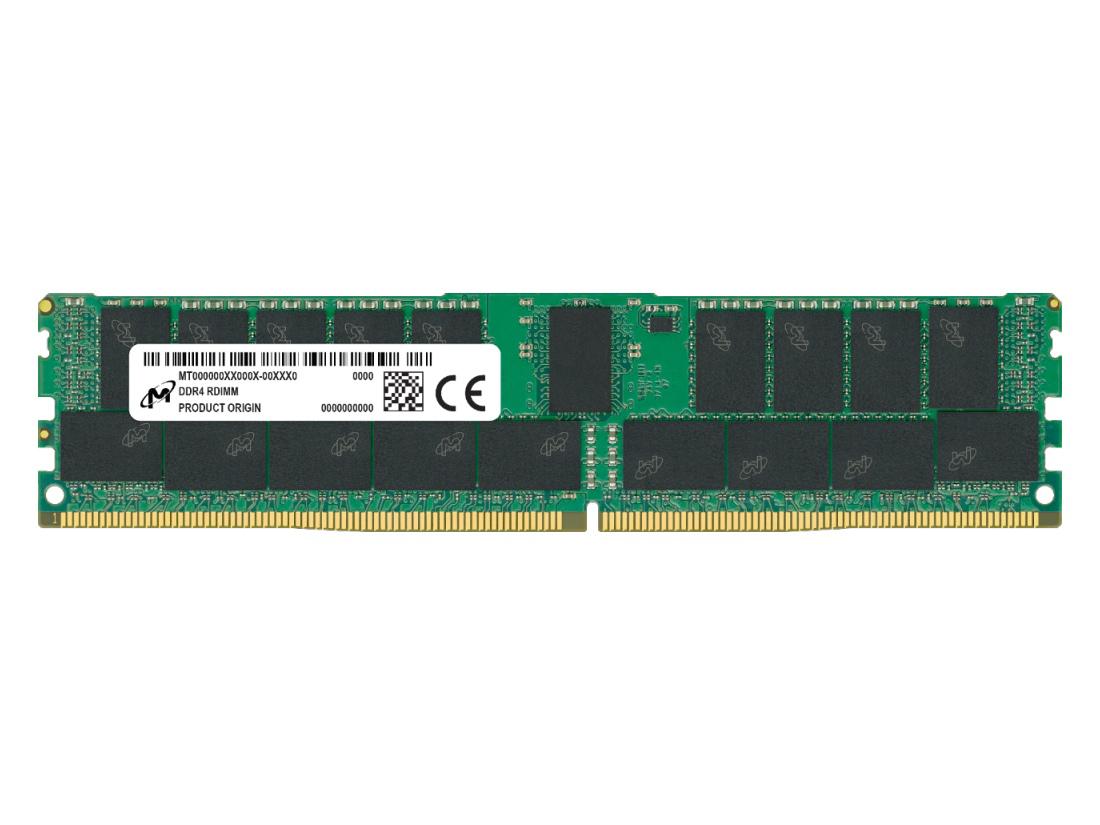
This RDIMM with ECC and a registered signal type is purpose-built for server platforms handling memory-intensive workloads such as virtualization and in-memory databases, where data integrity and stability under sustained load are critical. Its dual-rank configuration boosts interleaving efficiency for higher throughput, while registered signaling and 22-cycle CAS latency ensure reliable operation at 3200MHz across densely populated systems.
1. ECC error correction actively prevents data corruption, ensuring uninterrupted operation of critical database and transactional workloads that demand absolute reliability.
2. Registered buffering stabilizes command and address signals across fully loaded memory channels, preserving signal integrity in dense multi-socket server deployments.
3. Dual rank organization interleaves internal bank accesses to sustain peak channel bandwidth, directly improving throughput for hypervisor consolidation and heavy virtual machine densities.
4. The per-module capacity allows substantial total memory within limited chassis space, enabling larger in-memory caches and higher container orchestration efficiency.
5. High data transfer rate matches the throughput demands of modern server processors, reducing bottlenecking for real-time analytics and bandwidth-hungry infrastructure services.
The MTA18ASF2G72PDZ-3G2J3UI is a server-grade DDR4 RDIMM engineered for data centers and enterprise workloads where uptime and accuracy are non-negotiable. Its four cornerstone characteristics—ECC error correction, registered signaling, dual-rank architecture, and 3200 MT/s speed—are what make the difference between a minor electrical event and a major service outage.
In a dense virtualization cluster running dozens of VMs, a single bit flip caused by background radiation can silently corrupt a guest operating system or crash the hypervisor. ECC instantly detects and fixes these errors before they propagate into transactions, billing records, or user data, directly preventing financial and reputational damage. When populating all 24 slots of a dual-socket server, registered clock drivers buffer the command and address lines, preventing signal degradation and ensuring the platform remains stable even under 100% memory load. The dual-rank layout interleaves internal DRAM pages, which raises bank-level parallelism and delivers higher sustained bandwidth and command efficiency. This becomes critical in an in-memory database such as Redis or SAP HANA, where microsecond-level gains from rank interleaving translate into thousands of extra queries per second. The 3200 MT/s speed feeds modern multi-core CPUs fast enough to keep large analytics datasets and virtual machine migrations fluid.
Together, these attributes mean you can safely consolidate more workloads, eliminate silent data corruption, and extract full memory controller throughput without trading reliability for performance.
Capacity Planning for 16GB DDR4-3200 ECC RDIMM (Server Memory)
The 16GB capacity, 3200MT/s speed, and CAS 22 dual‑rank design suit modern server platforms. Below are recommendations for three key scenarios.
General Virtualization
Populate all memory channels symmetrically to balance capacity and bandwidth. In a dual‑processor platform with eight channels each, installing one 16GB DIMM per channel yields 256GB, suitable for medium‑density VM hosting. Scaling to two DIMMs per channel (2DPC) provides 512GB for larger deployments, with a minor speed reduction.
In-Memory Database
Maximum capacity and ECC integrity are critical. Fill all DIMM slots with identical 16GB modules; a 24‑slot server reaches 384GB. When more headroom is needed, use two modules per channel across all channels to achieve 768GB, ensuring reliable operation under sustained load.
High-Performance Computing
Bandwidth‑sensitive HPC jobs perform best with one 16GB RDIMM per memory channel (1DPC) at the full 3200MT/s rate. An eight‑channel node provides 128GB at peak throughput. The dual‑rank design enhances bank‑level parallelism, maximizing data access efficiency without the performance penalty of additional DIMMs per channel.
Rigorously tested server memory, compatible with Dell PowerEdge R750, HPE ProLiant DL380 Gen10 Plus, and Lenovo ThinkSystem SR650 V2.
Q: Can I mix this MTA18ASF2G72PDZ-3G2J3UI with other memory modules of different brands or speeds?
A: Mixing different brands or speeds is not recommended for this registered ECC module. Inconsistent timings and signal integrity may cause stability issues. Always use identical Micron-certified modules to ensure reliable server operation.
Q: Is this memory compatible with my system?
A: This is a DDR4-3200 ECC RDIMM designed for server platforms. It supports Intel Xeon Scalable and AMD EPYC processors on chipsets like C620 or SP3, provided the motherboard accepts 288-pin RDIMM with CL22 timing.
Q: What is the recommended DIMM population order for optimal performance?
A: For dual-rank RDIMMs, populate identical modules per memory channel following your server board's guide. Typically, fill blue or white slots first to maximize interleaving and bandwidth across all available memory channels.
Q: Does this module support overclocking or XMP profiles?
A: No. This is a JEDEC-compliant server memory module without XMP or overclocking support. It operates at fixed DDR4-3200 CL22 timing and 1.2V to guarantee data integrity in mission-critical environments.
Q: What warranty and typical failure rate can I expect?
A: This Micron module includes a one-year warranty. Like most enterprise ECC RAM, it exhibits an extremely low annualized failure rate (AFR), typically under 0.2%, ensuring high reliability for 24/7 server workloads.