











 Secure payments
Standard refund policy
Trade Assurance
Secure payments
Standard refund policy
Trade Assurance
| Product Type | Memory Module |
|---|---|
| Memory Capacity | 16 GB |
| Memory Technology | DDR4 |
| Product Voltage | 1.2V |
| RAM Speed | 3200MHz |
| RAM Standard | DDR4-3200/PC4-25600 |
| Error Identifying | ECC |
| Signal Type | Registered |
| Column Access Strobe (CAS) | CL22 |
| Rank | Dual Rank x8 |
| Quantity of Pins | 288-pin |
| RAM Genre | RDIMM |
This RDIMM is engineered for server platforms where data integrity and uptime are critical, making it ideal for virtualization, in-memory databases, and enterprise workloads that demand reliable ECC protection. The Registered signal type ensures stable operation across high-density memory configurations, while the dual-rank x8 organization leverages bank interleaving to boost throughput in multi-DIMM servers without excessive power draw at the standard 1.2V.
1. The on-module register buffers address and control signals, enabling stable signal integrity across heavily populated memory channels in multi-socket server platforms.
2. Hardware-level error correction autonomously detects and remedies single-bit faults, preserving data integrity in financial ledgers and long-running analytics.
3. The dual-rank organization interleaves banks to parallelize memory transactions, raising sustained bandwidth for heavily virtualized database clusters.
4. The high data transfer rate feeds contemporary multi-core server processors with the memory throughput needed for rapid VM migration and real-time caching.
5. This per-DIMM capacity strikes the ideal density for flexible scaling, letting administrators populate terabytes of total RAM across 24-slot server boards for enterprise consolidation.
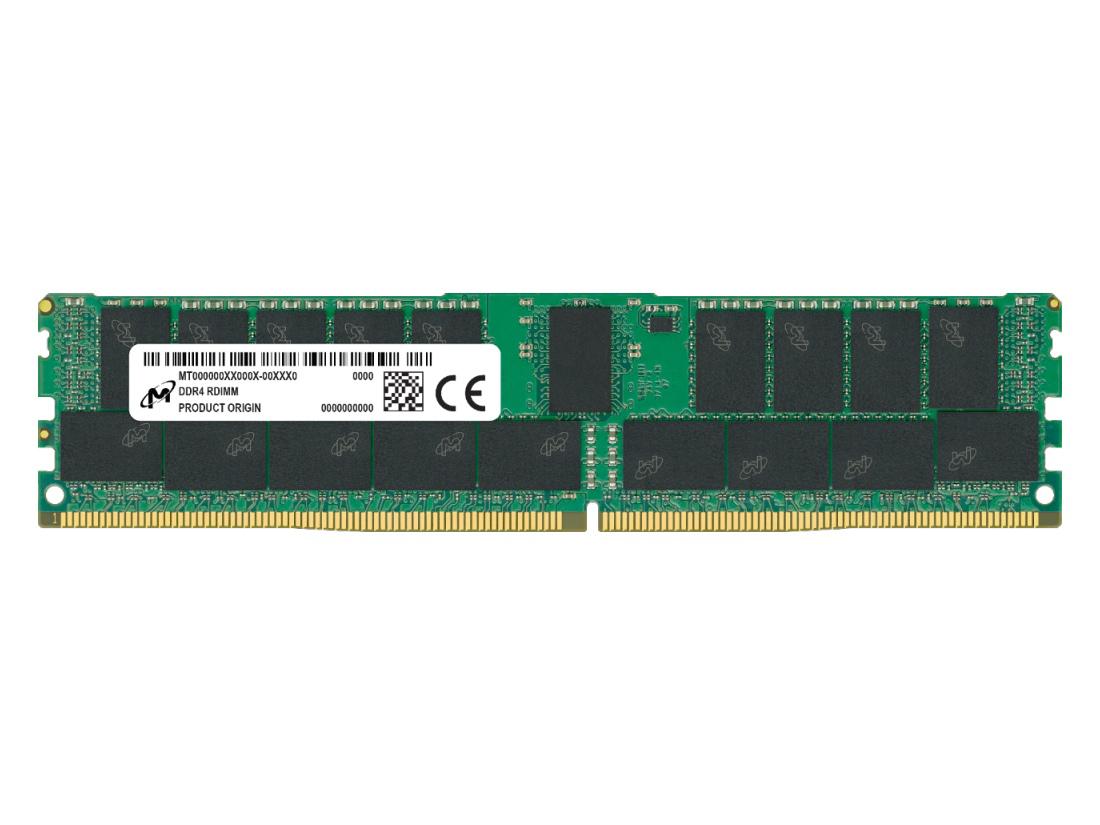
The memory module with MPN MTA18ASF2G72PDZ-3G2E1TG is a server-class DDR4-3200 Registered DIMM (RDIMM), purpose-built for data center workloads. Its ECC functionality corrects single-bit errors that commonly arise from background radiation in large-scale memory arrays, preventing silent data corruption that could crash virtual machines or corrupt database indexes. For IT managers running multi-tenant virtualization clusters, this data integrity is non-negotiable. The registered signal buffering allows dense server configurations to populate all memory channels without stability loss, essential when capacity demands grow. Furthermore, the dual-rank x8 design employs rank interleaving to maximize memory bandwidth, a critical advantage for in-memory databases like SAP HANA or Redis where every nanosecond of latencies stacks during massive concurrent queries. Operating at 3200MT/s with a CL22 latency, this module ensures rapid data delivery under sustained load, keeping application response times predictable. This memory transforms system uptime and throughput from a concern into a guarantee.
This DDR4-3200 Registered ECC DIMM is designed for server environments. Below are capacity planning guidelines for typical server workloads.
General Virtualization
Populate all memory channels symmetrically with these 16GB RDIMMs to maximize throughput. For a single-socket host, start with 8 identical modules (128GB) to comfortably run 30–40 light-to-moderate VMs while preserving headroom for vMotion and peak demands. For larger consolidation ratios, scale to 256GB across 16 DIMM slots.
In-Memory Database
In-memory platforms like Redis or SAP HANA require substantial, resilient capacity. Equip dual-socket servers with 16GB RDIMMs in every channel, targeting 512GB to 1TB total to hold large datasets entirely in RAM. The ECC and registered design delivers the long-term stability and data integrity that sustained high-write workloads demand.
High-Performance Computing
HPC benefits from balanced bandwidth per core. Install one 16GB RDIMM per channel, aiming for a uniform 2–4 GB per core ratio across all nodes. Matching rank, speed, and capacity eliminates NUMA imbalances and guarantees consistent job performance, while ECC prevents silent data corruption during long-running simulations.
Proven compatible after stringent testing with Dell PowerEdge R750, HPE DL380 Gen10+, Lenovo SR650 V2.
Q: Can I mix this MTA18ASF2G72PDZ-3G2E1TG with other memory modules of different brands or speeds?
A: Mixing this RDIMM with different brands, speeds, or timings is strongly discouraged. It risks silent data corruption and instability. For reliable ECC operation, always install identical modules sharing the same Micron part number, rank, and latency.
Q: Is this memory compatible with my server? Which Intel or AMD platforms are supported?
A: This DDR4-3200 registered ECC module targets dual-socket servers using Intel Xeon Scalable (2nd/3rd Gen) or AMD EPYC 7002/7003 processors. Please verify against your motherboard’s QVL with the exact Micron MPN for validated compatibility.
Q: What is the recommended DIMM population order for optimal performance in a server?
A: Populate identical DIMMs symmetrically across memory channels, following the server board’s population guide. Typically, install one DIMM per channel first, then add the second rank to maximize interleaving and balanced bandwidth.
Q: Does this RDIMM support overclocking or XMP profiles?
A: No. This enterprise JEDEC-standard RDIMM does not support overclocking or XMP. It runs at fixed 3200MHz CL22 to guarantee 24/7 stability, data integrity, and compatibility in mission-critical server environments.
Q: Can I install this registered server memory in a desktop or laptop?
A: Impossible. This 288-pin RDIMM with ECC and registered logic requires a server chipset and CPU. It will not physically fit or function in standard desktop or notebook motherboards that only accept UDIMMs or SO-DIMMs.
Q: What warranty and typical failure rate can I expect with this Micron module?
A: It comes with a 1-year warranty. Micron’s rigorous testing and integrated ECC deliver an extremely low annualized failure rate, typically well under 0.5% in specified conditions, making it ideal for around-the-clock server reliability.