











 Secure payments
Standard refund policy
Trade Assurance
Secure payments
Standard refund policy
Trade Assurance
| Product Type | Memory Module |
|---|---|
| Memory Capacity | 16 GB |
| Memory Technology | DDR4 |
| Product Voltage | 1.2 V |
| RAM Speed | 3200 MHz |
| RAM Standard | DDR4-3200/PC4-25600 |
| Error Identifying | ECC |
| Signal Type | Unbuffered |
| Column Access Strobe (CAS) | CL22 |
| Rank | Single Rank x8 |
| Quantity of Pins | 288-pin |
| RAM Genre | UDIMM |
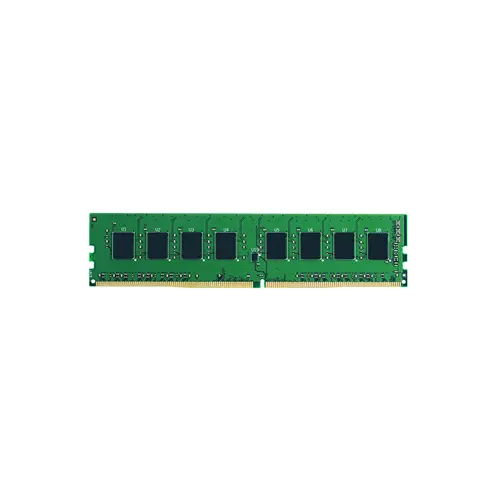
This ECC Unbuffered UDIMM is engineered for workstation and entry-level server platforms where data integrity is critical, making it ideal for financial modeling, CAD, and content creation workloads. Its single-rank x8 configuration ensures optimal signal integrity and low latency, while the integrated error correction reliably detects and corrects single-bit memory errors to prevent data corruption.
1. Error Correcting Code detects and corrects single-bit errors in real time, preserving data integrity for mission-critical server applications like financial databases and hyperconverged infrastructure.
2. A dense 16GB capacity per module allows for higher total memory in small form-factor servers, boosting virtualization density and supporting more concurrent containers or VMs.
3. 3200MHz data rate delivers generous memory bandwidth, accelerating in-memory analytics and reducing latency for heavily utilized database servers.
4. Unbuffered signal type minimizes access latency between the CPU and memory, a key advantage for latency-sensitive edge servers and lightweight virtualization hosts that do not require massive memory expansion.
5. CL22 column access strobe keeps response times tight, ensuring consistent transaction processing under bursty enterprise workloads without sacrificing stability.
In a dense virtualization cluster, every undetected memory error can silently corrupt critical data, crash hypervisors, and cascade into costly service outages. The Micron 16GB DDR4‑3200 UDIMM (MTA9ASF2G72AZ‑3G2B1R) eliminates this risk with hardware ECC that instantly corrects single‑bit flips, preserving the integrity of your VM states and transactional databases. Its Unbuffered architecture is deliberately chosen for single‑socket and light multi‑socket servers: by removing the register buffer, it shaves crucial nanoseconds off the access path, which directly translates into higher commit rates for in‑memory databases like Redis and SAP HANA where every microsecond counts. The module’s 3200 MT/s bandwidth works in tandem with a Single Rank x8 organization to reduce electrical loading on the memory channel, enabling stable dual‑channel interleaving without signal degradation. For you, this means your virtualized workloads and memory‑cached applications run with predictably low latency and maximum throughput under heavy consolidation, letting you scale infrastructure confidently instead of troubleshooting mysterious memory‑induced downtime.
Capacity Planning for ECC UDIMM DDR4-3200 Memory
Based on the specifications (ECC, Unbuffered, 288-pin UDIMM), this module is designed for entry-level servers and workstations that require data integrity. Below are configuration recommendations for typical server workloads.
General Virtualization
Virtualized environments are often memory-bound before CPU. Deploy modules in matched pairs for dual-channel performance, starting with four 16GB modules (64GB total) to comfortably host a dozen light VMs. When consolidating heavier workloads, populate all available slots to reach 128GB, ensuring you reserve headroom for hypervisor memory overhead and live migration buffer.
In-Memory Database
Databases like Redis or Memcached demand low latency and high capacity. Use the fastest supported speed (3200 MT/s) and populate in multiples of identical modules to avoid performance anomalies. A minimum of 128GB (eight modules) is recommended for moderate datasets, scaling linearly; always choose single-rank x8 modules for optimal signal integrity and thermal efficiency under sustained load.
High Performance Computing (HPC)
HPC nodes benefit more from memory bandwidth than sheer capacity. Configure at least two modules per memory channel to maximize interleaving, so a six-channel platform would require twelve modules (192GB total) for peak throughput. Ensure the ECC feature remains active to catch silent data corruption during long-running computational jobs, and maintain uniform rank configurations across all slots.
Validated for ECC UDIMM servers; rigorously tested, compatible with Dell PowerEdge T350, HPE ProLiant ML30 Gen10, and Lenovo ThinkSystem ST250.
Q: Can I mix this MTA9ASF2G72AZ-3G2B1R with other memory modules of different brands or speeds?
A: Mixing is not recommended. System stability requires identical part numbers, speeds, ranks, and ECC DIMMs. Discrepancies may force lower speeds, disable ECC, or cause boot failures.
Q: Is this memory compatible with my system?
A: It fits platforms supporting unbuffered ECC DDR4, such as Intel Xeon E-2300/E-2100 series or AMD Ryzen PRO with W480/B550 chipsets. Verify your motherboard's QVL for 288-pin UDIMM support.
Q: What is the recommended DIMM population order for optimal performance?
A: Populate one DIMM per channel first, typically starting with the farthest slot from the CPU (e.g., DIMM A2). Follow your motherboard manual to enable dual-channel interleaving for maximum bandwidth.
Q: Does this module support overclocking or XMP profiles?
A: No. As a JEDEC-compliant server UDIMM, it runs at fixed DDR4-3200 CL22. It lacks XMP profiles and does not support voltage or frequency overclocking to ensure data integrity with ECC.
Q: What warranty and typical failure rate can I expect?
A: This product includes a one-year limited warranty. Typical annualized failure rates are under 0.5%, reflecting enterprise-grade reliability for mission-critical workstation and server environments.