











 Secure payments
Standard refund policy
Trade Assurance
Secure payments
Standard refund policy
Trade Assurance
| Product Type | Memory Module |
|---|---|
| Memory Capacity | 16 GB |
| Memory Technology | DDR4 |
| Product Voltage | 1.2V |
| RAM Speed | 3200MHz |
| RAM Standard | DDR4-3200/PC4-25600 |
| Error Identifying | ECC |
| Signal Type | Unbuffered |
| Column Access Strobe (CAS) | CL22 |
| Rank | Dual Rank x8 |
| Quantity of Pins | 288-pin |
| RAM Genre | UDIMM |
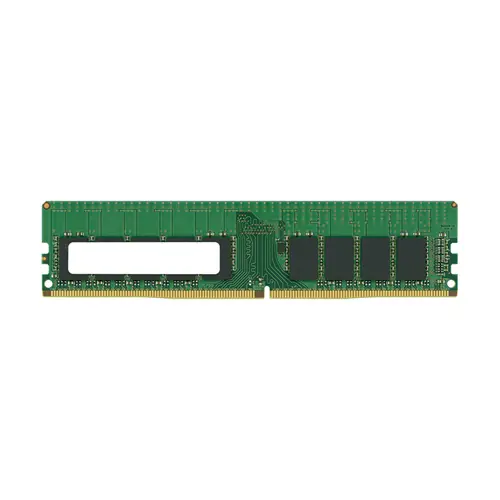
This UDIMM with ECC and dual-rank x8 organization is engineered for entry-level servers and workstations, delivering enhanced data integrity for virtualization and in-memory databases. Its DDR4-3200 speed at CL22 latency combined with unbuffered signaling ensures stable, low-latency performance while dual-rank interleaving boosts effective memory bandwidth under concurrent workloads.
1. ECC error correction identifies and fixes single-bit data errors on the fly, safeguarding transactional integrity and maximizing uptime in always-on server deployments.
2. Dual Rank x8 interleaving saturates memory channels more effectively, delivering consistent bandwidth that prevents bottlenecks in multi-tenant virtualized environments.
3. The 3200MT/s transfer rate accelerates in-memory caching and query responses, directly improving user-facing application performance under peak server loads.
4. A 16GB module size balances capacity and rank loading, allowing dense memory configurations that increase VM density per rack unit without compromising stability.
5. 1.2V low-power operation curbs both cooling demands and electricity draw, a meaningful efficiency gain when scaling out fleets of cloud or edge server nodes.
The Micron MTA18ASF2G72AZ-3G2R1 is a 16GB DDR4-3200 UDIMM with ECC, engineered specifically for entry-level servers and professional workstations where uptime and data accuracy are absolute necessities. Its four core characteristics directly address the critical pain points of these environments.
First, ECC memory is non-negotiable when you run a virtualized cluster. In a hypervisor hosting multiple VMs, a single-bit flip caused by background radiation can silently corrupt a database index or destabilize a guest operating system, leading to unexplained crashes that waste hours of diagnostics. This module’s hardware error correction actively detects and corrects single-bit errors, ensuring your virtualized services remain consistent and your weekend maintenance windows are rare. Second, the dual-rank x8 architecture comes into play during memory-intensive operations like an in-memory database or ZFS storage caching. Dual rank interleaves accesses across two internal sets of memory banks, significantly increasing sustainable bandwidth. When your Redis instance must serve thousands of concurrent reads or your storage array rebuilds a parity pool, this design prevents bottlenecks, delivering consistently low latency under concurrent load. Third, the unbuffered UDIMM format avoids the additional clock cycle penalty of registered memory, which is a deliberate advantage for workstation-class computational jobs like real-time financial simulation or 3D rendering previews where every nanosecond of transaction latency counts. Finally, the 3200MT/s speed at a low 1.2V strikes the perfect balance for 24/7 operation: it provides high data throughput to keep the CPU fed during heavy analytics workloads, while the reduced power draw lowers thermal stress and operating cost inside compact small-office server chassis, preserving system longevity and reliability without performance compromise.
This 16 GB DDR4-3200 ECC Unbuffered DIMM (UDIMM, Dual Rank x8) is primarily a server-grade module for platforms that support unregistered ECC memory, such as Intel Xeon E-2300 series or AMD AM4/AM5 with ECC-enabled motherboards. The following capacity planning guidance addresses typical server workloads.
General Virtualization
Deploy 4 to 6 identical 16 GB modules for a balanced 64–96 GB pool, which comfortably serves 10–15 light to medium VMs. Populate at least one DIMM per memory channel to enable interleaving and maintain steady throughput without exceeding mid-range host budgets.
In-Memory Database
Maximize capacity by filling all available slots — a 4-channel platform with four modules delivers 64 GB for smaller Redis or Memcached instances, while 8 slots can yield 128 GB. The Dual Rank design enhances command rate and data access efficiency, reducing latency for large in-memory datasets. Match all sticks for stable synchronous operation.
High-Performance Computing
HPC workloads thrive on bandwidth; install 6 or 8 modules to fully saturate memory channels and utilize dual-rank parallelism. A 128 GB (8×16 GB) configuration running at the full 3200 MT/s speed delivers the throughput needed for simulation codes and parallel solvers. ECC guards against silent bit errors during long-running compute runs that may span days.
Rigorously tested for workstations and entry-level servers, compatible with Dell Precision T3640, PowerEdge T140, HP Z2 G5, and more.
Q: Can I mix this MTA18ASF2G72AZ-3G2R1 with other memory modules of different brands or speeds?
A: Mixing is not recommended for server environments. Mismatched modules may disable ECC, cause instability, or force the system to the lowest common speed. Always use identical modules to ensure data integrity and full performance.
Q: Is this memory compatible with my system?
A: It is designed for servers and workstations supporting DDR4 ECC UDIMMs, such as platforms with Intel Xeon E-2300/E-2200 series or AMD Ryzen PRO CPUs. Verify your motherboard specifically supports 3200MT/s ECC Unbuffered DIMMs.
Q: What is the recommended DIMM population order for optimal performance?
A: Refer to your motherboard manual. Generally, populate identical DIMMs in symmetric slots per channel, such as one DIMM per channel first for dual-channel, balancing capacity across CPU memory controllers to maximize bandwidth.
Q: Does this module support overclocking or XMP profiles?
A: No. As an ECC UDIMM built for reliability, it strictly adheres to JEDEC DDR4-3200 (PC4-25600) at 1.2V with fixed CL22 timings. It does not support XMP or overclocking, ensuring mission-critical data integrity.
Q: What warranty and typical failure rate can I expect?
A: This module carries a 1-year limited warranty. Engineered to Micron’s rigorous standards, it exhibits an extremely low annualized failure rate (AFR), typically well below industry averages for enterprise memory.