











 Secure payments
Standard refund policy
Trade Assurance
Secure payments
Standard refund policy
Trade Assurance
| Product Type | Memory Module |
|---|---|
| Memory Capacity | 16 GB |
| Memory Technology | DDR4 |
| Product Voltage | 1.2V |
| RAM Speed | 3200MHz |
| RAM Standard | DDR4-3200/PC4-25600 |
| Error Identifying | ECC |
| Signal Type | Unbuffered |
| Column Access Strobe (CAS) | CL22 |
| Rank | Dual Rank x8 |
| Quantity of Pins | 288-pin |
| RAM Genre | UDIMM |
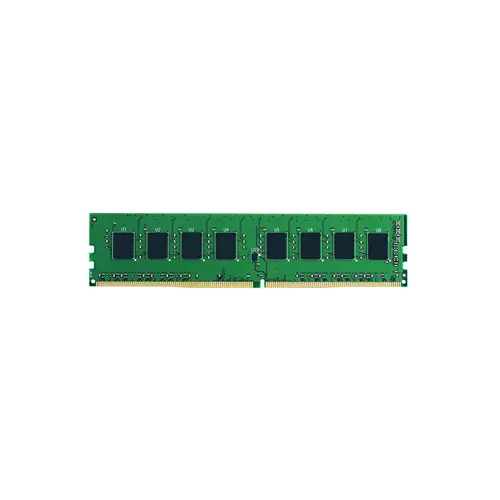
This 16GB DDR4-3200 ECC UDIMM is an unbuffered module designed for workstations and entry-level servers that require data integrity without the overhead of registered memory. Its dual-rank x8 configuration enables efficient interleaving for improved bandwidth, while the CL22 latency and 1.2V operating voltage deliver reliable, energy-efficient performance ideal for virtualization, light database workloads, and always-on mission-critical applications.
1. Error-correcting code protection detects and repairs single-bit memory errors, preserving data integrity in always-on enterprise services and virtualized infrastructures.
2. Unbuffered signaling simplifies the memory controller path, providing a cost-effective yet highly reliable solution for entry-level servers and network-attached storage appliances.
3. Dual-rank organization employs rank interleaving to keep the memory pipeline busy, maximizing sustained throughput for database queries and containerized microservices.
4. High-density module capacity elevates consolidation ratios, allowing more virtual machines per physical host without sacrificing performance or increasing hardware sprawl.
5. Low-voltage operation significantly reduces energy draw and waste heat, enabling denser rack configurations and lower data center cooling overhead.
Based on its 288-pin UDIMM form factor and ECC support, the MTA18ADF2G72AZ-3G2 is clearly server and workstation memory, engineered for entry-level servers and professional-grade desktop platforms that demand reliability over pure speed. This 16GB DDR4-3200 module brings four critical features together, and their real-world impact is what truly matters.
First, hardware error correction code guards against silent data corruption. In a small business running a virtualized file server and a customer database on a single machine, a single flipped bit in RAM could silently mangle an invoice or a financial record. ECC detects and corrects these errors before they reach storage, preserving transactional integrity that non-ECC desktop memory would simply ignore.
Second, the dual-rank x8 organization and 3200MHz bandwidth become vital when that same server hosts multiple virtual machines or containerized applications. Dual-rank interleaving allows the memory controller to overlap access, reducing latency spikes and boosting concurrent throughput for a database engine under mixed read-write loads.
Third, the low 1.2V operating voltage is not just a power figure; it directly translates to cooler thermals inside a 1U rack chassis or a compact engineering workstation running 24/7. Less heat means lower fan speeds and extended component lifespan, which is non-negotiable for an always-on NAS or a rendering node left to crunch overnight.
Fourth, the unbuffered topology guarantees broad compatibility with cost-conscious server motherboards and AMD Ryzen or Intel Xeon E platforms that accept ECC UDIMMs. This allows a consulting engineer to build a dependable simulation tower where multi-day CFD calculations never crash due to a random memory upset, and the dual-rank speed handles massive model meshes without stalling. Together, these attributes turn a simple memory stick into a foundation of quiet, uninterrupted productivity.
General Virtualization
For a virtualization host, 16 GB ECC UDIMMs are a solid building block. We recommend populating at least four modules per server to achieve 64 GB, enabling comfortable density for 10–15 moderate VMs. To preserve memory bandwidth under consolidation, deploy identical dual‑rank x8 DIMMs in a balanced configuration across all memory channels — typically six or eight identical sticks on a dual‑socket platform.
In-Memory Database
In‑memory databases such as Redis or SAP HANA demand absolute data integrity and low latency. Deploy six or eight of these 16 GB ECC modules for a 96–128 GB footprint, ensuring all capacity sits on the fastest available channels. Always configure mirroring or sparing with identical dual‑rank DIMMs to maintain performance parity and protect against uncorrectable errors under sustained write pressure.
High‑Performance Computing
HPC clusters require maximum memory bandwidth per core. Fill all memory channels of each node with these 3200 MT/s UDIMMs — typically one DIMM per channel — to achieve a bandwidth‑optimized 1‑DIMM‑per‑channel layout. Sizing 128–256 GB per node (8–16 modules) keeps simulation datasets local to memory, drastically reducing I/O stalls during parallel numerical workloads.
Rigorously tested server memory, compatible with Dell PowerEdge T150, HPE DL20 Gen10 Plus, Lenovo ST250 V2, and more.
Q: Can I mix this MTA18ADF2G72AZ-3G2 with other memory modules of different brands or speeds?
A: Mixing is strongly discouraged. ECC UDIMMs require matching ranks, timings, and organization. Mixed brands or speeds may cause POST failures, ECC errors, or force all modules to the slowest common JEDEC profile, undermining stability and performance.
Q: Is this memory compatible with my system?
A: It is designed for servers and workstations using Intel Xeon E-2100/2200 or AMD Ryzen PRO platforms with chipsets like C246, C242, or X570 that support ECC Unbuffered DIMMs. Always verify your motherboard's QVL for validated configurations.
Q: What is the recommended DIMM population order for optimal performance?
A: Populate identical modules in matched pairs per channel, typically starting with slots A2 and B2. Follow your system board manual, as dual-channel symmetry maximizes throughput and leverages full ECC capabilities on this 2Rx8 UDIMM.
Q: Does this module support overclocking or XMP profiles?
A: No. As a server-class ECC UDIMM, it runs strictly at JEDEC DDR4-3200 CL22 (1.2V). It does not include XMP profiles and is not designed for overclocking, ensuring data integrity and 24/7 operational reliability.
Q: What warranty and typical failure rate can I expect?
A: It carries a 1-year warranty. Engineered with Micron's stringent quality process, it delivers enterprise-grade reliability with an annualized failure rate well below 0.5% under nominal server operating conditions.