











 Secure payments
Standard refund policy
Trade Assurance
Secure payments
Standard refund policy
Trade Assurance
| Product Type | Memory Module |
|---|---|
| Memory Capacity | 16 GB |
| Memory Technology | DDR5 |
| Product Voltage | 1.1V |
| RAM Standard | DDR5-4800/PC5-38400 |
| Error Identifying | ECC |
| Signal Type | Unbuffered |
| Column Access Strobe (CAS) | CL4 |
| Rank | Single Rank x8 |
| Quantity of Pins | 288-pin |
| RAM Genre | UDIMM |
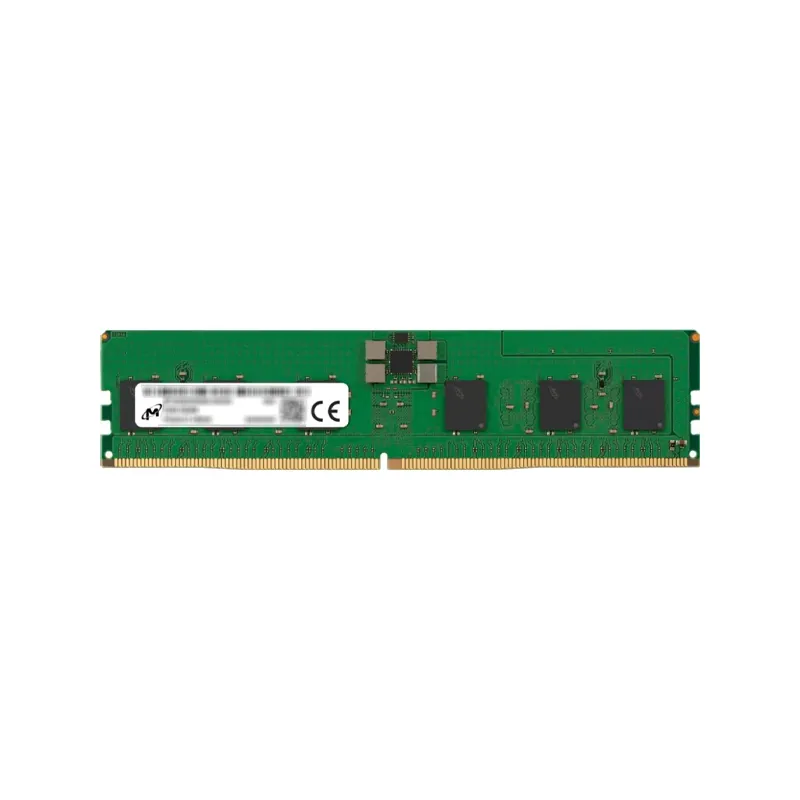
This unbuffered ECC DDR5 UDIMM is engineered for professional workstations and entry-level server platforms where data integrity is paramount, such as financial modeling or scientific computing. Its single-rank x8 organization and remarkably low CL4 latency deliver exceptional command response speed and signal stability, while integrated ECC actively corrects single-bit errors to prevent data corruption during critical workloads.
1. ECC protection corrects single-bit memory errors in real time, safeguarding data integrity for critical server workloads where even minor corruption is unacceptable.
2. A 16-gigabyte capacity provides ample headroom for virtualization, allowing more VMs per node without compromising performance.
3. DDR5-4800 bandwidth accelerates in-memory databases and real-time analytics, reducing latency in data-intensive server applications.
4. Operating at just 1.1 volts, this module significantly lowers server rack power consumption and cooling demands, improving total cost of ownership.
5. Single Rank x8 architecture ensures consistent signal integrity and low latency, enabling stable operation in dense multi-slot server boards.
Judging by the UDIMM form factor with full ECC support, this is unequivocally a server and workstation-class memory module, and every engineered characteristic directly addresses the real-world pain points of IT administrators and professionals. In a dense virtualization cluster running multiple VMs, the ECC function is non-negotiable—it corrects single-bit errors caused by background radiation before a flipped bit corrupts a hypervisor kernel or a financial transaction, meaning your hosted services stay up and your data stays accurate. For an in-memory database like Redis handling millions of real-time queries, the DDR5-4800 speed combined with the single‑rank x8 organization delivers both massive bandwidth and fast command cycling, shattering latency bottlenecks during peak load so your users never stare at a spinner. Meanwhile, the 1.1V operating voltage and unbuffered architecture strike a deliberate balance: the lower power draw reduces thermal stress in cramped 1U chassis, while the unbuffered design keeps electrical latency minimal, giving a single-socket edge server the responsive, no-compromise reliability it needs without wasting energy. This isn’t just memory—it’s a deliberate investment in uptime, throughput, and cooling efficiency for your critical infrastructure.
Based on the specifications — DDR5, ECC, Unbuffered, 288‑pin UDIMM — this is Server Memory (typically used in entry‑level servers and workstations that require error correction on unbuffered modules).
General Virtualization
Populate with balanced capacity across memory channels; for consolidated VM workloads, start with 8×16 GB (128 GB total) to allow headroom and NUMA awareness. ECC UDIMMs safeguard guest stability, while sticking to one DIMM per channel keeps DDR5‑4800 speed intact and latency predictable under multi‑tenant pressure.
In‑Memory Database
Maximize capacity and bandwidth by installing one module per channel on all available channels. A configuration of 8×16 GB provides 128 GB, but for large datasets scale to 256 GB (using higher‑density modules if supported). ECC is critical here — single‑bit errors in in‑memory datasets can corrupt transactions, so unbuffered ECC ensures data integrity with minimal access overhead.
High‑Performance Computing
Prioritize memory bandwidth over absolute capacity. Install identical 16 GB DIMMs, one per channel (e.g., 8×16 GB), to enable full memory interleaving and peak DDR5‑4800 throughput. Single‑rank x8 modules reduce electrical loading, helping sustain high clocks during sustained floating‑point and MPI workloads, while ECC guards results in long‑running simulations.
Rigorously tested for server compatibility: Dell PowerEdge T160, R260, HPE DL20 Gen11.
Q: Can I mix this MTC10C1084S1EC48B with other memory modules of different brands or speeds?
A: Mixing is strongly discouraged in server environments. Mismatched brands or speeds may cause stability issues, ECC errors, or system failures. For reliable operation, use identical modules with the same Micron part number across all channels.
Q: Is this memory compatible with my system? Which Intel or AMD server platforms are supported?
A: This DDR5 ECC UDIMM is designed for entry-level servers and workstations using Intel Xeon E-2400 / W series or AMD Ryzen 7000/9000 Pro platforms with appropriate chipsets. Always verify your motherboard QVL for ECC UDIMM support.
Q: What is the recommended DIMM population order for optimal performance on server boards?
A: Populate identical modules following your server board’s manual, typically filling slots in ascending order per channel. For dual-channel platforms, install pairs in the same-colored slots first to maintain balanced memory interleaving and full ECC functionality.
Q: Does this module support overclocking or XMP profiles?
A: No. This is a JEDEC-compliant DDR5-4800 server-grade UDIMM operating at 1.1V. It does not support XMP or overclocking. ECC memory prioritizes data integrity and stability over frequency manipulation, which is essential for mission-critical workloads.
Q: What warranty and typical failure rate can I expect with this server memory?
A: The module includes a 1-year warranty. Built with Micron’s rigorous testing and thermal screening, the AFR is extremely low. Typical field reliability consistently exceeds industry averages for DDR5 ECC UDIMMs in 24/7 server deployment.