











 Secure payments
Standard refund policy
Trade Assurance
Secure payments
Standard refund policy
Trade Assurance
| Product Type | Memory Module |
|---|---|
| Memory Capacity | 16 GB |
| Memory Technology | DDR5 |
| Product Voltage | 1.1 V |
| RAM Speed | 5600 MHz |
| RAM Standard | DDR5-5600/PC5-44800 |
| Error Identifying | ECC |
| Signal Type | Registered |
| Column Access Strobe (CAS) | CL46 |
| Rank | Dual Rank |
| Quantity of Pins | 288-pin |
| RAM Genre | RDIMM |
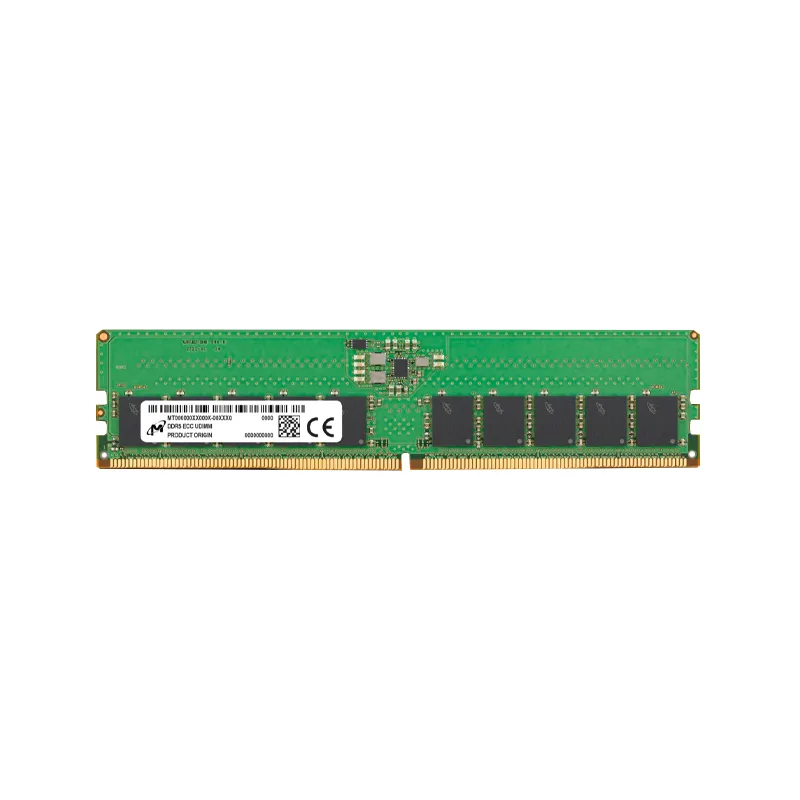
This 16 GB DDR5-5600 RDIMM with ECC is purpose-built for server platforms and excels in mission-critical workloads such as virtualization, in-memory databases, and enterprise data processing. Its registered signal architecture combined with a dual-rank configuration ensures robust signal integrity across dense memory populations while ECC delivers real-time error correction to maintain data accuracy under sustained load.
1. On-die ECC corrects single-bit errors on the fly, safeguarding data integrity in mission-critical server workloads such as financial transactions and virtualization.
2. The registered buffer isolates the memory controller from electrical loading, enabling stable operation across high-density server configurations with multiple DIMMs per channel.
3. DDR5’s doubled bank groups and burst length unlock significantly higher effective bandwidth, accelerating in-memory databases and large-scale analytics.
4. A 5600MT/s data rate feeds modern multi-core server CPUs with the memory throughput needed to prevent stalls during parallel data processing.
5. Dual-rank interleaving maximizes per-channel utilization, boosting throughput for virtualized environments where multiple VMs compete for memory resources.
Based on the Registered DIMM architecture, ECC functionality, and 288-pin form factor, the Micron MTC10F1084S1RC56BD1 is unequivocally a server memory module built for mission-critical enterprise environments. Its four defining characteristics translate directly into resilient real-world performance. The ECC engine continuously corrects single-bit memory errors, which can be triggered by cosmic rays, essentially eliminating silent data corruption. In a large-scale virtualization cluster hosting hundreds of virtual machines, a single uncorrected bit flip can cascade into hypervisor crashes and hours of downtime—ECC prevents this outright. The registered signal buffer acts as a traffic controller, amplifying command signals so the platform remains stable even when all memory slots are populated. This reliability is non-negotiable when you consolidate heavy workloads onto a single physical host.
Coupled with dual-rank organization, the module enables rank interleaving; the memory controller can access data from one rank while another is precharging, dramatically boosting effective bandwidth. For an in-memory database like Redis or SAP HANA where latency directly dictates transaction throughput, that parallel pipelining means more queries served per second. Running at 5600 MHz with a low 1.1V DDR5 power envelope, it also delivers this throughput within a shrinking thermal budget, helping data center operators rein in cooling costs. In practice, every single one of these features converges to keep your services online, your data accurate, and your performance consistently predictable under sustained load.
General Virtualization
For consolidated workloads running multiple VMs, start with a balanced dual‑channel configuration using two 16 GB RDIMMs (32 GB total). This provides sufficient memory bandwidth and capacity for typical hypervisors and moderate VM density. To scale compute headroom for heavier consolidation, populate four identical modules for 64 GB, ensuring all DIMMs are dual‑rank and identical to maintain registered ECC reliability.
In‑Memory Database
In‑memory databases like Redis or SAP HANA demand both large capacity and consistent low latency. Deploy at least four 16 GB RDIMMs (64 GB) to hold substantial datasets entirely in RAM, leveraging the dual‑rank design for improved row‑hit efficiency. For critical production environments, maximize capacity by populating all available memory channels with identical modules, aiming for 128 GB or more while maintaining a homogeneous register‑clocked layout to avoid training failures.
High‑Performance Computing (HPC)
HPC applications are highly sensitive to memory bandwidth. To saturate modern multi‑channel server platforms, fill every memory channel with one 16 GB RDIMM — for instance, eight modules on an 8‑channel system yielding 128 GB. This configuration exploits the dual‑rank 5600 MT/s speed to deliver peak throughput for simulation and modeling codes, while ECC registration ensures correctness during marathon runs.
Rigorously tested, this DDR5 RDIMM is compatible with Dell PowerEdge R760, HPE DL380 Gen11, Lenovo SR650 V3, and Supermicro servers.
Q: Can I mix this MTC10F1084S1RC56BD1 with other memory modules of different brands or speeds?
A: Mixing Registered ECC RDIMMs with different brands, speeds, or ranks is not recommended in server environments. It may cause signal integrity issues, instability, or force all modules to the lowest common speed, compromising validated performance.
Q: Is this memory compatible with my system?
A: This DDR5-5600 ECC RDIMM is designed for modern servers supporting registered DIMMs, such as Intel Xeon Scalable 4th Gen or AMD EPYC 9004 series. Please consult your server’s Qualified Vendor List (QVL) to confirm platform and CPU compatibility.
Q: What is the recommended DIMM population order for optimal performance?
A: Populate identical dual-rank RDIMMs in every white slot first, then black slots, following your server vendor’s memory population guide. Balanced channels maximize bandwidth and interleaving; unbalanced configurations can degrade performance.
Q: Does this module support overclocking or XMP profiles?
A: No. This is a JEDEC-compliant, server-grade ECC Registered DIMM designed for data integrity and stability. It does not support overclocking or Intel XMP 3.0 profiles. Clock and timing are fixed at DDR5-5600 CL46.
Q: What warranty and typical failure rate can I expect?
A: This Micron module carries a 1-year warranty. Enterprise RDIMMs with ECC have extremely low failure rates, typically less than 0.2% annually, aided by error correction and rigorous screening.